

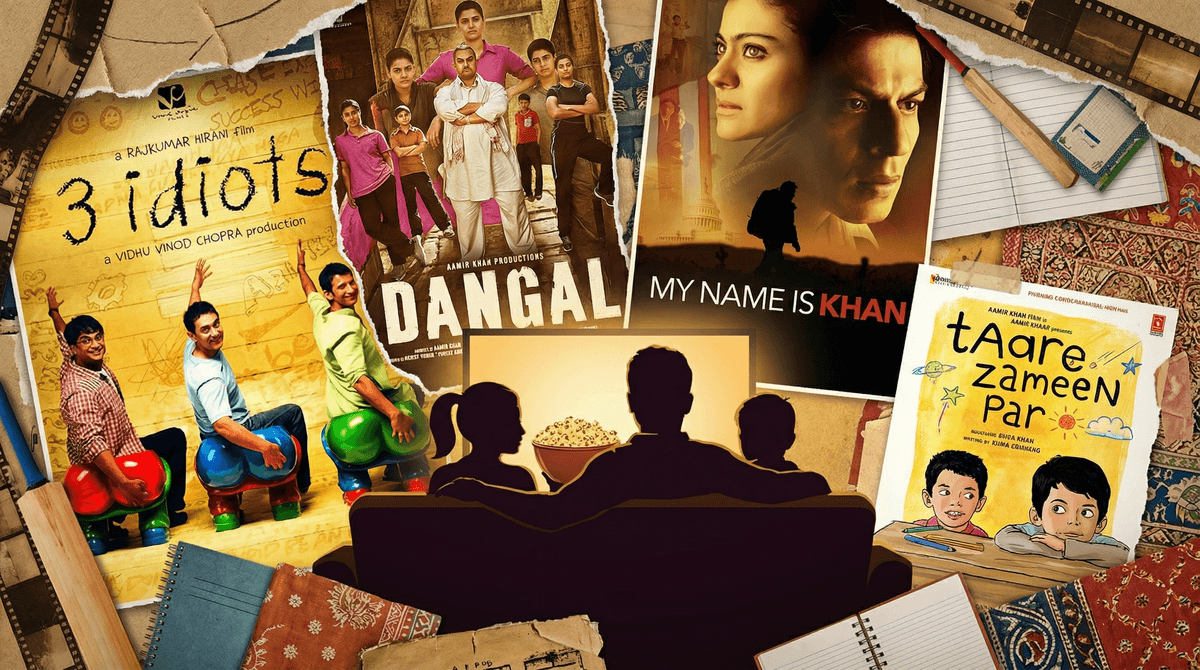
Bollywood Family Movie Night: 10 Films That Spark Conversation
TL;DR: Indian cinema offers some of the most emotionally intelligent, conversation-starting family films out there. Here are the ones that actually deliver—movies that entertain while tackling real issues like academic pressure, neurodiversity, gender equality, and what it means to succeed in life.
Jump to:
- 3 Idiots (Ages 10+)
- Taare Zameen Par (Ages 8+)
- Dangal (Ages 10+)
- Chhichhore (Ages 12+)
- Stanley Ka Dabba (Ages 7+)
Screenwise Parents
See allIndian family films have this incredible ability to be simultaneously entertaining, emotionally devastating, and genuinely educational—often with musical numbers thrown in. They tackle heavy topics without talking down to kids, and they're some of the best conversation-starters you'll find for discussing everything from learning differences to gender stereotypes to the pressure cooker of academic achievement.
The best part? These aren't "educational films" in that eye-roll-inducing way. They're legitimately great movies that happen to have something meaningful to say.
Ages 10+ | 2009 | 2h 50m
This is the one that started it all for many families discovering Indian cinema. Three engineering students navigate the soul-crushing pressure of India's education system, questioning whether memorization and grades actually equal intelligence or success.
Why it works: The film is hilarious—genuinely funny in a way that lands across cultures. But underneath the comedy is a serious critique of how we measure intelligence and success. The protagonist, Rancho, champions curiosity, creativity, and learning for its own sake over rote memorization and fear-based education.
The conversation it sparks: What does it mean to be "smart"? Is school measuring the right things? What's the difference between learning and memorizing? For families dealing with academic pressure (and let's be real, most of us are), this movie opens up space to talk about whether straight A's are actually the goal.
Parent heads-up: There's a suicide subplot that's handled sensitively but is definitely heavy. One character attempts suicide due to academic pressure—it's not graphic, but it's there and it's sad. This makes it perfect for tweens and teens who can handle mature themes, but probably not for younger kids.
Ages 8+ | 2007 | 2h 45m
Translated as "Stars on Earth," this film follows Ishaan, a third-grader struggling in school who everyone assumes is lazy or defiant. Turns out he has dyslexia, and it takes an art teacher to recognize what's actually going on.
Why it works: This is Aamir Khan's directorial masterpiece about neurodiversity before we were all fluent in that language. It's empathetic without being saccharine, and it shows how easily we can misread kids who learn differently.
The conversation it sparks: How do we define "normal"? What does it feel like when you're trying your hardest but everyone thinks you're not trying at all? The film is a beautiful entry point for discussing learning differences, ADHD, dyslexia, and the fact that struggling in school doesn't mean you're not brilliant.
Parent heads-up: There are scenes of Ishaan being bullied and punished for things he can't control. It's emotionally intense—you will cry, your kids might cry, everyone's crying. But it's the good kind of crying that leads to understanding.
Ages 10+ | 2016 | 2h 41m
Based on a true story, a former wrestler trains his daughters to become world-class wrestlers in a culture that doesn't believe girls belong in sports.
Why it works: This is a sports movie, a coming-of-age story, and a feminist statement all rolled into one. The father character is complex—he's pushing his daughters hard (sometimes too hard), but he's also the only one who believes they can achieve something extraordinary.
The conversation it sparks: Gender roles, athletic achievement, what it means to break barriers, and the complicated relationship between parental expectations and a child's own dreams. The film doesn't shy away from showing how the father's methods are sometimes problematic even as his belief in his daughters is revolutionary.
Parent heads-up: There's some intense wrestling violence (nothing gory, but still physical), and the father-daughter relationship is complicated in ways worth discussing. The film is long, but it moves.
Ages 12+ | 2019 | 2h 23m
When a college student attempts suicide after failing an entrance exam, his father gathers his old college friends to tell his son about their own "loser" days in college—and how failure isn't the end of the world.
Why it works: It's a comedy that takes on India's intense academic pressure and suicide rates among students head-on. The film moves between past and present, showing how the "losers" of college actually built meaningful, successful lives.
The conversation it sparks: Academic failure, resilience, the fact that your worth isn't determined by test scores, and how we define success. This is essential viewing for any family with a teen feeling academic pressure.
Parent heads-up: The suicide attempt is the inciting incident—it's serious and it's there from the beginning. There's also some college partying and mild sexual content. This is definitely for older tweens and teens, not younger kids.
Ages 7+ | 2011 | 1h 36m
Stanley is a fourth-grader who never brings lunch to school. His teacher, who's obsessed with stealing kids' food, targets him mercilessly. The reveal of why Stanley doesn't bring lunch is both heartbreaking and hopeful.
Why it works: It's a small, quiet film about childhood poverty, resilience, and the power of friendship. The kids in this movie feel like actual kids—they're not precocious movie children, they're just regular kids navigating school.
The conversation it sparks: Economic inequality, empathy, what it means to be a good friend, and how we treat people who are struggling. It's accessible enough for younger kids but meaningful for older ones too.
Parent heads-up: The reveal about Stanley's home situation is sad but handled gently. There's a gluttonous teacher character who's kind of a villain, which might bother some parents, but he's clearly meant to be the bad guy.
Ages 8+ | 2011 | 2h 15m
A group of kids in a Mumbai neighborhood befriend a homeless boy and his dog, then band together to fight injustice when local politicians try to get rid of street dogs.
Why it works: It's a kids' adventure movie that doesn't condescend. The children are the heroes, and they're tackling real issues—classism, animal rights, political corruption—without losing the fun and energy of a good adventure story.
The conversation it sparks: Social class, homelessness, standing up for what's right even when adults won't, and the power of community organizing. Yes, community organizing—these kids basically stage a protest.
Parent heads-up: There's some mild language and the threat of dog violence (no actual violence, but the threat is there). The homeless boy's situation is handled sensitively but realistically.
Ages 11+ | 2017 | 2h 30m
A teenage girl dreams of becoming a singer but faces opposition from her abusive father. She starts posting videos on YouTube while wearing a burqa to hide her identity.
Why it works: It's about finding your voice—literally and figuratively—in the face of domestic abuse and patriarchal control. The film doesn't shy away from showing domestic violence but also shows a path forward.
The conversation it sparks: Domestic abuse, women's autonomy, pursuing your dreams, and the role of social media in amplifying voices that might otherwise be silenced. Also, the complicated reality that sometimes the people who love you are also the ones holding you back.
Parent heads-up: There are scenes of domestic violence (a father hitting/threatening his wife and daughter). It's not gratuitous, but it's there and it's intense. This is definitely for older tweens and teens who can handle mature content.
Ages 10+ | 2017 | 2h 12m
A couple goes to absurd lengths to get their daughter into a prestigious English-medium private school, including pretending to be poor to qualify for a poverty quota.
Why it works: It's a comedy that skewers class anxiety, educational inequality, and the obsession with English as a marker of success in India. But it's also surprisingly moving about what we're willing to sacrifice for our kids' futures.
The conversation it sparks: Educational inequality, privilege, class anxiety, and whether the "best" schools are actually best for every kid. Also, the ethics of gaming systems designed to help the poor.
Parent heads-up: The couple's deception is a major plot point, which creates good ethical discussions but might bother some families. There's also some mild language.
Ages 9+ | 2005 | 2h 12m
A deaf and mute boy from a poor farming family dreams of playing cricket for India. With the help of a washed-up alcoholic coach, he pursues his seemingly impossible dream.
Why it works: It's a sports movie that's really about disability, class barriers, and the power of mentorship. The protagonist's disability is never treated as something to overcome or fix—it's just part of who he is as he pursues excellence.
The conversation it sparks: Disability representation, economic barriers to success, the role of mentorship, and what it takes to pursue a dream when everything seems stacked against you.
Parent heads-up: The coach character is an alcoholic (though he's sympathetic), and there's some cricket-related violence (getting hit by balls, etc.). The family's poverty is depicted realistically.
Ages 12+ | 2010 | 2h 45m
A Muslim man with Asperger's syndrome embarks on a journey across America to meet the President and deliver a message: "My name is Khan, and I am not a terrorist."
Why it works: It tackles Islamophobia, autism representation, and post-9/11 America with both sensitivity and directness. The protagonist is complex—his autism is part of his character but not his entire character.
The conversation it sparks: Religious discrimination, autism and neurodiversity, what it means to be "different" in a society that fears difference, and how we treat people who don't fit our expectations.
Parent heads-up: There are scenes of hate crimes and discrimination, including violence. A major character dies in a hate crime. There's also a natural disaster sequence. This is heavy material best suited for mature tweens and teens.
Ages 7-9: Start with Stanley Ka Dabba, Chillar Party, or Taare Zameen Par. These are gentler entry points with kid protagonists and age-appropriate themes.
Ages 10-12: Add 3 Idiots, Dangal, Hindi Medium, and Iqbal. These tackle heavier themes but in ways that are accessible to this age group.
Ages 13+: Everything's on the table, but especially Chhichhore, Secret Superstar, and My Name Is Khan. These deal with mature themes that resonate particularly with teens.
Runtime reality: Indian films are long. Like, really long. Most clock in around 2.5-3 hours. This isn't padding—it's just a different storytelling tradition. Plan accordingly with snacks and maybe an intermission break.
Musical numbers: Most of these films include song-and-dance sequences. Some kids love them, some find them jarring if they're not used to the format. It's worth explaining this convention before you start.
Cultural context: Some references might need explanation—the education system in India, cricket, specific cultural practices. But honestly, that's part of the value. These films open windows into experiences different from our own.
Subtitles vs. dubbing: Most of these are available in both Hindi with English subtitles and English-dubbed versions. If your kids can read fast enough, subtitles are better—the dubbing often loses emotional nuance. But dubbing is fine for younger kids or reluctant readers.
Emotional intensity: Indian cinema doesn't shy away from emotion. These films will make you feel things—sometimes big things. That's intentional and it's powerful, but be prepared for some tears.
These films are conversation-starters, not conversation-enders. Here are some questions to get you going:
For 3 Idiots or Chhichhore: "Do you ever feel pressure to get perfect grades? What would it be like if we cared more about what you're learning than what grades you're getting?"
For Taare Zameen Par or My Name Is Khan: "What do you think it feels like to learn differently than other kids? How can we make sure everyone feels understood?"
For Dangal or Secret Superstar: "Why do you think some people believe girls can't do certain things? What would you do if someone told you that you couldn't do something because of your gender?"
For Stanley Ka Dabba or Hindi Medium: "Why do you think some kids have more resources than others? What does it mean to be a good friend to someone whose life is different from yours?"
Indian family cinema offers something you don't often find in Hollywood: films that treat kids as capable of understanding complex issues while still being entertaining. These aren't vegetables disguised as dessert—they're genuinely good movies that happen to have something meaningful to say about education, disability, gender, class, and what it means to succeed in life.
Start with one that matches your family's current interests or challenges. Dealing with academic pressure? 3 Idiots or Chhichhore. Navigating learning differences? Taare Zameen Par. Want to talk about gender equality? Dangal.
And yes, they're long. But so are three episodes of whatever show your kids are currently binging. At least these will give you something to talk about afterward that isn't Skibidi Toilet.
Want more family movie recommendations? Check out our guides on family movies that teach emotional intelligence or movies about neurodiversity.