

Netflix’s documentary library is a goldmine for parents who want to move past "brain rot" YouTube loops and actually talk to their kids about how the world works—without it feeling like a lecture. Whether you’re looking for the visual "ASMR" of a high-def nature series or a deep dive into why our phones are designed to keep us scrolling, the best documentaries right now are the ones that make your kids pause their game of Roblox because the real world actually looks more interesting.
TL;DR: The best Netflix documentaries for families in April 2026 balance jaw-dropping visuals with heavy-hitting questions about ethics and technology. For younger kids, stick to the immersive nature of Our Planet II; for tweens and teens, use The Social Dilemma or The Antisocial Network to spark honest conversations about digital wellness and viral culture. Screenwise recommends these titles because they bridge the gap between passive entertainment and active family engagement.
Nature documentaries are the ultimate "safe bet" for family movie night. They are visually stunning, generally low-stress (aside from the occasional "circle of life" moment), and great for all ages.
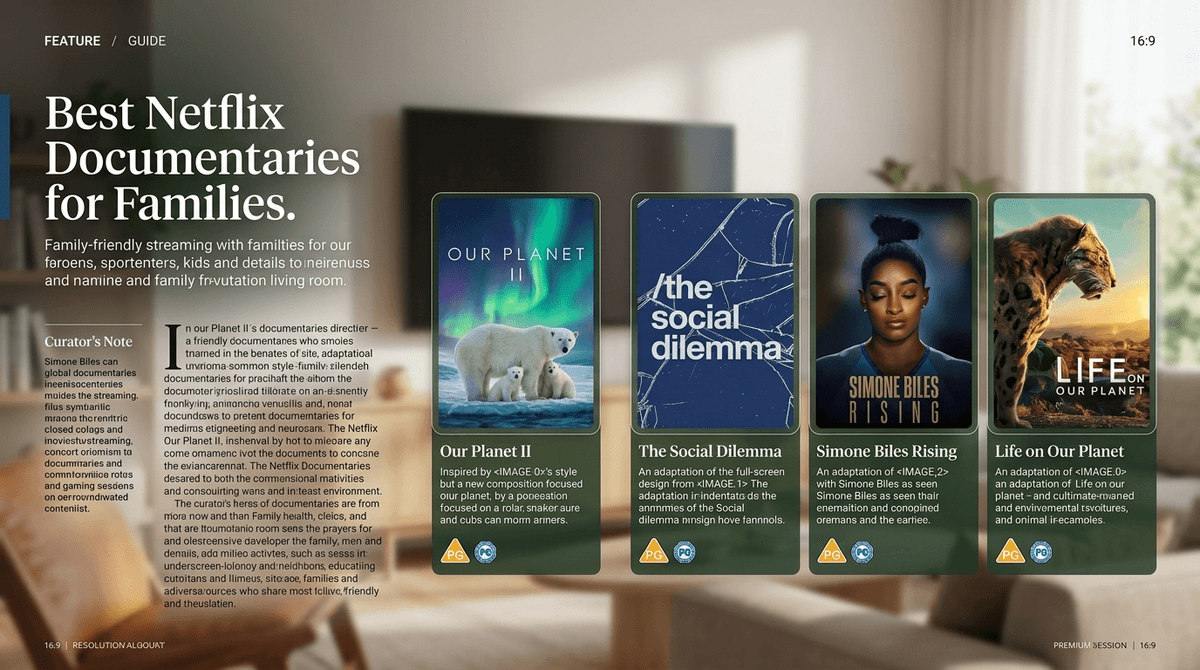
Narrated by David Attenborough, this series is basically the gold standard. It focuses on animal migrations and how the changing climate is impacting their journeys. It’s a great way to talk about climate change for kids without it feeling like a doom-and-gloom classroom session. Plus, the cinematography is so sharp it makes Minecraft look like a potato.
If your kid is still in their dinosaur phase (or never left it), this is the one. It uses incredible CGI to bring extinct creatures back to life alongside modern animals. It’s a crash course in evolution and resilience. Screenwise gives this a high educational score because it makes complex biological history feel like an action movie.
Narrated by Barack Obama, this series explores the world’s most iconic protected lands. It’s less about the "hunt" and more about the "ecosystem." It’s a perfect lead-in to a conversation about conservation and why we have rules in nature—and in our own communities.

By the time kids are using words like "Ohio" to describe anything weird or "Rizz" to describe... well, whatever they think it means this week, they are deep in the digital soup. These documentaries help them see the water they’re swimming in.
Even though it’s been out for a few years, it is still the most impactful doc for explaining how TikTok and Instagram algorithms actually work. It uses dramatizations to show how tech companies compete for "attention minutes." Watching this with a middle schooler is a rite of passage for intentional parents.
This one is for the older teens. It tracks how internet memes and 4chan culture eventually spilled over into real-world chaos. It’s a gritty look at how "trolling" can have massive consequences. If your teen is spending time in Discord servers or on Reddit, this is a mandatory watch to discuss media literacy and online radicalization.
With kids constantly seeing "get rich quick" schemes on their feeds, Bitconned serves as a wild cautionary tale about crypto scams and the lure of easy money. It’s a great way to talk about financial literacy for teens and why if something looks too good to be true on YouTube, it probably is.
Sports docs are great because they focus on "the grind." In a world of instant gratification, seeing a pro athlete fail and recover is a healthy reality check.
You don’t have to care about cars to get sucked into this. It’s pure soap opera for sports fans. It highlights the intense pressure of high-level competition and the importance of teamwork. Just a heads-up: the language can get a bit "salty" in the pits, but for most kids 10+, it’s nothing they haven’t heard on the playground.
This doc (and its 2025 follow-up episodes) is a masterclass in mental health for student athletes. It covers her journey from the "twisties" in Tokyo to her triumphant return in the 2024 Paris Olympics. It’s a beautiful way to talk about the courage it takes to say "I’m not okay" and the work it takes to get back on top.
This is a fun, lighter watch that explores the history of iconic toy lines like LEGO, Barbie, and Star Wars. It’s secretly a documentary about entrepreneurship, design, and marketing. It helps kids realize that the LEGO games they play today started as a struggling wooden toy company in Denmark.
Documentaries offer a "low-stakes" way to introduce "high-stakes" topics. It’s much easier to talk about the ethics of AI or the dangers of social media when you’re both reacting to a story on screen rather than you hovering over their shoulder while they’re on their phone.
Screenwise data shows that families who watch "active content" (like documentaries) together at least once a week report higher levels of "digital trust"—the feeling that kids can talk to their parents about weird stuff they see online without getting their devices confiscated.
Instead of asking "What did you learn?" (which is a total conversation killer), try these:
- The "What If" Question: "If you were the person in that doc, would you have made the same choice?"
- The "Follow the Money" Question: "Who do you think is making money off the thing we just watched?"
- The "Fact Check" Question: "That seemed wild—do you think they exaggerated that for the camera?"
Q: What are the best Netflix documentaries for a 7 year old? Nature series like Our Great National Parks and If I Were an Animal are perfect. They are educational, visually engaging, and avoid the more intense "predator vs. prey" violence found in some older docs.
Q: Is The Social Dilemma too scary for middle schoolers? It’s not "scary" in a horror sense, but it is designed to be provocative. Most 11-13 year olds are already experiencing the things the movie describes, so it usually feels more "validating" than "scary" to them.
Q: Are there any documentaries on Netflix that teach about AI? Yes, Netflix frequently updates its tech catalog. Look for Unknown: Killer Robots for a look at AI in the military, or search for their newer 2025 specials on generative AI and the future of work.
Q: How do I find documentaries that aren't "boring" for kids? Look for "docuseries" rather than feature films. Series like The Toys That Made Us use fast-paced editing and humor that feels more like a YouTube video than a traditional documentary.
Netflix’s documentary section is the best tool in your parenting kit for turning screen time into "connection time." Whether you’re marveling at a snow leopard or deconstructing the latest crypto scam, you’re building a shared language with your kids.
Next time the kids say they’re bored, skip the latest animated sequel and put on Life on Our Planet. You might be surprised at how long they stay off their phones.