

So you're at that moment. Your toddler is suddenly interested in the glowing rectangle, or maybe you just need 20 minutes to make dinner without someone hanging on your leg. Either way, you're about to introduce screen time, and you want to do it right.
Here's the thing: there's no perfect answer, but there are definitely better and worse ways to start. The goal isn't to avoid screens entirely (unless that's your thing, and hey, respect). The goal is to build habits now that won't bite you in the butt when they're 8 and begging for YouTube Kids unsupervised.
The first shows you introduce aren't just entertainment—they're basically teaching your kid what "screen time" means. If the first experience is a hyperstimulating YouTube compilation of toy unboxings with janky music, that becomes their baseline. If it's a thoughtfully-paced show with actual educational content, that's a different foundation entirely.
Research shows that kids under 5 are in a critical window for language development, attention span formation, and understanding narrative structure. The content they watch actually shapes how their brain processes media. No pressure or anything.
Not all preschool content is created equal. Here's what actually matters:
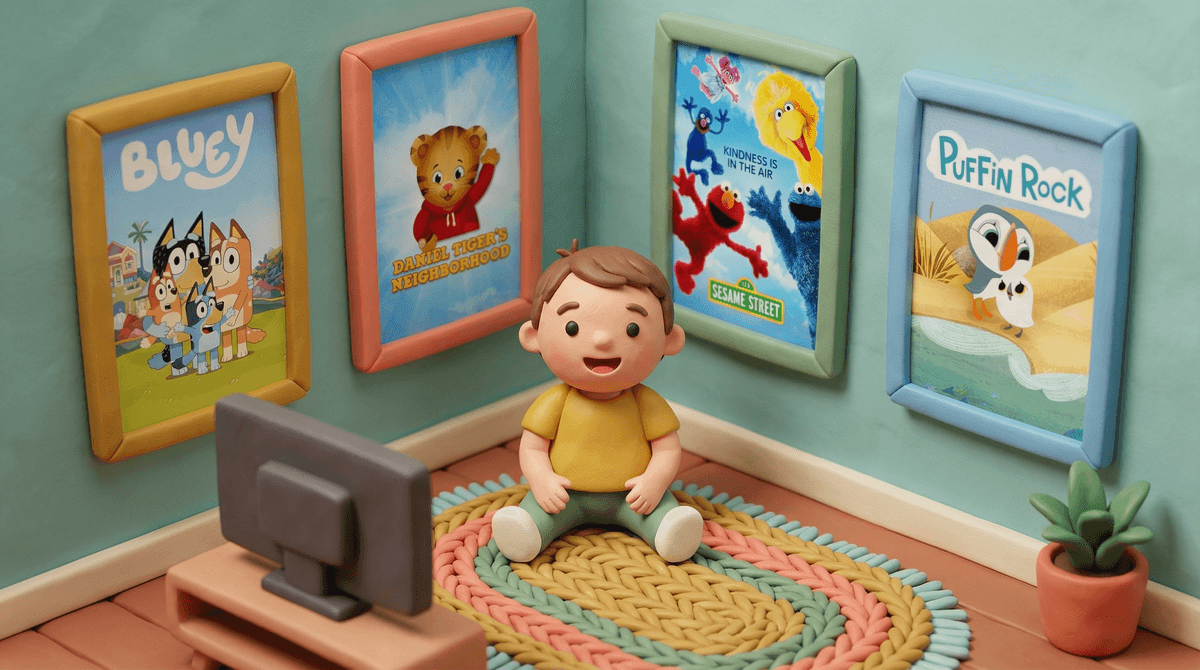
Pacing that matches real life: Shows like Bluey and Daniel Tiger's Neighborhood have natural pauses, realistic conversations, and plots that don't move at cocaine speed. Compare that to some of the stuff on YouTube Kids and you'll see the difference immediately.
Co-viewing friendly: The best first shows are ones you can actually stand to watch. Bluey is the gold standard here—parents genuinely enjoy it, which means you're more likely to actually sit with your kid and talk about what's happening. That co-viewing is huge for comprehension and making screen time interactive rather than passive.
Educational without being obvious about it: Sesame Street has been doing this for 50+ years. Kids learn letters, numbers, emotional regulation, and social skills without feeling like they're in school. Elinor Wonders Why teaches scientific thinking. Bluey teaches emotional intelligence and creative play.
Short episodes: For first-time viewers, 7-11 minute episodes are perfect. Daniel Tiger's Neighborhood clocks in around 11 minutes per story. This makes it easier to set boundaries ("one episode" is manageable) and keeps attention spans from getting overtrained to longer content.
Here are the shows that consistently work well for first-time viewers ages 2-5:
Bluey (Ages 2-6): Australian family of dogs, 7-minute episodes, genuinely funny, teaches imaginative play. This is the one show that nearly every parenting expert and regular parent agrees on. It's just good.
Daniel Tiger's Neighborhood (Ages 2-5): Mr. Rogers' spiritual successor. Teaches emotional regulation with catchy songs that will live in your head rent-free. "When you feel so mad that you want to roar, take a deep breath and count to four" actually works.
Sesame Street (Ages 2-5): The classic for a reason. Educational, diverse, well-paced. The newer episodes on HBO Max are excellent.
Elinor Wonders Why (Ages 3-5): PBS show about a bunny who asks questions about nature and science. Slower-paced, encourages curiosity and observation.
Puffin Rock (Ages 2-5): Gentle Irish show about puffins narrated by Chris O'Dowd. Extremely chill, nature-focused, perfect for wind-down time.
The American Academy of Pediatrics recommends no screen time before 18 months (except video chatting), and 1 hour max per day for ages 2-5.
In reality? Most families land somewhere between "we follow this religiously" and "some days we definitely exceed this and that's okay." The key is knowing what your baseline is and being intentional about exceptions.
Here's what matters more than the exact minute count:
- Co-viewing when possible - Sit with them, talk about what's happening, ask questions
- No screens during meals - This one's worth protecting
- No screens within an hour of bedtime - The blue light and stimulation actually do mess with sleep
- Screen time shouldn't replace active play - If they're watching TV instead of running around outside, that's a problem. If they're watching while you make dinner and they'll play outside after? That's just life.
YouTube Kids unsupervised: Even with filters, the algorithm serves up some genuinely weird stuff. Toy unboxings, kids' channels with hyperstimulating editing, and content that's technically "for kids" but absolutely brain-rotting. If you're doing YouTube, curate specific channels and watch with them.
Cocomelon: Look, this is controversial, but many pediatric experts flag Cocomelon for its extremely rapid scene changes and overstimulation. Some kids are fine with it. Some kids become absolute zombies and then melt down when it ends. You'll know pretty quickly if it's a problem for your kid.
Anything with ads: Preschoolers cannot distinguish between content and advertising. They will 100% ask you to buy everything they see. Stick to ad-free platforms (Netflix, Disney+, PBS Kids app, HBO Max).
Shows marketed as "educational" that are just... not: There's a lot of content that slaps "learning" on the label but is really just noise and colors. If you watch 5 minutes and feel like your brain is melting, trust that instinct.
The habits you set now are so much easier than trying to course-correct later. Here's what actually works:
Set clear boundaries before you start: "We watch one episode after lunch" is way easier to enforce from day one than trying to implement it after months of unlimited access.
Make it a planned activity, not a default: Screen time should be intentional, not just what happens when you're bored. This prevents the "I'm bored, can I watch TV?" loop.
Talk about what you're watching: Ask questions, make connections to their life, point out emotions characters are feeling. This transforms passive watching into active learning.
Use a visual timer: Preschoolers don't understand time. A visual timer (like the Time Timer) helps them see when screen time is ending. This reduces meltdowns significantly.
Have a transition plan: "When this episode ends, we're going to go play with blocks" works better than just turning off the TV and expecting them to figure out what's next.
Your preschooler's first TV shows are a bigger deal than they seem, but they're not make-or-break. Choose well-paced, educational content like Bluey or Daniel Tiger. Keep it to around an hour a day. Watch together when you can. Set boundaries early.
And remember: the goal isn't perfection. Some days you'll need more screen time. Some days they'll watch something that's not your first choice. That's fine. What matters is the overall pattern you're building—one where screens are a tool, not a default, and where content is something you're thoughtful about rather than just whatever keeps them quiet.
You've got this.
Start with one show: Pick one from the list above and commit to it for a week. See how your kid responds, how you feel about it, and whether the length/pacing works for your family.
Check out our guide to PBS Kids shows for more detailed breakdowns of educational content.
Set up your streaming services right: Remove auto-play, set up kids' profiles, and curate what's available. Learn how to set up Netflix parental controls and do the same for whatever platforms you're using.
Join the Screenwise community: Get personalized recommendations based on your family's values and your kid's interests. Because one-size-fits-all advice only goes so far.