

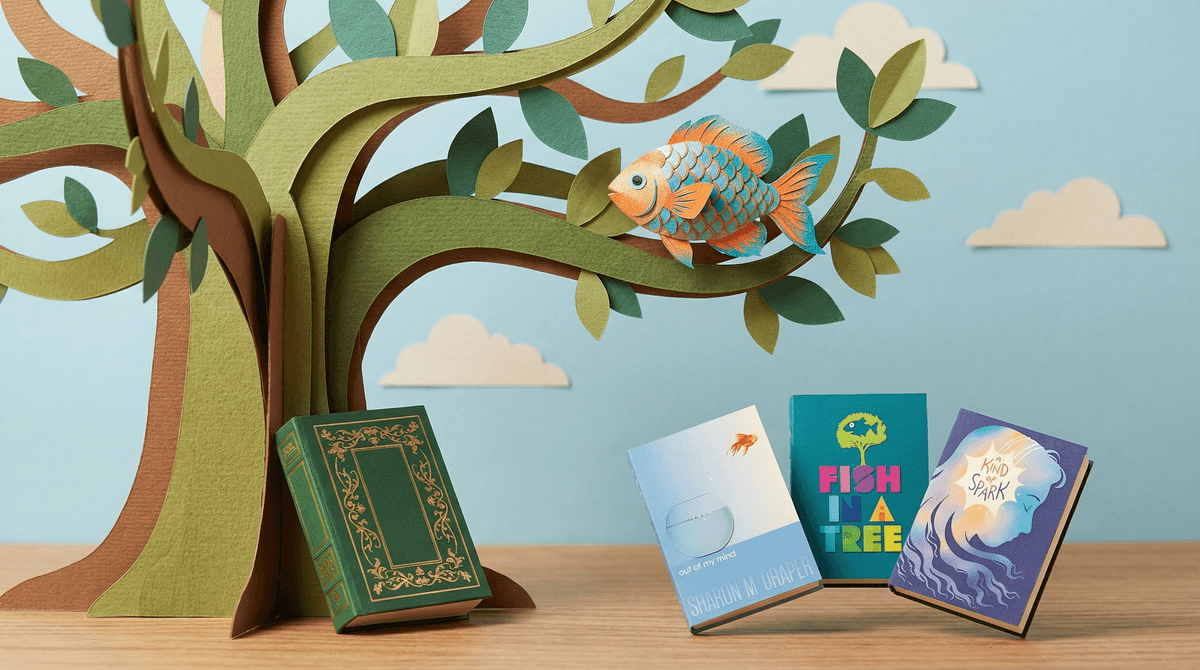
Fish in a Tree by Lynda Mullaly Hunt is a middle-grade novel that's become required reading in many schools—and for good reason. Published in 2015, it tells the story of Ally Nickerson, a sixth-grader who's incredibly smart but can't read. She's developed elaborate strategies to hide her struggles: acting out, cracking jokes, "forgetting" her homework. Her teachers think she's a troublemaker. Her classmates think she's dumb. But Ally knows the truth is more complicated—she just can't make sense of the letters on the page.
When a new teacher, Mr. Daniels, arrives and recognizes that Ally has dyslexia, everything begins to shift. The book follows Ally's journey as she learns she's not "stupid," builds real friendships, and discovers her own unique strengths.
The title comes from the Albert Einstein quote: "Everybody is a genius. But if you judge a fish by its ability to climb a tree, it will live its whole life believing that it is stupid."
Here's the thing about Fish in a Tree—it's not just a book about dyslexia. It's a book about every kid who's ever felt like they don't fit the mold. Which is, honestly, most kids at some point.
If your child has a learning difference, this book can be transformative. Seeing a character who struggles the same way they do, who has the same fears about being "found out," who develops the same coping mechanisms—it's validating in a way that a hundred adult reassurances can't match. Many kids with dyslexia report that reading this book (or having it read to them) was the first time they felt truly understood.
But even if your child doesn't have dyslexia, this book opens crucial conversations about:
- How intelligence shows up differently in different people
- The damage of making assumptions about others
- Standing up for people who are being bullied
- The impact one caring adult can have
It's also worth noting that the book tackles bullying head-on, particularly the kind of mean-girl social manipulation that peaks in middle school. The character Shay is a realistic portrayal of a bully—not a cartoon villain, but someone who uses social power to control and exclude.
Best for: Ages 8-13 (grades 3-8)
The sweet spot is really grades 4-6, when kids are old enough to grasp the nuances but still young enough that the middle school setting feels relevant or aspirational.
Reading level vs. interest level: This is important—the book is written at about a 4th-5th grade reading level, but the themes and emotional content are perfect for middle schoolers. This makes it accessible for struggling readers while still being engaging for more advanced readers.
Sensitive content to know about:
- Bullying (verbal and social exclusion, not physical violence)
- A character dealing with family instability and potential homelessness
- References to a grandfather with Alzheimer's
- Ally's brother is in the military and deployed
Nothing graphic or inappropriate, but these are real issues that might prompt questions or feelings.
This might hit close to home. If your child has struggled in school—whether with a diagnosed learning difference or just with feeling "different"—some scenes might be emotional. Ally's internal monologue about feeling stupid, her anxiety about being called on in class, her certainty that she's letting everyone down... it's authentic and sometimes painful.
One parent told me her daughter with ADHD sobbed through several chapters because "finally someone gets it." That's powerful, but also something to be prepared for.
The teacher is idealized (but in a good way). Mr. Daniels is patient, insightful, and seems to have unlimited time to work with individual students. Is this realistic? Not always. But having a model of what good teaching looks like—someone who sees potential instead of problems—gives kids (and parents) language for what they need and deserve.
It might inspire requests for testing. After reading this book, some kids start wondering if they might have dyslexia or another learning difference. This is actually a positive outcome if it leads to getting support they need. Learn more about educational assessments and when they make sense .
.
The friendship arc is just as important as the dyslexia arc. Ally's friendships with Albert (a Star Trek-obsessed kid who gets bullied) and Keisha (a new girl dealing with her own challenges) are beautifully developed. The book shows how real friendship involves seeing and accepting each other's whole selves.
If you're reading it together or your child just finished:
"What did you think about how Ally felt about school at the beginning? Has school ever felt that hard for you?"
"Mr. Daniels says everyone is smart in different ways. What do you think you're smart at?"
"Shay was pretty mean to Ally and the others. Why do you think she acted that way? Does that make it okay?"
If your child has a learning difference:
"Ally had dyslexia and needed to learn in a different way. What helps you learn best?"
"Ally was really good at some things, like art and understanding people. What are you really good at?"
If your child doesn't have a learning difference:
"Have you ever felt like things were easy for everyone else but hard for you? What was that like?"
"If you had a friend like Ally who was struggling with something, how could you be supportive?"
Fish in a Tree works beautifully as a conversation starter about neurodiversity and different ways of learning. If you're trying to help siblings understand why their brother or sister gets different accommodations at school, this book can help. If you're trying to help your child understand their own diagnosis, this book can help.
It's also a great entry point into other books with neurodivergent protagonists: Wonder by R.J. Palacio (about a boy with facial differences), Out of My Mind by Sharon Draper (about a girl with cerebral palsy), or A Kind of Spark by Elle McNicoll (about an autistic girl).
Fish in a Tree is one of those rare books that manages to be both educational and deeply moving without being preachy. It gives kids with learning differences a mirror, and kids without them a window. It shows that "smart" comes in many forms, and that the right support at the right time can change everything.
The real magic of this book? It doesn't just tell kids they're capable—it shows them a character discovering her own capabilities, which is so much more powerful.
Whether your child struggles with reading, math, attention, social situations, or just fitting in, there's something here that will resonate. And honestly, there's something here for parents too—a reminder that our job isn't to make our kids fit the mold, but to help them discover what makes them uniquely brilliant.
Want to dig deeper? The author, Lynda Mullaly Hunt, has written other books including One for the Murphys (about foster care) and Shouting at the Rain (about family and belonging).
Looking for more books that celebrate different kinds of minds? Check out our guide to books about neurodiversity.
Wondering if your child might benefit from an evaluation? Learn about the signs of dyslexia and other learning differences.