

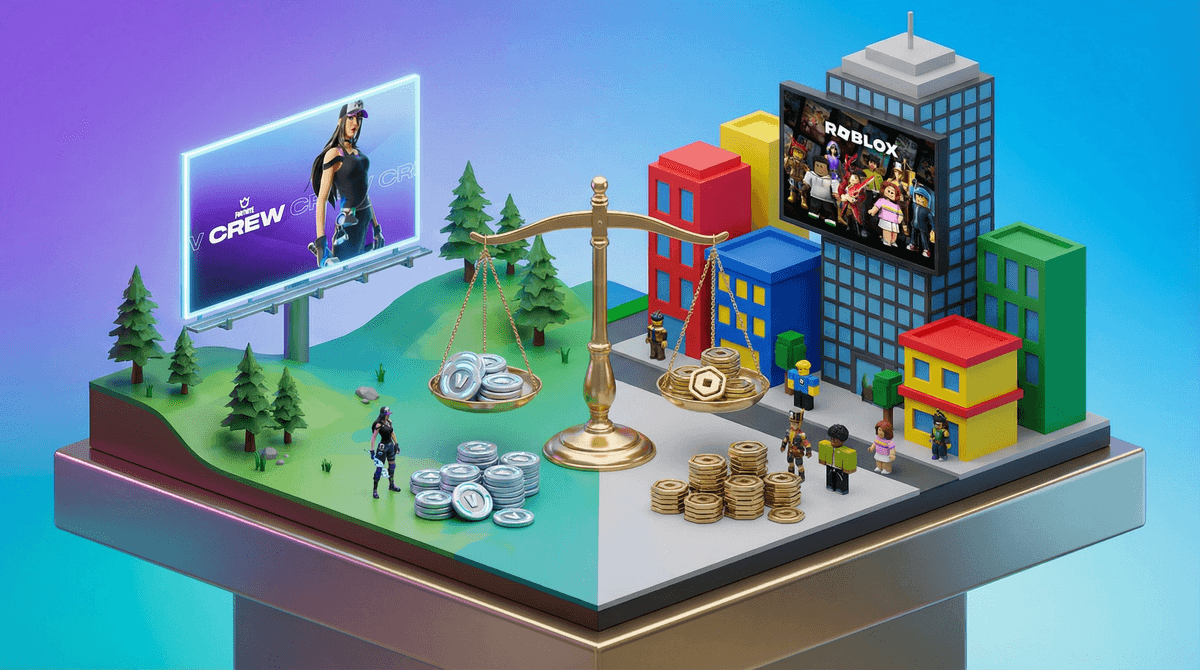
Let's cut to the chase: V-Bucks and Robux are digital currencies that your kids desperately want you to buy so they can spend them in Fortnite and Roblox, respectively. They're essentially gift cards for virtual worlds, except instead of buying one $25 card occasionally, you're fielding requests every single week.
V-Bucks are Fortnite's currency. Kids use them primarily to buy cosmetic items—skins (character outfits), emotes (dances and gestures), pickaxes, gliders, and Battle Passes (seasonal content unlocks). None of this affects gameplay. Your kid will not jump higher, shoot better, or win more often with a fancy skin. It's purely aesthetic.
Robux is Roblox's currency. This one's trickier because Roblox isn't one game—it's a platform with millions of user-created games. Kids use Robux to buy avatar items (clothing, accessories), game passes (special abilities or access within specific games), and in-game items. Some of these purchases do affect gameplay, giving advantages in certain games.
The big difference? Fortnite is one game with one store. Roblox is an entire ecosystem where every game can have its own monetization scheme. It's like comparing a single boutique to an entire shopping mall where some stores are run by 13-year-olds.
Here's where it gets interesting (and by interesting, I mean expensive).
V-Bucks pricing:
- 1,000 V-Bucks = $7.99
- 2,800 V-Bucks = $19.99
- 5,000 V-Bucks = $31.99
- 13,500 V-Bucks = $79.99
A typical skin costs 800-2,000 V-Bucks ($6-16). The Battle Pass, which most kids consider essential, costs 950 V-Bucks (~$8) per season and lasts about 10 weeks.
Robux pricing:
- 400 Robux = $4.99
- 800 Robux = $9.99
- 1,700 Robux = $19.99
- 4,500 Robux = $49.99
But here's the kicker: Roblox also offers a Premium subscription ($4.99-$19.99/month) that gives you monthly Robux plus a 10% bonus when buying more. It's basically trying to turn casual spending into a subscription model.
In Roblox, costs vary wildly. Some games are pay-to-win nightmares charging hundreds of Robux for advantages. Others are completely free to enjoy. Avatar items range from 5 Robux to thousands.
Let's be real about the psychology here because it's not just "kids being kids."
Social currency is real currency. In both games, your appearance and items signal status. Having the latest Fortnite skin or a premium Roblox avatar isn't frivolous to kids—it's social signaling in their digital spaces. It's the equivalent of wearing the "right" shoes to school, except the school is online and open 24/7.
FOMO is built into the design. Fortnite's item shop rotates daily with "limited time" offers. Roblox constantly promotes new items and experiences. Both platforms are engineered to create urgency. That skin your kid wants? It might not be available tomorrow. (Spoiler: it probably will be back eventually, but they don't know that.)
The Battle Pass is actually clever. Fortnite's Battle Pass is arguably the best value if your kid plays regularly. For $8, they get 10 weeks of unlockable content and can earn enough V-Bucks back to buy next season's pass. It's a contained, predictable cost. Many parents find this more manageable than random purchases.
Roblox adds a creator economy twist. Some kids aren't just spending Robux—they're trying to earn it by creating games or items. This adds a "but it's educational!" angle that makes it harder to dismiss outright. Is Roblox actually teaching entrepreneurship or just exploitation? That's a whole other conversation.
There's no universal answer, but here's how to think about it:
Choose Fortnite/V-Bucks if:
- You want predictable, transparent costs. One game, one store, clear prices.
- You prefer cosmetic-only purchases that don't affect gameplay fairness.
- Your kid is 13+ (Fortnite's official age rating, though plenty of younger kids play).
- You're okay with shooter game content (it's cartoonish, but it's still a battle royale).
- You want to use the Battle Pass strategy—one purchase per season that feels like a subscription.
Choose Roblox/Robux if:
- Your kid is younger (7-12) and wants more age-appropriate content variety.
- They enjoy creative play and game creation more than competitive shooting.
- You're willing to actively monitor spending across multiple games (this is non-negotiable).
- You can handle the complexity of setting up Roblox parental controls properly.
- Your kid has friends already playing (Roblox is incredibly social).
The honest truth? Fortnite is easier to manage financially. Roblox offers more variety but requires more parental involvement. Neither is inherently "better"—they're different tools for different families.
Both platforms are designed to maximize spending. Let's not be naive. These are free-to-play games that make billions of dollars. The entire business model is getting people (including kids) to make small, frequent purchases that add up.
Your kid's friends are probably spending. According to various surveys, about 60-70% of kids who play these games have made purchases. Your kid isn't making this up when they say "everyone has it."
Gift cards are your friend. Physical gift cards create a natural boundary. When it's gone, it's gone. No surprise charges, no "just this once" credit card swipes. Here's why gift cards might be your best strategy.
You can earn currency through gameplay... kind of. Fortnite's Battle Pass lets you earn V-Bucks back. Roblox has Microsoft Rewards integration where you can earn points toward gift cards. These aren't game-changers, but they're something.
The "trading" and "free Robux" scams are everywhere. Kids will encounter YouTube videos and websites promising free currency. These are scams. Every single one. Have this conversation early and often.
Account security matters more than you think. These accounts have real monetary value. Enable two-factor authentication on both platforms immediately. Kids' accounts get hacked and drained regularly.
Here's what works for real families (not just in theory):
The monthly allowance approach: Give a set amount of V-Bucks or Robux per month (or per season for Fortnite). When it's gone, it's gone. This teaches budgeting and makes kids think about purchases.
Earn-it systems: Tie currency to chores, reading, or other goals. This works well for kids 8-13 who understand the connection between effort and reward.
Special occasion only: Birthdays, holidays, report cards. This keeps costs down but can create intense pressure around those events.
Battle Pass only (Fortnite): Many parents land here—one Battle Pass per season (~$8 every 10 weeks), nothing else. It's contained, predictable, and kids can earn unlockables through play.
The "matching" strategy: You'll match whatever they earn through chores or save from allowance. This creates skin in the game (pun intended) and teaches value.
The hard no: Some families just don't do it, period. That's valid. Your kids will survive without cosmetic items. They might feel left out sometimes, but they'll develop other forms of social currency.
Neither V-Bucks nor Robux is objectively "better." They're currencies for different gaming experiences with different age groups, complexity levels, and spending dynamics.
Fortnite/V-Bucks is more straightforward, easier to manage, and purely cosmetic—but it's a shooter game that skews older.
Roblox/Robux offers more variety and creativity for younger kids but requires more active parental management and has more potential for spending to spiral.
The real question isn't which currency is better—it's what boundaries work for your family and how much energy you want to put into managing this. Because let's be honest: both of these platforms are designed to be money pits. They're just very fun, very social money pits that your kids' friends are all playing.
If you're just starting out:
If you're already in the thick of it:
- Review the last 3 months of spending—you might be shocked
- Have a family meeting about the new system (not as punishment, as adjustment)
- Consider switching to gift cards only if credit card charges are getting out of hand
- Remember that saying no is always an option, even if you've said yes before
If you want to dig deeper:
You've got this. It's complicated, it's annoying, and it's probably not going away. But with clear boundaries and honest conversations, you can navigate this without either going broke or becoming the "mean parent" (though let's be real, you'll probably be called that anyway).