

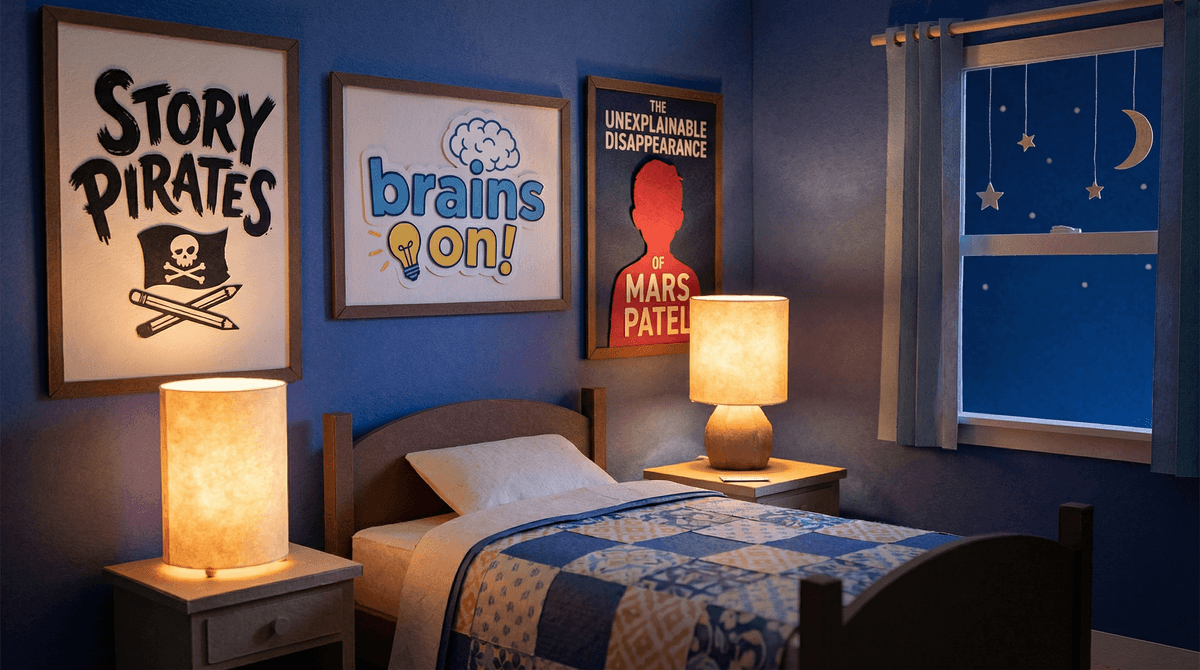
Screen-free bedtime means exactly what it sounds like: creating a window of time before sleep where screens are off-limits. No phones, no tablets, no TV, no "just one more episode," no "I'm just checking something real quick."
The idea is simple, but let's be honest—the execution? That's where things get messy. Because we're not just fighting our kids' habits here. We're fighting our own scrolling addictions, the convenience of a YouTube video buying us ten minutes of peace, and the fact that screens have somehow become the default transition tool for basically everything in modern parenting.
But here's the thing: the science on screens and sleep is pretty unambiguous. Blue light suppresses melatonin production. Stimulating content (whether it's Fortnite or just scrolling TikTok) keeps brains activated when they should be winding down. And the habit of screens-as-sleep-aid creates a dependency that makes falling asleep without them genuinely harder over time.
Let's talk about what's actually happening when kids (or adults) use screens right up until lights-out:
The blue light issue is real. Screens emit blue wavelength light that tells our brains "hey, it's daytime, stay alert!" This suppresses melatonin, the hormone that makes us sleepy. Yes, there are blue light filters and "night mode" settings, but they're not a complete solution—they reduce the problem, they don't eliminate it.
Content matters as much as light. Even if you've got every filter enabled, watching something exciting, funny, scary, or emotionally engaging keeps the brain in an active state. A kid who just watched a intense Minecraft PvP battle or a tense episode of Wednesday isn't going to immediately shift into sleep mode just because you turned off the iPad.
Sleep quality affects everything. We're not just talking about grumpy mornings (though yes, obviously that). Poor sleep impacts learning, memory consolidation, emotional regulation, immune function, and growth. Kids who don't sleep well struggle more in school, have more behavioral issues, and are more prone to anxiety and depression.
The habit becomes the problem. When screens become the bedtime routine, kids literally forget how to fall asleep without them. The brain learns to need that specific input as a sleep cue, which means every sleep situation becomes harder—sleepovers, camping trips, nights when the tablet is dead or lost.
Ages 0-5: Building the Foundation
This is actually the easiest age to establish screen-free bedtime because you have complete control and they haven't developed strong habits yet. The American Academy of Pediatrics recommends no screens at all in the hour before bed for this age group.
What works:
- Bath, books, songs, cuddles—the classic routine exists for a reason
- Consistency is everything; same order, same time, every night
- If screens are part of your day, end them well before bedtime starts (at least 60-90 minutes)
Ages 6-10: The Negotiation Years
This is where it gets trickier. Kids have opinions now, they've seen what their friends do, and they're starting to push back on rules that feel arbitrary.
What works:
- Set a clear screen curfew (like 7:30 PM if bedtime is 8:30 PM)
- Create a charging station outside bedrooms where all devices live overnight
- Offer appealing alternatives: audiobooks
 , podcasts like Story Pirates, paper books with a reading light
 - Let them have some control over the non-screen routine (pick the book, choose pajamas, etc.)
Ages 11-14: The Reality Check
Middle schoolers are a whole different beast. Many have phones now, group chats are active 24/7, FOMO is real, and they genuinely believe they're the only person whose parents have screen rules.
What works:
- Be honest about the science—show them the research on sleep and screens
- Set device curfews with consequences (and yes, you'll need to actually collect devices)
- Acknowledge that this is harder for them than it was for you at their age
- Consider alarm clocks that aren't phones
- Discuss the psychology of infinite scroll and how apps are designed to keep them engaged
Ages 15-18: Preparing for Independence
At this point, you're mostly modeling and advising rather than controlling. They need to learn to manage this themselves before they head to college or independent life.
What works:
- Focus on natural consequences (tired = harder to focus, worse performance)
- Share your own screen-free bedtime practices
- Set household norms rather than kid-specific rules (everyone's phone charges in the kitchen overnight)
- Talk about how they'll manage this when you're not there to enforce it
Start with Yourself
You cannot successfully implement screen-free bedtime for your kids while you're scrolling Instagram in bed. Kids will call out hypocrisy faster than you can say "because I said so." Plus, you probably need better sleep too.
Make it a household rule, not a kid rule. Everyone's devices charge in a central location overnight. Everyone stops screens at the same time. This eliminates the fairness argument and models the behavior you want to see.
Create a Transition Ritual
The hardest part of screen-free bedtime is the transition itself. Going from high-stimulation screen time directly to "okay now lie still and sleep" is like asking someone to go from sprinting to napping. You need a buffer.
The 30-60 minute wind-down window:
- Dim the lights throughout the house
- Shift to calming activities: reading, drawing, puzzles, board games, quiet conversation
- Keep it consistent so the routine itself becomes a sleep cue
Make Alternatives Actually Appealing
If you take away screens and replace them with nothing, you're just creating a void. Fill it with things kids actually want to do.
Screen-free bedtime activities that don't suck:
- Audiobooks and podcasts (Brains On!, The Unexplainable Disappearance of Mars Patel)
- Reading with a book light or e-reader (yes, e-readers with e-ink displays like Kindle are much better than tablets—no blue light, no notifications)
- Journaling or drawing
- Listening to music (create calming playlists together)
- Actual conversation (revolutionary, I know)
Address the Practical Obstacles
"But I use my phone as an alarm!"
Buy a $10 alarm clock. This is not a real obstacle, this is an excuse.
"But my friends text me at night!"
This is real, and it's hard. Group chats are active 24/7, and FOMO is legitimate. Solutions: set up auto-replies that say "I'm offline after 9 PM, I'll respond tomorrow," talk to other parents about coordinating device curfews, help kids understand that real friends will understand boundaries.
"But I need it for homework!"
If homework genuinely requires devices late at night, that's a scheduling problem, not a bedtime problem. Work on time management, start homework earlier, or talk to teachers about workload. Don't let "homework" become the excuse that destroys sleep.
Use Technology to Manage Technology
Yes, the irony is thick, but parental controls and screen time limits can help:
- iOS Screen Time and Android Digital Wellbeing let you set app limits and downtime schedules
- Wi-Fi routers can be scheduled to turn off at certain times
- Apps like Circle or Bark offer more granular controls
Just remember: technology is a tool, not the solution. If you're only relying on parental controls without building actual habits and having conversations, kids will find workarounds.
Oh, there will be pushback. Count on it. Here's how to handle it:
"None of my friends have this rule!"
Maybe true, maybe not. Either way, irrelevant. "We're not making decisions based on what other families do. We're making decisions based on what we think is best for our family." If you want to soften it: "I'm happy to talk to other parents about this—you might be surprised how many families are struggling with the same thing."
"This is so unfair!"
"I know it feels unfair. This is hard for everyone. But sleep is not negotiable—it's literally a biological need, like food and water."
"You're so strict!"
"Maybe. But I'd rather be strict about sleep than watch you struggle through school exhausted. We can revisit this as you get older and show me you can manage it yourself."
The nuclear option: "I hate you!"
Stay calm. Don't take it personally (easier said than done). "I hear that you're really upset. This rule isn't changing tonight, but we can talk about it tomorrow when we're both calmer."
Screen-free bedtime isn't about being anti-technology or anti-fun. It's about recognizing that sleep is foundational to everything else, and screens before bed genuinely interfere with sleep quality.
Will your kids complain? Probably. Will it be inconvenient sometimes? Definitely. Will you occasionally break your own rule because you're exhausted and just need them to go to sleep? Yeah, that'll happen too. Perfect execution is not the goal—consistent effort is.
The families who make this work aren't the ones who never mess up. They're the ones who keep coming back to the boundary, who have honest conversations about why it matters, and who model the behavior they want to see.
This week:
- Pick a screen curfew time (start with 30-60 minutes before actual bedtime)
- Set up a device charging station outside of bedrooms
- Buy alarm clocks if phones are currently serving that purpose
- Have a family meeting to explain the new routine (not asking permission, just explaining)
This month:
- Establish 2-3 appealing screen-free bedtime activities for each kid
- Be consistent with the routine, even when it's hard
- Check in with kids about how they're sleeping—are they falling asleep faster? Waking up easier?
Long-term:
- Adjust the routine as needed, but keep the core boundary intact
- Revisit and revise as kids get older and show they can self-regulate
- Model your own healthy screen habits (this is ongoing forever)
Need help talking to your kids about why screens affect sleep? Here's how to have that conversation without sounding like a lecture. Or if you're dealing with a kid who genuinely can't fall asleep without screens, let's talk about breaking that dependency gently.