

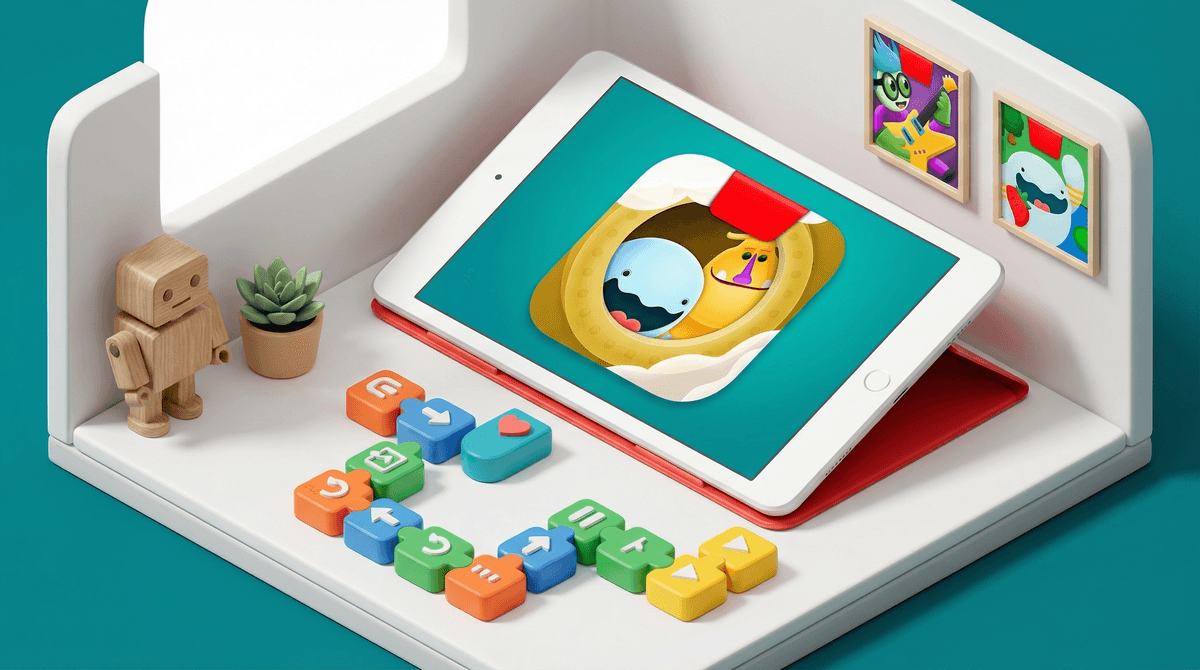
Osmo Coding Awbie is a physical coding game that works with an iPad and uses actual, tangible blocks to teach programming concepts. Kids arrange colorful magnetic blocks to create sequences that guide a character named Awbie through a digital world to collect strawberries. It's part of the larger Osmo ecosystem—that clever system that uses a mirror attachment on your iPad to "see" physical objects on the table.
The genius here is that kids aren't just tapping a screen. They're physically manipulating blocks that represent coding commands (walk, jump, grab), which makes abstract programming concepts feel concrete and intuitive. When they press play, Awbie follows their block sequence on screen. It's like writing code, but you can hold it in your hands.
The game comes with three coding adventures of increasing complexity: Coding Awbie (basic sequencing), Coding Jam (music and patterns), and Coding Duo (two-player collaborative coding). You'll need the Osmo base (sold separately or in various bundles) and an iPad to play.
It feels like magic. The moment a kid realizes that the physical blocks they're arranging are actually controlling what happens on screen? That's the hook. It bridges the gap between the physical world they understand and the digital world they're learning to navigate.
Immediate feedback without failure shame. When their code doesn't work, kids can see exactly where the sequence went wrong. Awbie doesn't die dramatically or flash "GAME OVER"—he just follows the instructions they gave him, even if that means walking into a tree. Kids naturally want to fix it and try again.
It's genuinely playful. Unlike some educational games that feel like vegetables disguised as dessert, Coding Awbie doesn't pretend to be something it's not. The strawberry-collecting missions are silly and charming. The sound design is delightful. Kids ages 5-12 actually choose to play this during free time, not just when parents suggest "something educational."
Ages 5-7: Perfect sweet spot. This is where Osmo Coding Awbie really shines. The physical blocks are easier for younger kids to manipulate than abstract touchscreen interfaces, and the progression from simple sequences (walk, walk, jump) to more complex loops feels natural. Expect to sit with them initially to explain the concept, but most kids grasp it within 15-20 minutes.
Ages 8-10: Still engaging, but.. Kids in this range will fly through the basic levels and appreciate the more complex challenges in Coding Jam and Coding Duo. However, some might start wanting "real" coding on a screen. This is actually a great bridge age—they can master Osmo Coding and then transition to something like Scratch or CodeSpark Academy.
Ages 10+: Probably outgrowing it. By fifth grade, most kids are ready for actual text-based coding or more sophisticated block coding environments. If your 11-year-old hasn't used Osmo before, they might find it too "baby." But if they loved it at 7, they might still enjoy the advanced levels nostalgically.
The investment is real. Let's talk money. You need the Osmo Base + the Coding Awbie game kit. Depending on sales and bundles, you're looking at $60-100 to get started. That's not cheap for a single game, even if it's educational. The good news? The Osmo base works with other Osmo games (Pizza Co., Detective Agency, Creative Board), so if your kid loves it, you can expand the ecosystem. The bad news? You're potentially buying into a whole system.
iPad required, no exceptions. This only works with iPads (and specific Fire tablets). If you're an Android household or don't have a tablet, this isn't going to work. The Osmo website has a compatibility checker—use it before buying.
It teaches actual coding concepts. This isn't just "tech time." Kids learn sequencing, loops, conditional logic, and debugging—the foundational concepts of programming. A 6-year-old using Osmo Coding is learning the same logical thinking that a programmer uses when writing Python. That's legitimately valuable.
Screen time that feels different. Here's the thing: this requires a screen, but it doesn't feel like passive screen time. Kids are actively problem-solving, using their hands, often collaborating with siblings. It's more like "screen-enhanced play" than traditional screen time. That said, it still counts toward daily limits in most families' frameworks, so plan accordingly.
The longevity question. Most kids get 20-40 hours of engaged play from Coding Awbie before they've mastered everything. That's solid for an educational toy, but it's not infinite. Some kids will return to it periodically; others will complete it and move on. Consider whether that value proposition works for your family.
Osmo Coding Awbie is one of the best introductions to programming concepts for elementary-aged kids, particularly in the 5-8 range. It makes abstract ideas concrete, encourages experimentation without punishment, and genuinely engages kids in logical thinking.
Buy it if:
- You have an iPad and a kid ages 5-9 who's curious about how things work
- You want to introduce coding concepts without a purely digital experience
- You're okay with the investment, especially if you might buy other Osmo games
- Your kid learns well with hands-on, tactile experiences
Skip it if:
- You don't have a compatible device and don't want to buy one
- Your kid is already deep into Minecraft redstone or Roblox Studio
 —they're probably ready for more advanced tools
 - You're looking for something with infinite replayability
- The price point feels like too much for what might be a passing interest
If you're on the fence, check if your local library has Osmo kits you can borrow (many do!). Or see if a friend will let your kid try theirs for 30 minutes—you'll know pretty quickly if it clicks.
If you buy it and your kid loves it, the natural progression is either more Osmo games or moving to screen-based coding like Scratch (free!) or CodeSpark Academy (subscription). Here's a guide to coding apps and games for different ages if you want to explore what comes next.
And hey—if your kid finishes all the Coding Awbie levels and asks what else they can code, that's a really good problem to have.