

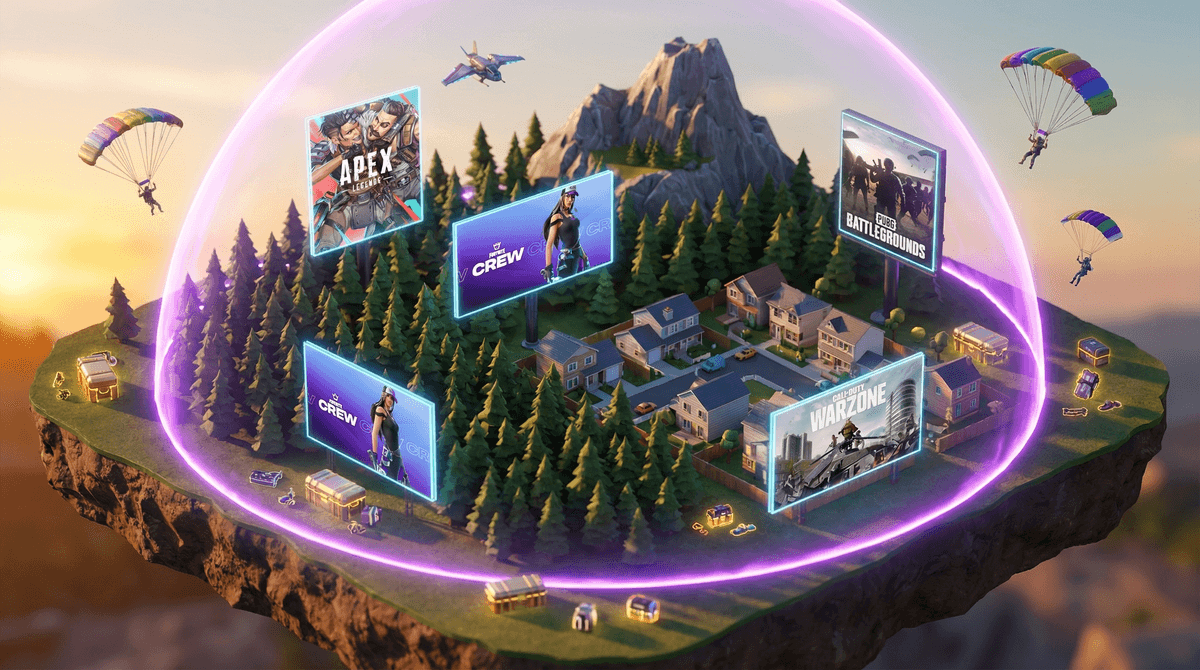
Battle royale games drop dozens (or hundreds) of players into a shrinking map where they scavenge for weapons, build defenses, and fight until only one player or team remains standing. Think The Hunger Games meets video games, minus the dystopian child murder vibes and plus a lot of cartoon skins and victory dances.
The genre exploded around 2017 with PUBG and Fortnite, and it's still absolutely dominating what kids are playing. If your child games at all, they've either played a battle royale or desperately want to.
The basic loop: You parachute/drop onto an island with nothing. You scramble to find weapons and resources while avoiding other players. A storm/zone forces everyone closer together. Last one alive wins. Rinse and repeat, because each match only lasts 15-30 minutes.
It's social. Battle royales are built for playing with friends. Most kids aren't actually trying to "win" — they're goofing around with their squad, trying ridiculous strategies, and laughing when someone accidentally launches themselves off a cliff. The voice chat is often more important than the gameplay.
Every match feels different. Unlike traditional games with levels you master, battle royales have randomized loot and player encounters. You never know if you'll find the perfect weapon immediately or spend five minutes punching trees while someone snipes you.
The stakes are low. Die in the first minute? No big deal, queue up another match. This makes them less frustrating than games where you lose hours of progress. It also means kids can play "just one more game" approximately 47 times before dinner.
It's free. Most battle royales are free-to-play, which is why they spread through friend groups like wildfire. The catch? They make money through cosmetic items (skins, emotes, battle passes), which we'll get to.
The skill ceiling is high. There's always something to improve — aim, building, positioning, game sense. Kids love the progression from getting destroyed immediately to actually surviving past the first fight.
Fortnite is the cultural juggernaut. Rated T (13+), but let's be real — third and fourth graders are playing it. It has cartoon violence, building mechanics, and constant crossovers with everything from Marvel to Star Wars. The community skews younger (ages 10-16 are the sweet spot). Read our full Fortnite guide for the deep dive.
PUBG (PlayerUnknown's Battlegrounds) is the more realistic, grittier option. Rated T (13+), with actual military weapons and blood effects. The playerbase is older — mostly teens and adults. It's less popular with elementary kids, more popular with middle schoolers who think Fortnite is "for babies."
Apex Legends sits between Fortnite and PUBG in tone. Rated T (13+), it's a hero-based shooter where you pick characters with special abilities. Fast-paced, team-focused, and popular with the high school crowd and skilled middle schoolers.
Call of Duty: Warzone is the M-rated (17+) option with realistic military violence and blood. If your 12-year-old is begging for this, they're probably playing it at a friend's house already. It's intense, graphically violent, and genuinely not appropriate for younger kids despite what they tell you.
Roblox has dozens of battle royale games within its platform. These vary wildly in quality but are generally less intense and more accessible for younger kids (ages 7-12). The blocky graphics make violence feel more abstract.
Ages 7-9: If they're gaming at all, Roblox battle royales are your best bet. The violence is cartoonish, matches are shorter, and the skill floor is lower. Some kids this age handle Fortnite fine, but be prepared for frustration when they get eliminated quickly.
Ages 10-12: This is peak Fortnite age. Most kids in this range are playing or want to. The cartoon violence is relatively mild (no blood, eliminated players just disappear), but the social pressure is real. If you're going to say yes to battle royales, Fortnite is probably where you'll land.
Ages 13-15: They can probably handle the T-rated options (Fortnite, PUBG, Apex Legends). Some will push for M-rated games like Warzone. This is a family values call — the violence in M-rated shooters is significantly more realistic and graphic.
Ages 16+: They're probably already playing whatever they want at friends' houses. Your leverage here is more about time management and whether you're funding their gaming setup.
Time. Battle royales are designed to be addictive. The "just one more match" pull is real, and 30 minutes turns into three hours shockingly fast. They're also hard to pause mid-match, which creates conflict around dinner/bedtime/homework.
Money. While the games are free, kids will beg for V-Bucks (Fortnite), Apex Coins, or whatever the currency is. Battle passes cost $10-20 per season (every few months), and rare skins can be $20 each. This can add up fast , and kids don't always understand that digital items have zero resale value.
Voice chat. Most battle royales have open voice chat with strangers. Your sweet 10-year-old will hear language that would make a sailor blush. They'll also potentially encounter adults who... shouldn't be talking to 10-year-olds. Most games have options to disable voice chat or limit it to friends only — use them.
Toxicity. Gaming culture can be brutal. Kids get mocked for being "bad," for their voice, for being girls, for literally anything. The competitive nature of battle royales amplifies this. Talk to your kids about muting toxic players and not internalizing random internet cruelty.
Screen violence. Even cartoon violence is still violence. Some kids are totally fine with it; others get anxious or aggressive. You know your kid. The research on video game violence and real-world aggression is mixed, but if you notice behavioral changes, that's data.
You can (and should) adjust settings. Most battle royales let you disable voice chat, hide player names, and adjust violence settings. Spend 20 minutes learning the parental controls for whatever game your kid is playing. Here's how to set up Fortnite parental controls.
Playing with friends isn't optional — it's the entire point. If you let your kid play but don't let them voice chat or play with friends, you're basically giving them the worst version of the experience. It's like letting them go to a party but making them sit in the corner silently. Either embrace the social aspect with guardrails, or consider whether battle royales are right for your family yet.
The building thing in Fortnite is actually impressive. If your kid is into Fortnite's building mechanics, they're developing spatial reasoning and quick decision-making skills. It's not just mindless shooting — there's genuine strategy and creativity involved.
They will spend money if you let them. Set clear boundaries about spending before starting. Many parents do a "you can spend your own money/gift cards only" rule, or a monthly allowance for gaming purchases. Whatever you do, don't save your credit card in the game.
Watching is different than playing. Lots of kids watch battle royale streams on YouTube or Twitch. The streamers often use adult language and humor. If your 8-year-old is watching, you might want to check out what they're actually viewing.
Battle royales aren't going anywhere. They're the dominant multiplayer genre for kids and teens, and for good reason — they're genuinely fun, social, and endlessly replayable.
Are they appropriate for your kid? That depends on your family's tolerance for cartoon violence, your kid's maturity level, and your ability to set boundaries around time and money. A 10-year-old playing Fortnite for an hour after homework with friends they know from school, with voice chat limited to that friend group? That's probably fine for most families. A 7-year-old playing M-rated Warzone for four hours daily with strangers? That's a different story.
The key is being informed and intentional. Know what they're playing, who they're playing with, and what the actual content is. Set clear expectations about time limits, spending, and behavior. Check in regularly about whether they're having fun or feeling stressed.
And maybe, just maybe, ask them to teach you how to play. You'll probably be terrible, they'll find it hilarious, and you'll actually understand what they're talking about at dinner. Plus, getting eliminated in 30 seconds by a 12-year-old wearing a banana costume is weirdly humbling.
- Try it yourself. Download Fortnite and play a few matches. You'll die immediately, but you'll get it.
- Set up parental controls before your kid plays their first match, not after.
- Talk about money and agree on spending limits before V-Bucks become a source of conflict.
- Watch them play for 20 minutes. See who they're talking to, how they handle losing, what the actual content is.
- Check out alternatives if battle royales don't feel right yet. Minecraft and Rocket League offer multiplayer fun with less violence.