

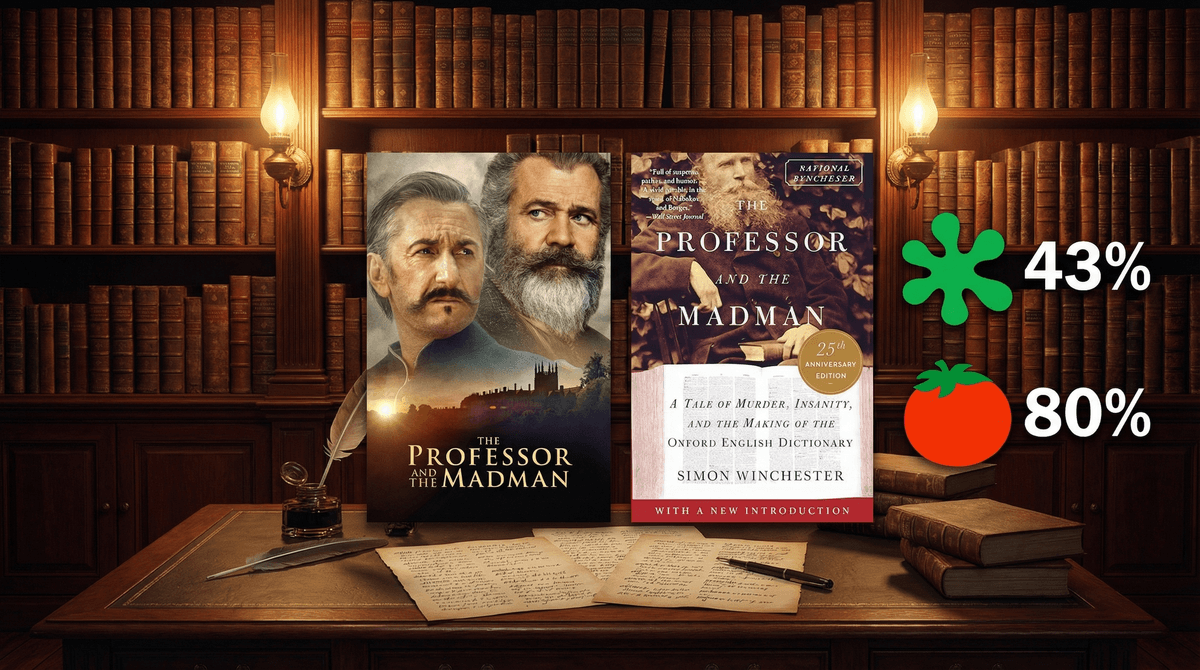
The Truth Behind The Professor and the Madman's Rotten Tomatoes Score
TL;DR: Critics gave this historical drama about the Oxford English Dictionary a brutal 43% on Rotten Tomatoes, while 80% of audiences loved it. The split tells us more about Hollywood drama and what makes a "prestige" film than it does about whether your family should watch it. Spoiler: it's actually a solid choice for older teens interested in history, language, or true stories—just know what you're getting into.
The Professor and the Madman is a 2019 film starring Mel Gibson and Sean Penn about the unlikely collaboration between James Murray (the editor of the Oxford English Dictionary) and Dr. W.C. Minor (a brilliant but institutionalized contributor who submitted thousands of definitions from an asylum). It's based on Simon Winchester's bestselling book The Professor and the Madman by Simon Winchester.
The movie has one of those head-scratching Rotten Tomatoes splits that makes you wonder if critics and regular viewers watched the same film:
- Critics: 43% (Rotten)
- Audiences: 80% (Fresh)
That's a 37-point gap. For context, that's bigger than the split on Venom (30 points) and almost as big as The Greatest Showman (42 points).
So what gives?
Here's what parents need to know: the critical reception has almost nothing to do with the movie itself and everything to do with the absolute mess of its production and release.
The film was mired in a legal battle between director Farhad Safinia and Mel Gibson (who also produced). Safinia sued Gibson's production company, claiming they took the film away from him and re-edited it without his approval. The movie sat on a shelf for years, got a tiny theatrical release, and basically went straight to streaming.
Critics knew all this drama going in. When a film has "troubled production" written all over it, reviewers tend to approach it with skepticism—and that colors their perception. They're looking for evidence of studio meddling, creative compromise, and narrative issues.
Regular audiences? They just pressed play on Netflix or Amazon Prime without knowing any of this backstory. They watched it as a period drama about an interesting historical footnote, and most of them enjoyed it.
Strip away the Hollywood drama, and you've got a pretty straightforward historical drama that:
- Tells a genuinely interesting true story about how the OED was created through crowdsourcing before the internet existed
- Features strong performances from Gibson and Penn (whatever you think of them personally, they're both capable actors)
- Looks beautiful with solid period production design
- Moves at a deliberate pace (this is NOT an action movie—it's about dictionary-making)
- Deals with mental illness, violence, and trauma in ways that require maturity to process
It's not groundbreaking cinema. It's not going to win awards. But it's also not the disaster the critical score suggests.
Reading through the negative reviews, the complaints are:
- "Pedestrian" and "by-the-numbers" storytelling
- Lack of narrative innovation or risk-taking
- The sense that it could have been better with different creative choices
- Awareness of the production drama undermining trust in the final product
- Mel Gibson's controversial personal history affecting reception
Basically, critics wanted a prestige film that did something innovative with the material. What they got was a competent but conventional period drama.
The positive audience reviews focus on:
- "I didn't know this story and found it fascinating"
- Strong acting, especially the chemistry between the leads
- Beautiful cinematography and authentic period details
- Appreciation for a "thinking person's" drama that isn't Marvel or Fast & Furious
- The emotional weight of the friendship at the story's center
Audiences weren't expecting it to reinvent cinema—they just wanted an engaging story well-told. And by that measure, it delivers.
Recommended for ages 14+, and even then, it depends on your teen's maturity and interests.
Content concerns:
- Violence: The film depicts Dr. Minor's traumatic Civil War experiences and a murder he commits while experiencing delusions. There's also a disturbing scene of self-mutilation late in the film.
- Mental illness: The portrayal of schizophrenia and institutionalization is central to the plot. It's handled more thoughtfully than many films, but it's intense.
- Pacing: This is a slow, dialogue-heavy film about language and friendship. If your teen loved Hidden Figures or The Imitation Game, they might enjoy this. If they struggled through Lincoln, skip it.
- Language: Period-appropriate language, nothing shocking
- Sexual content: Minimal, though there are references to Dr. Minor's past
Who might love it:
- Teens interested in history, language, or etymology
- Students who enjoyed Winchester's book
- Kids who like "true story" dramas
- Young people who appreciate character-driven narratives over action
Who should skip it:
- Younger kids (under 14, definitely)
- Teens who need fast pacing and action
- Anyone triggered by depictions of mental illness or self-harm
- Families looking for light entertainment
If you're watching with your teen, this is actually a great opportunity to discuss:
Mental health and historical treatment: The film shows 19th-century psychiatric care, which was often brutal. You can talk about how far we've come (and how far we still need to go) in treating mental illness with dignity.
The power of purpose: Dr. Minor's work on the dictionary gave his life meaning even while institutionalized. It's a powerful example of how contributing to something larger than yourself can be healing.
Friendship across boundaries: The relationship between Murray and Minor crosses class, nationality, and the walls of an asylum. It's a reminder that meaningful connections can happen in unexpected places.
The Rotten Tomatoes trap: This is honestly a perfect case study in teaching media literacy. The critical score doesn't tell the whole story. Looking at the context—production drama, release strategy, and the gap between critics and audiences—reveals more than the number itself.
Winchester's The Professor and the Madman is excellent and more appropriate for a wider age range (12+). The book provides more historical context, goes deeper into the creation of the OED, and handles Dr. Minor's mental illness with more nuance.
If your teen is interested in the story, honestly, start with the book. It's a quick read, it's fascinating, and it doesn't have the violent imagery that makes the film more intense. Then if they want to see the film adaptation, they'll have the context to appreciate what works and what doesn't.
Other books in this vein that teens might enjoy:
- The Invention of Hugo Cabret by Brian Selznick (ages 8-12)
- Code Girls by Liza Mundy (ages 14+)
- Winchester's other books like The Map That Changed the World
The Professor and the Madman's Rotten Tomatoes split is a perfect example of why you can't just look at a score and make a decision. The 43% critical rating reflects Hollywood drama, production issues, and reviewers' expectations for prestige filmmaking. The 80% audience score reflects what the movie actually is: a solid, well-acted historical drama that tells an interesting true story.
Is it worth watching with your teen? If they're 14+, interested in history or language, and okay with slower pacing and some intense content around mental illness, yes. It's not a masterpiece, but it's a perfectly fine way to spend two hours learning about something fascinating.
Should you stress about the critical score? Nope. This is a case where the audience score is more useful for family decision-making.
Better options for younger kids interested in language and words? Check out Frindle by Andrew Clements, Word Up, or the documentary Spellbound about the National Spelling Bee.
The real lesson here isn't about whether this particular movie is good or bad—it's about teaching our kids (and reminding ourselves) to look beyond the numbers and understand the context. That's a skill that'll serve them well whether they're choosing movies, evaluating social media claims, or navigating which YouTube channels are actually worth their time.