

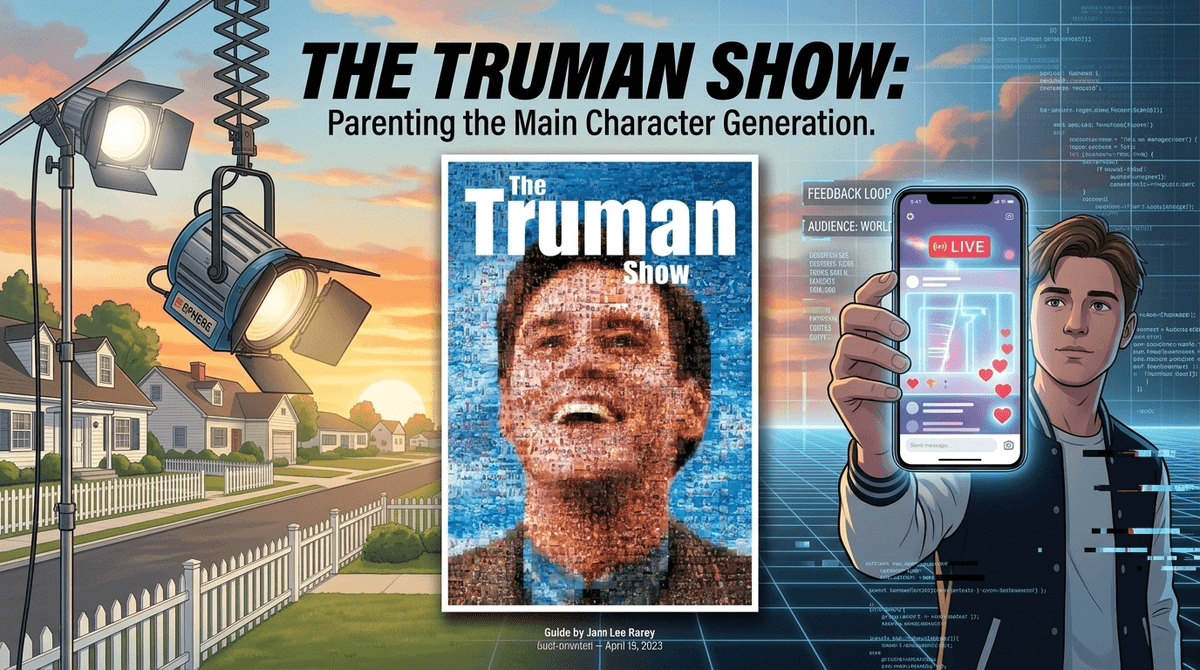
TL;DR: The Truman Show is the ultimate "unplugging" manifesto for a generation raised on TikTok and Instagram. It’s a 1998 classic that feels more relevant in 2026 than it did when it was released. It’s the perfect conversation starter for kids who are obsessed with "Main Character Energy" or who dream of becoming influencers.
Quick Recommendations for the "Truman" Vibe:
- For the "Everything is fake" realization: The LEGO Movie
- For the "Privacy is a gift" talk: The Giver by Lois Lowry
- For the "Existential dread but make it funny" mood: The Good Place
- For the "Social media is a simulation" deep dive: The Social Dilemma
If you missed this one in the late 90s, here’s the deal: Truman Burbank (Jim Carrey) lives a perfect, suburban life in a town called Seahaven. Everything is great, everyone is nice, and the sun always shines. The catch? Truman is the only person who doesn’t know his entire life is a 24/7 reality TV show. Every "friend" is a paid actor, every "neighbor" is an extra, and his wife is basically a walking product placement for kitchen appliances.
The movie follows Truman as he starts noticing the glitches in the Matrix—like a studio light falling from the "sky" or his dead father showing up as an extra—and his eventual, terrifying realization that his privacy has been a commodity since the day he was born.
Check out our full guide on why The Truman Show is the perfect family movie night choice
We live in the era of "Main Character Energy." You’ve probably heard your kids use the term. It’s that vibe where you act like you’re the protagonist of a movie and everyone else is just an NPC (non-player character). In many ways, Truman Burbank is the original "Main Character," but with one massive difference: he didn't choose it.
Today’s kids are growing up in a world where they are encouraged to "Truman" themselves. Between TikTok and Instagram, kids are constantly filming their lives, narrating their "morning routines," and performing for an invisible audience. They are the directors, actors, and producers of their own Seahaven.
The Truman Show flips the script. It shows that being the center of the universe—where every moment is recorded and every "friend" is actually just a follower or a fan—is actually a nightmare. It’s a prison. For a kid who thinks being a famous YouTuber sounds like the dream, watching Truman fight for the right to be boring and private is a total perspective shift.
Even though this movie is over 25 years old, it doesn't feel "cringe" or dated to most kids. Here’s why it hits:
- The "Glitches": Kids who grew up on "analog horror" or "liminal space" aesthetics (think the Backrooms or Skibidi Toilet weirdness) love the eerie feeling of a world that is "off."
- The Rebellion: Every teen feels like their parents or teachers are watching their every move. Truman’s struggle to escape the prying eyes of "Christof" (the show's creator) feels like the ultimate teenage rebellion.
- The Humor: Jim Carrey is at his peak here. It’s funny until it’s suddenly very, very not funny.
If The Truman Show sparks a good conversation in your house, here are some other media items to keep the momentum going, categorized by age and theme.
For the Younger Crowd (Ages 7-11)
- It sounds silly, but Emmet’s journey from a "follow the instructions" nobody to realizing his world is literally being controlled by a "Man Upstairs" is Truman Show 101 for the elementary set.
- A great book about kids trapped in a highly curated, game-like environment where they have to use their wits to find the "exit."
- Wait, why Minecraft? Because it’s the ultimate sandbox. Talk to your kids about the difference between "Creative Mode" (where you control everything) and "Survival Mode" (where the world is real and dangerous). Truman lived in a permanent Creative Mode built by someone else.
For the "Deep Thinkers" (Ages 12-15)
- This is the gold standard for "the world isn't what it seems." Jonas lives in a world without color or pain—until he realizes the cost of that comfort is his humanity.
- This is basically The Truman Show but with Marvel superheroes. Wanda creates a sitcom-perfect reality to hide from her grief. It’s a great way to talk about how we use social media to "filter" our real-life sadness.
- A hilarious dive into ethics and the "curated" afterlife. It asks: What does it mean to be a "good" person if you think someone is always watching and grading you?
For Older Teens (Ages 16+)
- Specifically the episode "Nosedive." It’s a brutal look at a world where everyone is rated on a 5-star scale for every social interaction. It’s The Truman Show but the audience is everyone you know. (Note: This show is TV-MA and very dark—check our guide first). Read our guide on navigating Black Mirror with teens
Is it safe? The Truman Show is rated PG. There’s no gore, no "spicy" scenes (though there is some suggestive dialogue between Truman and his wife), and very little profanity.
The real "risk": The movie deals with heavy existential themes. For sensitive kids, the idea that "everyone is lying to me" or "my parents are actors" could be a bit much. It’s less about "scary" and more about "creepy." If your kid is prone to anxiety about being watched or "the world isn't real" (sometimes called "existential dread" or "derealization" in online circles), maybe pre-screen it or watch it together.
The most powerful part of watching this movie in 2026 is the product placement. In the movie, Truman’s wife, Meryl, will literally stop in the middle of a conversation to hold up a can of "Mococoa" hot chocolate and describe its "all-natural cocoa beans from the upper slopes of Mt. Nicaragua."
It’s hilarious because it’s so awkward. But then, open TikTok. Your kid is watching "Get Ready With Me" (GRWM) videos where influencers do the exact same thing. They are selling skincare, energy drinks, and "aesthetic" room decor while pretending to just "be themselves."
The conversation to have: "Do you think [Influencer Name] actually likes that water bottle, or are they like Meryl in The Truman Show?"
This helps kids develop media literacy. It helps them see that "authenticity" on a screen is often a carefully constructed product designed to keep them watching (and buying).
Learn more about how the influencer economy affects teen mental health
Don't make it a lecture. Just watch the movie, order some pizza, and ask a few "what if" questions:
- The Audience: "If you knew 1 billion people were watching you brush your teeth, would you do it differently? Why?"
- The Choice: "At the end, Truman has a choice to stay in the perfect, safe world or go into the 'real' world which is messy and dangerous. Which would you pick?"
- The Privacy: "What’s one thing you do that you would never want to be broadcast on TV? Why is it important that some things stay just for us?"
- The "Ohio" Factor: "Is our town a little bit like Seahaven? Is it too 'perfect' or 'weird' in some ways?" (Using their slang like "Ohio" or "NPC" can actually help bridge the gap here—just don't overdo it or you'll be "cringe").
The Truman Show isn't just a "good movie." It’s a tool. It’s a way to help our kids realize that while the digital world wants them to be the "Main Character" for an audience, the real world is where the actual life happens—off-camera, unedited, and beautifully private.
In a world that wants everyone to be "on" 24/7, Truman Burbank’s final bow and exit through a literal door in the sky is the most "alpha" move of all.
- Host a movie night: Stream The Truman Show.
- Audit the feed: After the movie, scroll through YouTube or Instagram together and try to spot the "Meryl moments" (obvious product placements).
- Go "Ghost Mode": Try a family "Truman Day" where no one posts anything, takes any photos, or records any videos. Just live the day for yourselves, not the audience.