

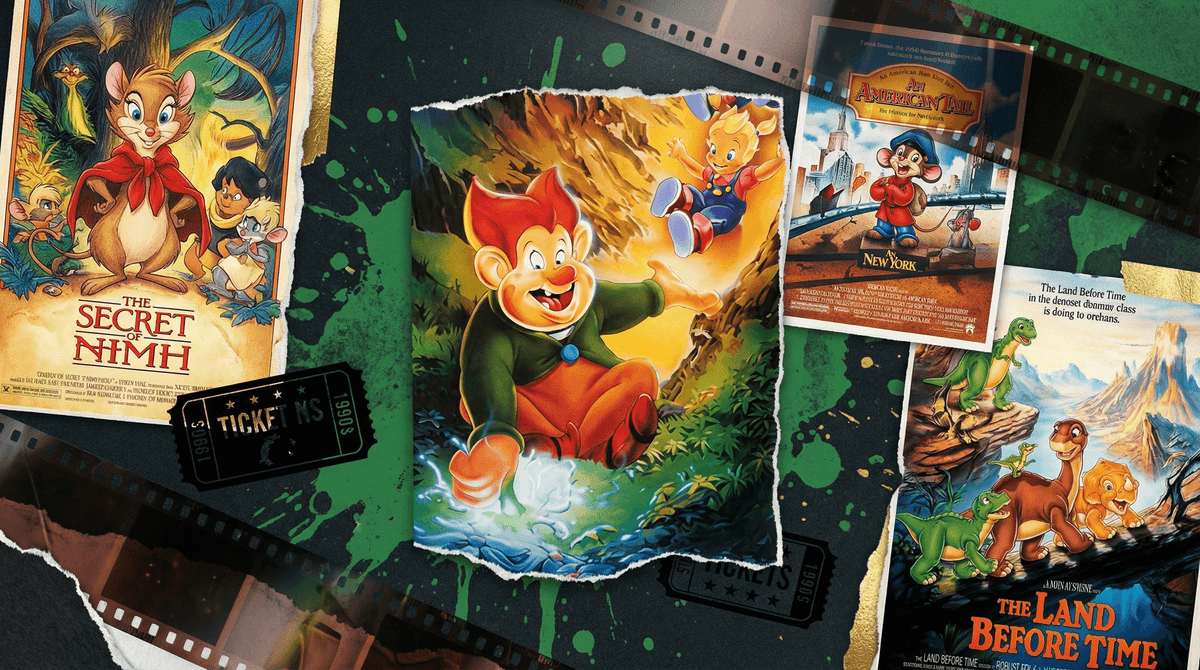
The True Story Behind Don Bluth's Lowest-Grossing Flop: A Troll in Central Park
TL;DR: A Troll in Central Park earned just $71,368 at the box office in 1994, making it the biggest financial disaster in Don Bluth's career. It's a syrupy-sweet tale about a troll with a green thumb who befriends two kids in New York City. Should you watch it with your kids? Honestly, probably not—but the story of why it failed so spectacularly is actually fascinating.
Don Bluth was the guy who gave us The Secret of NIMH, An American Tail, and The Land Before Time. These were films that didn't talk down to kids, that dealt with real darkness and loss, and that trusted children to handle complex emotions. They were Disney alternatives that felt different—grittier, more honest, sometimes genuinely scary.
Then came A Troll in Central Park.
The film was released in October 1994 with almost no marketing, dumped into a handful of theaters, and vanished within days. That $71,368 gross? That's not a typo. For context, The Lion King had been released just three months earlier and would go on to earn over $760 million worldwide. Even accounting for Disney's marketing muscle, the contrast is staggering.
The movie itself is... not good. Stanley (the troll) has a magical green thumb that makes flowers bloom everywhere. He's exiled from the troll kingdom for being too nice and ends up in Central Park, where he meets Gus, a toddler who can barely talk, and his older sister Rosie. There's a villain named Gnorga who wants to turn everything to stone. The conflict is paper-thin, the songs are forgettable, and the whole thing feels like it was made for kids under 5—but even preschoolers deserve better.
But the real story is about what was happening behind the scenes. By 1994, Bluth's studio was in financial trouble. After the success of An American Tail and The Land Before Time, Bluth had made a string of box office disappointments: All Dogs Go to Heaven, Rock-a-Doodle, and Thumbelina.
The studio was hemorrhaging money and desperately needed a hit. A Troll in Central Park was originally conceived as a smaller, cheaper project—something they could produce quickly while working on bigger films. But as the studio's financial situation worsened, corners were cut. The animation budget was slashed. Marketing was practically nonexistent.
Warner Bros., the distributor, had zero faith in the film. They gave it a token theatrical release to fulfill contractual obligations, then immediately dumped it to home video. They didn't screen it for critics. They barely advertised it. It was a mercy killing.
If your kid somehow discovers this movie on a streaming service, here's what you're in for:
Ages 3-6: The target demographic, theoretically. Stanley is gentle and non-threatening, the colors are bright, and there's nothing scary except Gnorga, who's more annoying than frightening. But even for this age group, the pacing is slow and the story is thin. Your preschooler might enjoy it once, but they're not going to request it on repeat like Bluey or Daniel Tiger.
Ages 7+: They'll be bored. The main character is a toddler who speaks in baby talk. There's no real tension or stakes. Older kids who enjoy Bluth's other work will wonder what happened to the edge and emotion that made those films special.
Content concerns: Basically none. It's rated G and earns it. No violence beyond cartoon peril, no scary imagery that'll cause nightmares, no questionable messages. It's just... bland.
The failure of A Troll in Central Park is actually a great case study in what happens when you lose sight of what makes your work special. Bluth's best films worked because they respected kids' intelligence and emotional capacity. The Land Before Time opens with the main character's mother dying. An American Tail is about immigration and separation and loss. These films trusted kids to handle real feelings.
A Troll in Central Park feels like it was made by a committee trying to create "content for children" rather than a story that happens to be animated. It's the difference between Pixar's Inside Out—which tackles depression and growing up with nuance and depth—and generic direct-to-video sequels that just want to sell toys.
This is worth talking about with older kids who are interested in storytelling or animation. Why do some animated films become classics while others disappear? What makes a story feel authentic versus pandering? If your kid is into animation history , the rise and fall of Don Bluth's studio is genuinely fascinating.
If you're looking for Don Bluth films that actually showcase his talent:
-
The Secret of NIMH (Ages 8+): Dark, gorgeous, and genuinely moving. About a field mouse trying to save her family. Has some scary moments but it's a masterpiece.
-
An American Tail (Ages 6+): Fievel's journey from Russia to America is heartbreaking and hopeful. The "Somewhere Out There" sequence still hits hard.
-
The Land Before Time (Ages 5+): Just watch the original, not the 13 direct-to-video sequels. It's a beautiful film about loss and friendship.
If you want modern animated films that respect kids' intelligence:
-
The Wild Robot (Ages 7+): About a robot learning to survive in the wilderness and becoming a mother to a gosling. Gorgeous and emotional.
-
Wolfwalkers (Ages 8+): Irish folklore meets stunning hand-drawn animation. Has real stakes and doesn't pull punches.
-
Spider-Man: Into the Spider-Verse (Ages 8+): Proof that animated films can be visually innovative, emotionally complex, and wildly entertaining all at once.
A Troll in Central Park isn't going to traumatize your kids, but it's not going to enrich them either. It's a historical curiosity—the lowest point in a talented filmmaker's career, a cautionary tale about what happens when financial desperation meets creative compromise.
The real value here is in the conversation. If your kid is interested in animation or filmmaking, the story of this flop is more interesting than the movie itself. Why do some films succeed and others fail? What happens when artists lose creative control? How do you balance commercial needs with artistic vision?
Those are questions worth exploring, even if the movie itself isn't worth watching.
Want to explore more about animation history with your kids? Check out documentaries about animation or books about how movies are made. The behind-the-scenes stories are often more compelling than what ends up on screen.