

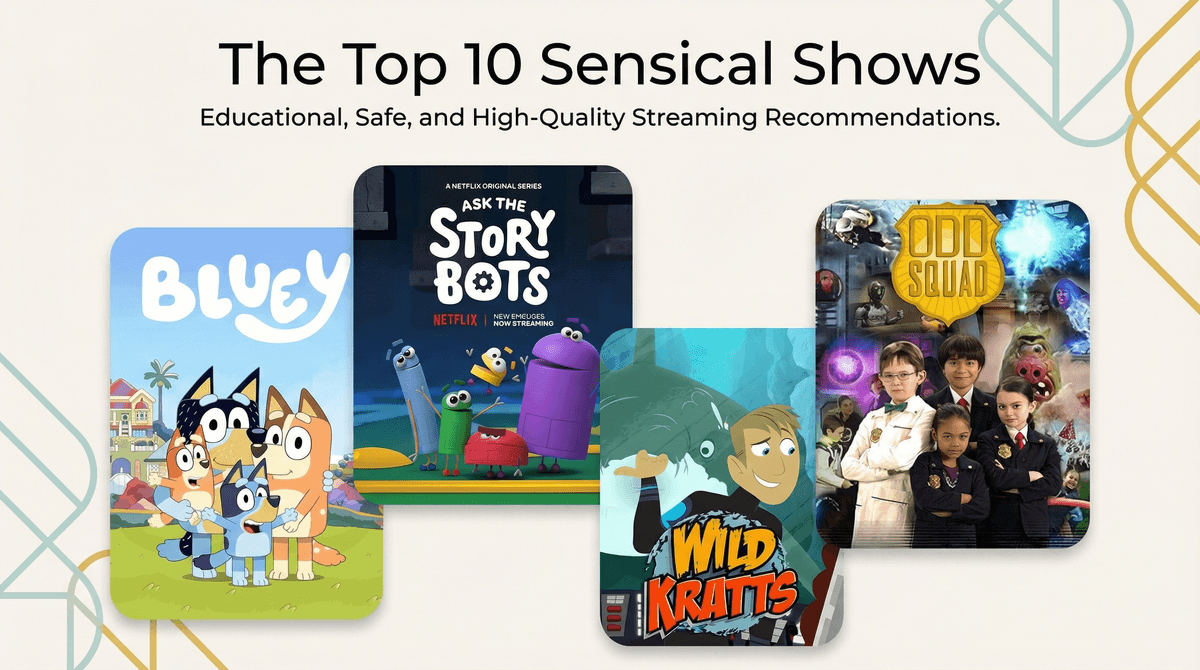
The Top 10 Sensical Shows Your Kids Need to Watch Now
Sensical is a free streaming platform packed with quality educational content for kids ages 2-10, and honestly? It's kind of a hidden gem. Here are the absolute best shows on there right now:
- Bluey (Ages 2-8)
- StoryBots (Ages 3-8)
- Sesame Street (Ages 2-5)
- Wild Kratts (Ages 4-10)
- Odd Squad (Ages 5-10)
- Daniel Tiger's Neighborhood (Ages 2-5)
- Super Why! (Ages 3-6)
- Elinor Wonders Why (Ages 3-7)
- Sid the Science Kid (Ages 3-7)
- Dinosaur Train (Ages 3-6)
If you haven't heard of Sensical, it's a free streaming app from Common Sense Media (yes, the same folks who rate everything we Google before letting our kids watch). No ads, no subscriptions, no credit card required. Just download and go.
The catch? The content library isn't massive like Netflix or Disney+. But what it lacks in quantity, it makes up for in curation. Everything on there has been vetted for educational value and age-appropriateness. It's basically what YouTube Kids should be but isn't.
The app organizes content into channels like "Preschool Pals," "Early Elementary," and subject-based categories. Kids can browse independently without you worrying they'll stumble into some weird AI-generated nonsense or unboxing videos that are basically 20-minute toy commercials.
1. Bluey
Ages 2-8 | Perfect for: Everyone, honestly
You already know about Bluey. Your kids love it, you secretly love it, and you've probably cried during at least one episode. The Australian Blue Heeler family show is streaming gold—teaching emotional intelligence, creative play, and family dynamics without being preachy.
What makes it perfect for Sensical is that you can let younger kids browse and click on episodes without worrying about them accidentally finding something inappropriate. Unlike Disney+, where Bluey lives alongside Marvel movies and shows that might be too intense for preschoolers.
Parent tip: The episode "Sleepytime" is a masterpiece. If you haven't watched it yet, grab tissues.
2. StoryBots
Ages 3-8 | Perfect for: Question-asking phase
The StoryBots answer kid questions through catchy songs, animation, and celebrity cameos. "How do computers work?" "Why do we have to recycle?" "How do airplanes fly?" Each episode tackles a different question with genuinely entertaining content that doesn't make you want to fake a bathroom emergency.
The music is actually good—like, you won't mind when your kid plays the same song 47 times. The animation is vibrant and engaging, and the educational content is solid without feeling like homework.
Ages 2-5 | Perfect for: Classic early learning
Yes, Sesame Street is over 50 years old. Yes, it's still fantastic. The show has evolved beautifully, incorporating modern topics like mindfulness and STEM concepts while maintaining the core social-emotional learning that made it legendary.
Sensical has a solid collection of episodes, and the beauty is that Sesame Street content is basically timeless. An episode from 2015 is just as relevant today. Your kids will learn letters, numbers, empathy, and problem-solving from Elmo, Abby Cadabby, and the gang.
4. Wild Kratts
Ages 4-10 | Perfect for: Animal-obsessed kids
If your kid can name 47 different dinosaurs but can't remember to put their shoes away, Wild Kratts is their show. The Kratt brothers (real-life zoologists) use "creature power suits" to transform into animals and go on adventures while teaching about animal biology, habitats, and conservation.
The show brilliantly balances entertainment with education. Kids are learning about biomimicry, ecosystems, and animal behavior without realizing they're basically watching a nature documentary. The animation is engaging, and the pacing keeps even squirmy kids interested.
Why it's great: It actually inspires kids to want to learn more. Don't be surprised if your child suddenly becomes an expert on honey badgers or wants to visit the rainforest.
5. Odd Squad
Ages 5-10 | Perfect for: Math-phobic kids
Odd Squad is a PBS gem that makes math genuinely cool. Kid agents solve weird problems using math concepts—symmetry, patterns, measurement, basic algebra—in a format that feels like a spy show parody.
The humor is smart enough that adults can watch without wanting to claw their eyes out. It's diverse, funny, and sneakily educational. Kids don't realize they're learning math because they're too busy enjoying the absurd plots about blob attacks and backwards-talking villains.
Bonus: The show features actual problem-solving processes, showing kids that making mistakes and trying different approaches is part of learning.
Ages 2-5 | Perfect for: Emotional regulation
Daniel Tiger is the Mr. Rogers successor we needed. Each episode tackles a social-emotional challenge—dealing with anger, trying new things, handling disappointment—with catchy strategy songs that actually work.
Yes, you'll have "When you feel so mad that you want to roar, take a deep breath and count to four" stuck in your head forever. But you'll also have tools to help your toddler manage big feelings. The show is gentle, kind, and incredibly effective at teaching emotional intelligence.
Real talk: Some parents find Daniel's voice annoying. That's valid. But the content is so good that it's worth pushing through.
7. Super Why!
Ages 3-6 | Perfect for: Early literacy
Super Why teaches reading skills through fairy tale adventures. The characters have "super powers" related to literacy—identifying letters, sounding out words, understanding story structure, finding rhymes. It's explicitly educational, but the fairy tale framework keeps it engaging.
For kids in the pre-reading or early reading stage, this show is gold. It builds phonological awareness, letter recognition, and comprehension skills in a way that feels like play. The interactive format encourages kids to "help" the characters solve problems.
Ages 3-7 | Perfect for: Little scientists
Elinor is a curious bunny who asks questions about the natural world and then actually investigates to find answers. It's all about the scientific method—observe, hypothesize, test, conclude. The show teaches kids that wondering "why" is the first step to learning.
What sets this apart from other science shows is the focus on process over facts. Kids learn how to think like scientists, not just memorize information. It's also beautifully animated and features diverse characters and families.
Ages 3-7 | Perfect for: Hands-on learners
Sid asks everyday questions—"Why do bananas get mushy?" "Why do my shoes shrink?"—and explores them through preschool science activities. The show models curiosity, investigation, and the idea that science is everywhere in daily life.
The Jim Henson Company animation style is distinctive (some love it, some find it slightly uncanny valley). But the content is solid, introducing concepts like observation, comparison, and simple experiments. Many episodes inspire kids to want to try their own investigations at home.
10. Dinosaur Train
Ages 3-6 | Perfect for: Dino fanatics
A family of pteranodons adopts a T-Rex, and they all ride a time-traveling train to learn about different dinosaurs and prehistoric eras. It's exactly as delightful as it sounds. The show teaches paleontology concepts, scientific thinking, and natural history while celebrating family differences.
Each episode includes a live-action segment with real paleontologist Dr. Scott discussing the dinosaurs featured in the episode. It bridges animation and reality in a way that reinforces learning. Plus, the songs are catchy without being annoying (a rare feat).
Ages 2-4: Start with Daniel Tiger's Neighborhood, Sesame Street, and Bluey. These focus on social-emotional learning and basic concepts without overwhelming young viewers.
Ages 4-6: Add StoryBots, Wild Kratts, Super Why!, and Dinosaur Train. These introduce more complex concepts while maintaining engaging formats.
Ages 6-10: Odd Squad and Wild Kratts are perfect for this age group. The humor is more sophisticated, and the educational content goes deeper.
Mixed-age families: Bluey is your friend. It genuinely works for everyone from toddlers to adults. Wild Kratts also has broad appeal across elementary ages.
It's actually free: No trial period that converts to a subscription, no hidden fees. Sensical makes money through partnerships and grants, not by charging parents. You don't even need to create an account to start watching, though creating one lets you save favorites and get recommendations.
No ads, but some sponsorship messages: You might see brief messages like "This program is brought to you by [organization]" but they're not traditional ads and they're minimal. Nothing like the ad assault on YouTube.
Content rotates: Unlike Netflix where things live forever (or get pulled suddenly), Sensical's library rotates. Shows come and go based on licensing. If your kid finds a favorite, download episodes while they're available if the app allows it.
Limited on-demand control: The channel-based format means you can't always pick specific episodes. Some parents find this frustrating; others appreciate that it prevents the "just one more episode" negotiation spiral.
Best for younger kids: The content tops out around age 10. If you've got tweens, they'll likely find it babyish. This is really optimized for the 2-8 age range, with some content extending to 10.
Works on multiple devices: Available on iOS, Android, Roku, Fire TV, Apple TV, and web browsers. You can start an episode on your phone and finish it on the TV.
Sensical isn't going to replace your existing streaming services, but it's an excellent addition to your digital toolkit. For the preschool and early elementary years, it offers a curated, safe space where kids can explore content independently without you worrying about what they'll stumble into.
The shows listed here represent the best of what's available—content that entertains while teaching, that respects kids' intelligence while meeting them at their developmental level, and that you won't hate watching for the 47th time.
Is it perfect? No. The library could be bigger, and the interface could be more polished. But for a free platform that prioritizes quality over quantity and learning over mindless consumption, it's pretty damn good.
Download the app: Available free on most streaming devices and mobile platforms. No credit card required.
Create profiles for each kid: This helps the algorithm recommend age-appropriate content and lets each child build their own favorites list.
Try the channel approach: Instead of letting kids pick specific shows, try the channel format. It introduces them to new content they might not choose on their own.
Use it strategically: Sensical works great for morning routines, quiet time, or when you need 20 minutes to make dinner without someone asking you 47 questions about why clouds float.
Pair it with other quality options: Sensical is fantastic, but also explore PBS Kids, Apple TV+ kids content, and quality YouTube channels for a well-rounded media diet.
Want to dig deeper into any of these shows? Find age-appropriate shows and alternatives . And if you're trying to figure out how much screen time is actually reasonable for your kid's age, let's talk about that too.