

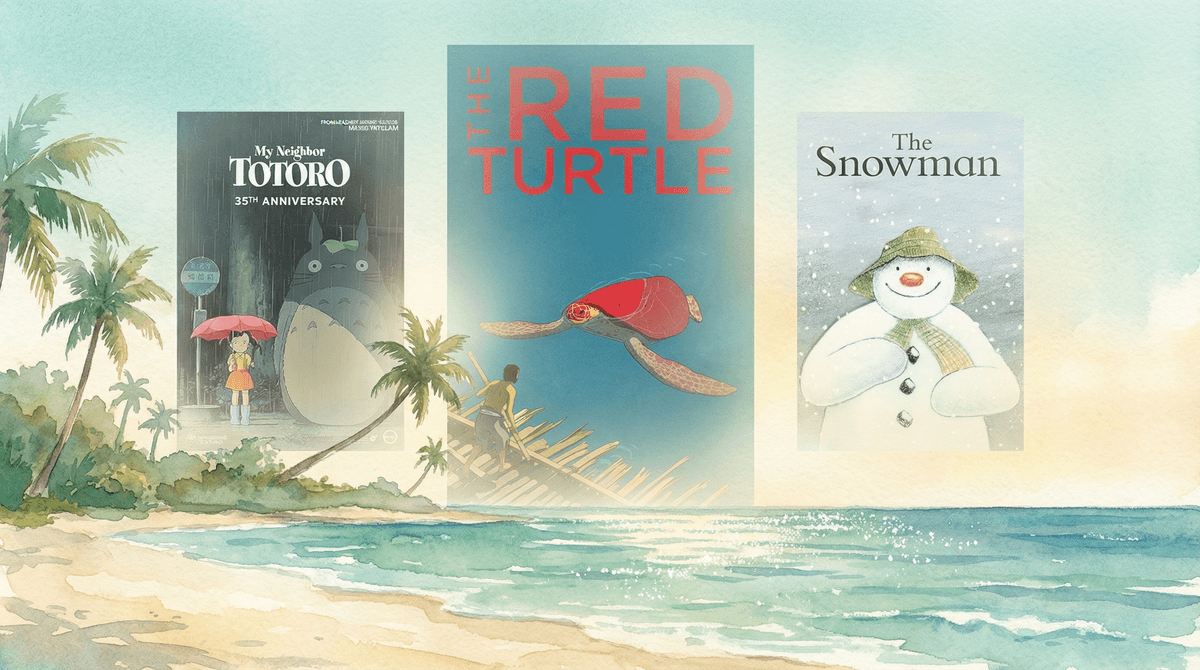
The Red Turtle is a 2016 animated film that's genuinely unlike anything else you'll find on Netflix (where about 80% of families in our community have active accounts). It's a co-production between Studio Ghibli and a European studio, and here's the wild part: there's no dialogue. Zero words. Just a man stranded on a deserted island, a mysterious red turtle, and one of the most beautiful meditations on life you'll ever watch with your kids.
The film runs about 80 minutes and tells the story of a man who washes ashore on a tropical island. Every time he tries to escape on a raft, a giant red turtle destroys it. What happens next is... well, it's magical realism that explores themes of acceptance, connection, family, and the passage of time. And somehow, without a single word, it communicates more than most movies manage with entire scripts.
It won a bunch of awards (Special Prize at Cannes, Oscar nomination) and sits at a rare 93% on Rotten Tomatoes. But more importantly, it's the kind of film that makes kids ask big questions afterward.
In a media landscape where even Bluey feels overstimulated compared to this, The Red Turtle offers something genuinely different. It's slow. It's contemplative. It trusts viewers—including young ones—to sit with ambiguity and interpret meaning for themselves.
The lack of dialogue means kids as young as 4 or 5 can follow the story visually, but the themes resonate differently depending on age. A six-year-old might see it as a story about making friends with nature. A ten-year-old might pick up on themes of loneliness and adaptation. A teenager (or adult) might find themselves thinking about it for days afterward, processing ideas about fate, acceptance, and what it means to build a life when your plans get destroyed.
It's also genuinely calming. The pacing is meditative, the hand-drawn animation is gorgeous, and the score is stunning. In our community data, 40% of families report kids regularly using streaming platforms—and if your family is in that group, this is the kind of content that feels like the opposite of "brain rot."
Ages 4-7: They'll follow the visual story and likely be captivated by the turtle, the island animals, and the ocean scenes. Some moments might feel slow, and there's one scene where the man hits the turtle that could upset sensitive viewers. The film also deals with aging and death in abstract but clear ways—you'll want to be prepared for questions.
Ages 8-12: This is probably the sweet spot. Kids this age can engage with the deeper themes while still being enchanted by the visual storytelling. They'll have opinions about what the turtle represents, why things happen the way they do, and what the ending means. Great conversation starter material .
.
Ages 13+: Teens might initially resist the slow pace (especially if they're used to YouTube or TikTok pacing), but many find it surprisingly moving. The themes of accepting what we cannot change and finding meaning in unexpected circumstances hit differently in adolescence.
Content notes: There's no violence beyond the man hitting the turtle with a stick (which he later regrets). There's brief nudity (non-sexual, in context of the story). The film deals with aging, death, and loss in ways that are sad but not traumatic. Some kids find the wordlessness unsettling at first.
The beauty of The Red Turtle is that it demands co-viewing. Not because it's scary or inappropriate, but because it's the kind of film that generates conversation. Kids will have questions—not "what happened?" questions, but "what does it mean?" questions.
Some talking points that might come up:
- Why couldn't the man leave the island?
- What was the turtle trying to tell him?
- Why did the man's life turn out differently than he planned?
- What happens at the end? (No spoilers, but it's open to interpretation)
- How can a story work without any words?
The film also offers a rare opportunity to talk about accepting disappointment and finding unexpected joy. The man's plans keep getting destroyed, but something else—something he couldn't have imagined—takes their place. That's a pretty profound message in a culture that tells kids they can be anything and do anything if they just try hard enough.
Set expectations: Let kids know beforehand that there are no words. Frame it as a special kind of movie where they get to figure out what's happening.
Watch together: This isn't background viewing. The slow pace and lack of dialogue means kids might get restless without a parent present to help them stay engaged.
Pause if needed: Especially with younger kids, it's totally fine to pause and check in. "What do you think is happening?" "How do you think he feels right now?"
Plan for post-movie conversation: This film lingers. Don't rush to the next activity. Ask open-ended questions and be prepared for some surprisingly deep responses.
Consider the timing: Maybe not right before bed if your kid is the type to process emotions at 9 PM. But also, maybe perfect for a rainy Sunday afternoon when you have time to decompress together.
The Red Turtle isn't for every family or every moment. If your kids are in a phase where they need constant action and stimulation, this might not land. But if you're looking for something that slows down, invites interpretation, and treats young viewers as capable of handling complex emotions and themes—this is exceptional.
In our community, where 40% of families report regular streaming usage, content choices matter. The Red Turtle is proof that animated films can be art, that kids can handle ambiguity, and that sometimes the most powerful stories are told without words.
It's available on most major streaming platforms, runs just over an hour, and might just surprise you with how much it gives your family to talk about.
If your family loves this, check out other Studio Ghibli films like My Neighbor Totoro or Kiki's Delivery Service. For more wordless or near-wordless storytelling, Wall-E and The Snowman offer similar experiences.
Want to explore more intentional viewing options? Find thoughtful animated films for family viewing about films that match your family's values and your kids' ages.