

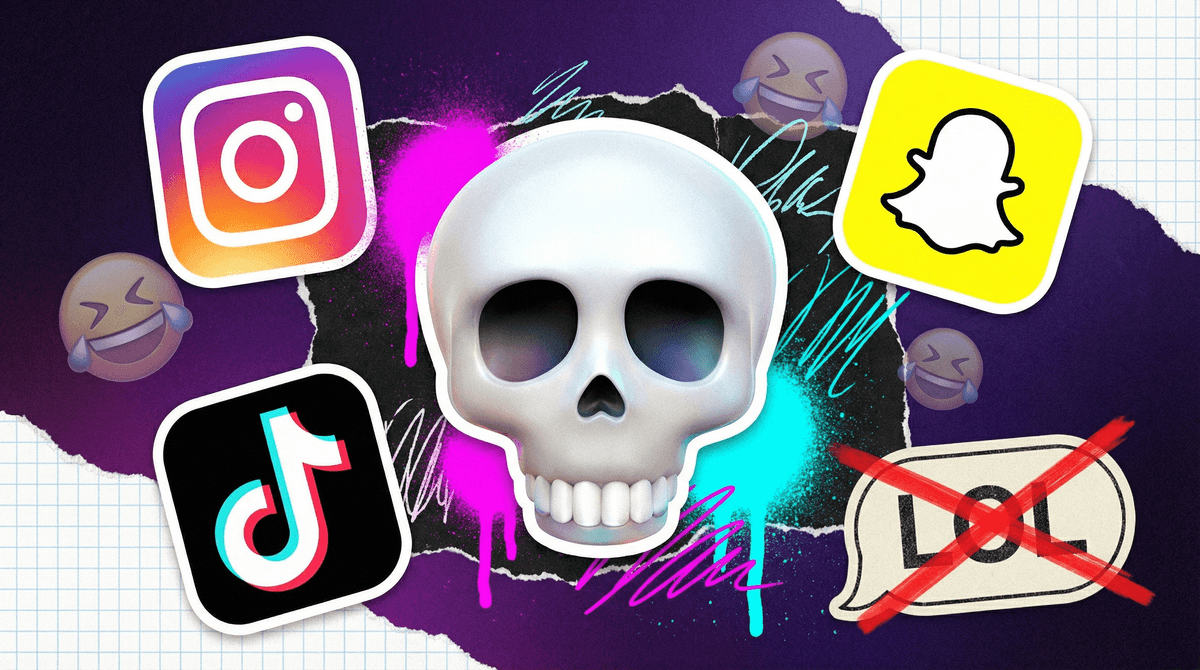
If you've glanced at your kid's texts or Instagram comments lately, you've probably seen it: 💀💀💀
And if you're like most parents, you had a brief moment of panic. Are they okay? Is someone hurt? Why are they talking about death?
Deep breath. Nobody died. Your kid just thought something was really, really funny.
The skull emoji has become Gen Z and Gen Alpha's go-to way of saying "I'm laughing so hard I'm dead" or "that killed me." It's essentially replaced "LOL" and even the crying-laughing emoji 😂 (which, by the way, is now considered deeply uncool by anyone under 18—sorry to break it to you).
When your 13-year-old sends you 💀💀💀 after you ask if they want "chicken nuggies" for dinner, they're not being morbid. They're just mortified. And amused. Mostly mortified.
Language evolves, and nowhere faster than in teen digital spaces. "LOL" became so overused it lost all meaning—people would type "lol" while staring blankly at their phone, not even smiling. The crying-laughing emoji 😂 took over for a while, but then parents started using it, which was basically its death sentence (pun intended).
Enter the skull emoji: more dramatic, more visceral, more hyperbolic. It's the digital equivalent of "I'm dying" or "I'm dead"—phrases teens have been using for years to describe something hilarious. The emoji just made it faster.
The key thing to understand: intensity matters. One skull 💀 means "that's funny." Three skulls 💀💀💀 means "I literally cannot breathe I'm laughing so hard." Five or more? Your kid just witnessed the funniest thing they've ever seen in their entire life (until tomorrow).
Here's how kids are actually using it:
Laughing at something funny:
- "bro just tripped over his own shoelaces 💀💀💀"
- "my mom called it 'the TikToks' 💀"
Secondhand embarrassment:
- "she really wore crocs to the dance 💀"
- "dad tried to dab in front of my friends I'm literally 💀"
Disbelief or shock:
- "you failed the test AGAIN? 💀"
- "he said what to the teacher??? 💀💀💀"
Self-deprecating humor:
- "forgot my own locker combination 💀"
- "wore my shirt inside out all day and nobody told me 💀💀"
Notice the pattern? It's almost always tied to humor, embarrassment, or something absurd. It's never actually about death or danger.
The disconnect makes sense. For most adults, skulls represent death, danger, or Halloween. We didn't grow up with emoji as a primary language, and the skull emoji specifically wasn't part of early emoji sets that focused on smiley faces and hearts.
But for kids who've grown up with smartphones, emojis have evolved into a sophisticated communication system with layers of meaning that shift rapidly. The skull emoji is just one example of how visual language can diverge from its literal meaning.
Think about it this way: when you say "I'm dying laughing," you're not actually concerned about your mortality. The skull emoji is the same thing—just faster to type.
This is normal digital slang. Just like you probably said "that's sick" to mean "that's cool" when you were younger (and your parents were confused), this is just the current generation's version.
It's not concerning. Unless your child is showing other signs of distress, the skull emoji is not a red flag. It's actually a sign they're fluent in current digital communication—which is honestly a useful skill.
You don't have to use it. Please, for the love of everything, don't start dropping skull emojis into your texts to try to seem cool. Your kid will find that embarrassing, and you'll probably use it wrong anyway. It's okay to let them have their own language.
Context matters. If you see 💀 in a conversation and you're genuinely concerned about the context, just ask. "Hey, I saw you used the skull emoji—what were you laughing about?" is a perfectly reasonable question that shows you're interested without being invasive.
While we're here, a few other emoji meanings that have evolved:
- 🧢 (cap): Means "lie" or "false" (as in "no capp](https://screenwiseapp.com/guides/understanding-kids-texting-culture-and-slang)" = "no lie")
- 😭 (loudly crying): Often means laughing hard, not actual sadness
- 💅 (nail polish): Sassy confidence, "I'm unbothered"
- 🤡 (clown): Calling yourself or someone else out for foolish behavior
- 👁️👄👁️: An expression of shock, confusion, or "I'm watching"
The digital language your kids speak is constantly evolving, and that's actually pretty fascinating. Learn more about how emoji language works if you want to dig deeper into this stuff.
The skull emoji is just Gen Z's way of saying something is hilarious. It's not morbid, it's not concerning, and it's not going away anytime soon.
You don't need to police it, you don't need to use it yourself, and you definitely don't need to worry about it. What you can do is see it as a window into how your kid communicates with their peers—and maybe even find it a little funny when they send you 💀💀💀 after you accidentally call Snapchat "Snappychat."
Digital communication is just another language, and your kids are native speakers. The good news? You don't have to be fluent to stay connected. You just have to stay curious, ask questions when you're confused, and remember that every generation has had their own way of saying "that's hilarious."
Now if you'll excuse me, I need to go explain to someone's dad why his son keeps commenting "Fr fr no cap" on everything. 💀
Want to understand more of what your kids are actually saying online? Screenwise can help you decode the digital world without the panic. Take our quick survey to get personalized insights about your family's digital habits in context with what's actually normal for your kid's age and community.
Because the more you understand their world, the better conversations you can have—skull emojis and all.