

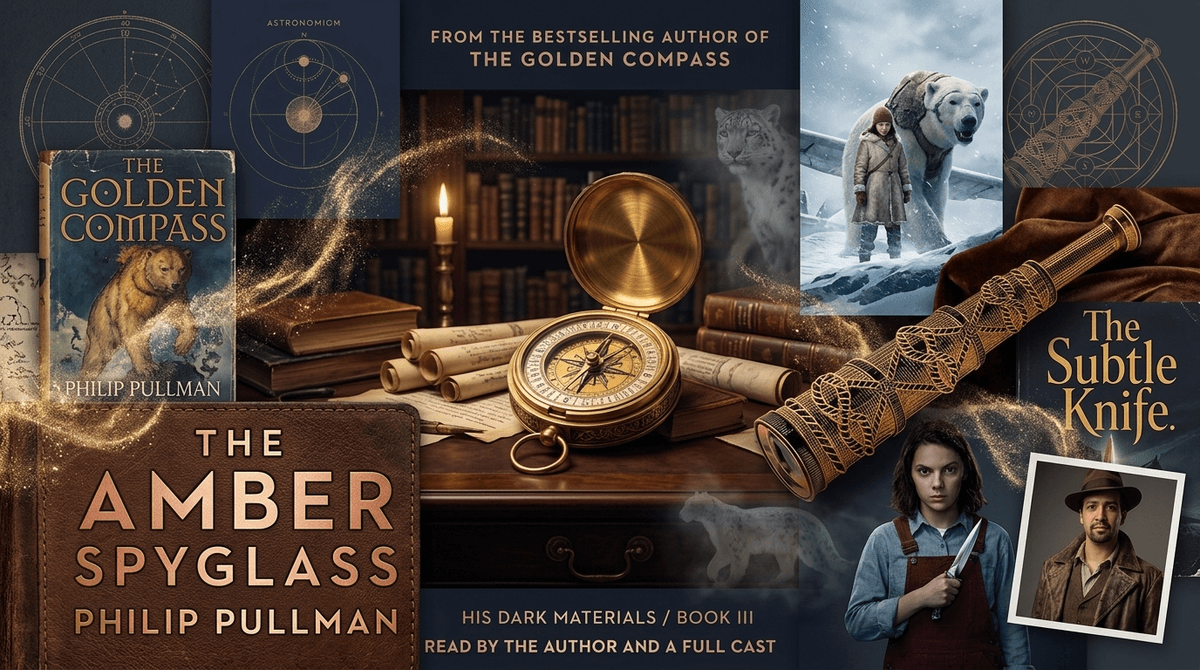
TL;DR: His Dark Materials is often called the "Anti-Narnia" because while C.S. Lewis wrote The Chronicles of Narnia as a Christian allegory, Philip Pullman wrote this series to explicitly challenge organized religion and dogma. It’s a brilliant, complex, and sometimes controversial story about two kids saving the multiverse. It’s perfect for ages 11+ but requires some "debrief" sessions at the dinner table.
Quick Links:
- The Golden Compass (Book 1)
- His Dark Materials (HBO/BBC Show)
- The Golden Compass (Movie) — Note: Most fans agree the show is way better than the movie.
- The Book of Dust (Prequel/Sequel series)
If you grew up in a house where The Chronicles of Narnia was the gold standard for fantasy, His Dark Materials might feel like a bit of a shock to the system. You’ve probably heard the whispers in parent Facebook groups or seen the old headlines from the early 2000s claiming these books are "atheism for kids."
Here’s the thing: Pullman isn’t actually trying to "delete" God. He is, however, very interested in dismantling the idea that a powerful institution (like a church) should have total control over what you think, who you love, and how you learn.
In 2026, when our kids are constantly bombarded with "fake news," algorithmic echo chambers, and massive institutions telling them what to believe, the themes in this series are more relevant than ever. But as a parent, you need to know what you’re walking into before your middle-schooler starts asking why the main characters are trying to "kill God."
At its simplest, it’s a story about Lyra Belacqua, a girl living in a parallel Oxford where everyone’s soul lives outside their body as a talking animal called a dæmon. Lyra discovers a plot by a powerful organization called the Magisterium to kidnap children and perform a horrific experiment called "intercision" (cutting the bond between a child and their dæmon).
As the story expands into The Subtle Knife and The Amber Spyglass, it becomes a multiversal epic involving armored bears, witches, physicists, and a war against "The Authority"—the first angel who claimed to be the creator of the universe.
Philip Pullman famously disliked the Narnia books. He felt that C.S. Lewis’s ending to The Last Battle was "propaganda" and that it punished characters for growing up and discovering their own identity (specifically Susan Pevensie).
In Pullman’s world:
- Original Sin is a good thing. It’s represented by "Dust," a mysterious particle that links to consciousness and maturity. The "villains" want to stop Dust from settling on people because they see it as sin; the "heroes" want to protect it because they see it as the essence of being human.
- The Church (The Magisterium) is the antagonist. They represent any institution that uses fear and dogma to suppress truth.
- Growing up is the goal. Unlike Narnia, where the kids often want to stay children in a magical land, Lyra and Will’s journey is about the necessary, painful, and beautiful transition into adulthood.
This is the part that usually worries parents. In the final book, The Amber Spyglass, characters do indeed set out to overthrow "The Authority."
However, if you watch the His Dark Materials show or read the books closely, "The Authority" isn't a benevolent, all-knowing Creator. He’s depicted as a frail, ancient angel who has become a prisoner of his own regent (Metatron). When he finally dies, it’s not a violent execution; it’s a moment of mercy. He literally dissolves into the wind because he’s too old to exist anymore.
Pullman’s argument isn't necessarily that there is no spiritual side to the universe—after all, the books are full of souls, ghosts, and angels. His argument is that no one has the right to rule over your conscience.
See the specific theological differences between Narnia and His Dark Materials
The Books (Ages 11+)
The prose is beautiful but dense. The Golden Compass starts off as a fairly standard adventure, but by book three, things get very philosophical and heavy.
- Content Concerns: Death of major characters, some mild gore (armored bears fighting), and the intense emotional weight of "intercision" (which feels like a metaphor for child abuse or soul-crushing trauma).
The HBO/BBC Show (Ages 12-13+)
The His Dark Materials show is excellent—far better than the 2007 movie. It leans harder into the "adult" side of the story. Ruth Wilson’s performance as Mrs. Coulter is terrifyingly good, but she might be a bit much for younger kids.
- Content Concerns: Rated TV-14 for some violence and scary sequences. It handles the religious themes with a bit more nuance than the books, making the Magisterium feel like a modern political thriller.
If your kid is reading these books or watching the show, don't panic. This is actually a massive opportunity to talk about critical thinking.
Here are three ways to frame the conversation:
- The "Authority" vs. Faith: Ask them, "Is the Magisterium evil because they believe in something, or because they are hurting people to stay in power?" This helps kids distinguish between personal faith and institutional corruption.
- The Meaning of the Dæmon: Kids love the idea of having a talking animal soul. Ask them, "If your soul was an animal right now, what would it be? Why does it change when you're a kid but stay the same when you're an adult?" This is a great way to talk about identity and the "settling" of one's personality.
- The Value of Knowledge: In the story, the villains want to keep people ignorant to "save" them. The heroes want to learn the truth, even if it’s dangerous. Ask, "Why would a government or a school want to stop people from reading certain books or learning certain things?"
Check out our guide on talking to kids about "dark" themes in literature
Let’s be real: If you are a very conservative family where any questioning of religious authority is a red line, you are going to hate these books. Full stop.
But if you’re an intentional parent who wants to raise kids who can navigate a world full of conflicting ideologies, His Dark Materials is a masterclass in storytelling. It’s not "brain rot" like some of the stuff on YouTube. It’s high-level literature that treats children as capable of understanding complex morality.
Yes, it’s the "Anti-Narnia," but that doesn't make it "pro-evil." It makes it a pro-human, pro-curiosity, and pro-science epic.
His Dark Materials is a "Level 3" series.
- Level 1 is Harry Potter (good vs. evil).
- Level 2 is Percy Jackson (identity and mythology).
- Level 3 is Pullman (the nature of the soul and the structure of the universe).
If your kid is ready for it, it will likely become one of their favorite series of all time. Just be ready for the questions that come with it.
- Read Book 1 together. The Golden Compass is a great "read-aloud" for 5th or 6th graders.
- Watch the show. If you’ve already read the books, the HBO series is a fantastic weekend binge for families with teens.
- Explore the "Dæmon" concept. Use it as a writing prompt or a dinner conversation starter.
Learn more about why middle schoolers are obsessed with "dark" fantasy