

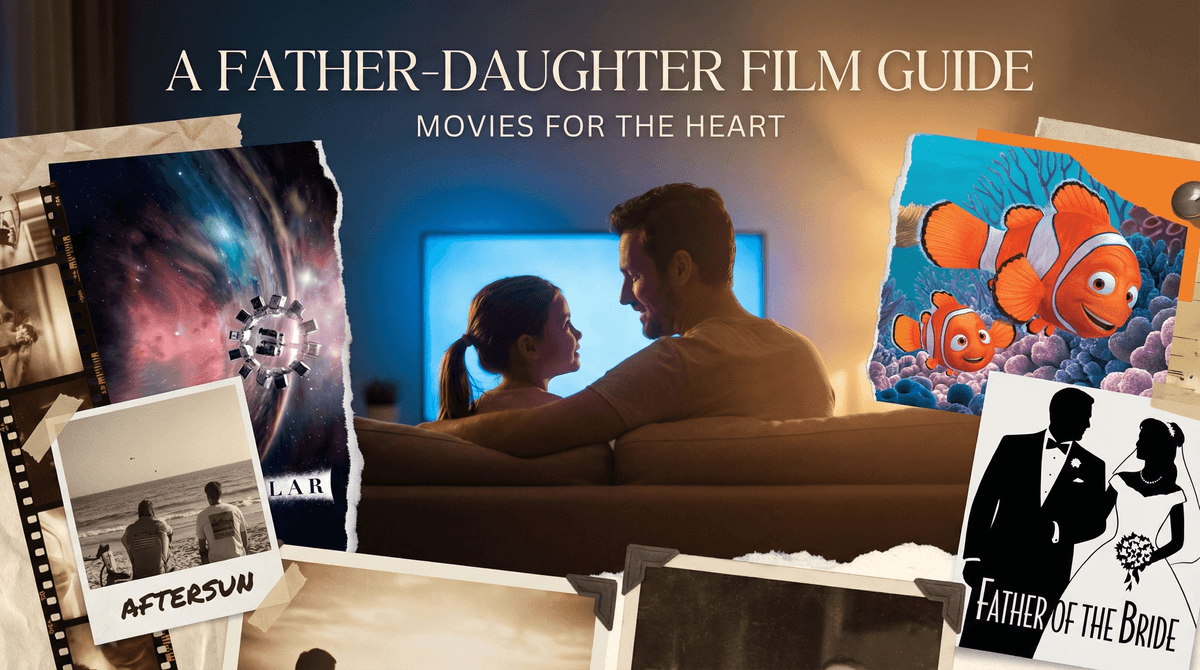
The Most Touching Father-Daughter Movies of All Time
Father-daughter relationships on screen hit different. Whether you're looking for a movie night with your tween, a film that captures the complexity of growing up, or just want a good cry after bedtime, these films nail the bittersweet, complicated, beautiful bond between dads and daughters.
Quick picks:
- For younger kids (8-11): Brave, Onward
- For tweens/teens (12+): Aftersun, The Father of the Bride
- For serious family discussion (14+): Interstellar, Eighth Grade
- For nostalgia and tears (all ages): Finding Nemo, Inside Out
There's something uniquely powerful about father-daughter stories on screen. Maybe it's because these relationships are often less explored than mother-daughter dynamics, or maybe it's because watching a dad try to understand his daughter (or vice versa) just hits that universal nerve of "we're trying our best but also completely fumbling this."
These films range from animated adventures to gut-wrenching indie dramas, but they all capture something true about the distance and closeness, the misunderstandings and moments of perfect clarity, that define these relationships.
Ages 14+ | Drama | 2022
This is the film that had everyone texting their dads after watching. Paul Mescal plays Calum, a young father on vacation with his 11-year-old daughter Sophie in Turkey. On the surface, it's a simple story about a summer holiday. But director Charlotte Wells crafts something devastating: a daughter's adult memories of a trip where she didn't fully understand what her father was going through.
Why it matters: This isn't a movie about big dramatic moments. It's about the small ways we miss each other, even when we're trying hard to connect. The film is told through Sophie's adult recollection, and that distance—between child perspective and adult understanding—is what makes it so powerful.
Parent note: This is slow, contemplative, and emotionally complex. It's also about depression and mental health, though never explicitly stated. Best for older teens who can handle ambiguity and emotional weight. Not a fun family movie night, but an incredible conversation starter about how we remember our parents and how much we don't understand as kids.
Ages 12+ | Sci-Fi Drama | 2014
Christopher Nolan's space epic is ostensibly about saving humanity, but it's really about a father (Matthew McConaughey) who leaves his daughter to try to secure her future. The scenes between Cooper and Murph—especially the gut-wrenching video messages—are some of the most emotionally devastating in sci-fi cinema.
Why it works: The film literalizes what every parent feels: time is moving too fast, you're missing too much, and the choices you make for your kid's future might mean sacrificing the present. When Cooper watches decades of his daughter's life in minutes, it's basically every parent's nightmare about time slipping away.
Watch-together value: High. The science is fascinating (even if sometimes nonsense), the visuals are stunning, and it opens up conversations about sacrifice, time, and what we owe our children versus what we owe the world. Just keep tissues handy for the bookshelf scene.
Ages 10+ | Comedy-Drama | 1991
Steve Martin's George Banks is every dad who's ever realized his little girl is grown up and he somehow missed it happening. Yes, it's a comedy about wedding planning, but it's really about a father processing the fact that his daughter doesn't need him the same way anymore.
The scene: When George breaks down remembering Annie as a little girl, talking about how she used to hold his hand crossing the street. If you're a dad of daughters, good luck making it through dry-eyed.
Modern context: Some gender dynamics feel dated (the whole "giving away" thing), but the core emotion—that bittersweet pride and loss when your kid becomes an adult—is timeless. Great for family viewing with tweens and teens, and surprisingly good at opening conversations about growing up and letting go.
Ages 7+ | Animation | 2012
Technically this is more mother-daughter, but King Fergus's relationship with Merida deserves mention. He's the dad who sees his daughter's spirit and wants to protect it, even when it conflicts with tradition and his wife's plans. The scene where he stands up for Merida's right to choose her own path? Chef's kiss.
Why kids love it: Adventure, magic, bears, archery. The mother-daughter conflict is the main plot, but Fergus represents the parent who truly sees and celebrates who their kid actually is.
Discussion starter: Great for talking about how different parents relate to kids differently, and how sometimes the parent who seems less involved actually "gets it" in important ways.
Ages 8+ | Animation | 2020
Two brothers on a quest to spend one more day with their deceased father. The twist ending—where Ian realizes the father figure he needed was his brother all along—is beautiful, but the whole film is about longing for a parent you never really knew.
The emotional punch: When Ian gives up his chance to see his dad so his brother can say goodbye properly? Absolutely wrecking. This one works for families dealing with loss, absent parents, or complex family structures.
Ages 5+ | Animation | 2003
Marlin is the helicopter parent who has to learn to let his kid take risks. The opening tragedy explains his overprotectiveness, but the whole film is about a parent learning that keeping your kid safe isn't the same as keeping them in a bubble.
Still relevant: In an age of anxious parenting and debates about free-range childhood , Nemo's message hits even harder. "Just keep swimming" has become a cultural touchstone, but "I can do it, Dad" might be the more important line.
Ages 7+ | Animation | 2015
Riley's dad is a smaller character here, but the family dynamics are pitch-perfect. The dinner table scene where both parents are trying to connect with Riley while she's shutting down? Every parent of a tween has lived that moment.
Why it's essential: This isn't specifically father-daughter, but it's the best film ever made about the emotional transition of growing up and how parents struggle to reach kids going through internal changes they can't see. Required viewing for any family with kids ages 8-14.
Ages 10+ | Comedy-Drama | 1973
Real-life father-daughter duo Ryan and Tatum O'Neal play a con man and the maybe-his-daughter kid he gets stuck with during the Depression. Their chemistry is magic, and watching them become a real family while running scams is both funny and touching.
Why it holds up: It's about found family and how parenting is sometimes just showing up and trying, even when you have no idea what you're doing. Also, Tatum O'Neal's performance is incredible—she won an Oscar at age 10 and absolutely earned it.
Ages 12+ | Western | 2010 (or 1969)
Mattie Ross isn't looking for a father figure, but her relationship with Rooster Cogburn becomes one anyway. Both versions (John Wayne's and Jeff Bridges's) capture something important: sometimes the parent-child bond forms between people who aren't related, and sometimes what a kid needs is someone who respects their competence.
For families with strong-willed daughters: Mattie is stubborn, capable, and refuses to be dismissed because she's young or female. Rooster is the adult who recognizes those qualities and works with her rather than trying to diminish her.
Ages 13+ | Drama | 2018
Bo Burnham's directorial debut is painfully accurate about middle school life, but the heart of the film is Kayla's single dad trying desperately to connect with his anxious, phone-obsessed daughter. The campfire scene where he tells her how hard it is to watch her struggle? Absolutely destroys.
Why parents need to see this: It captures the specific hell of parenting a middle schooler who's suffering but won't let you help. Mark (Josh Hamilton) is doing everything right—he's present, loving, trying—and his daughter still can't really see him because she's drowning in her own head.
Watch together? Maybe. It's rated R for language and some sexual content discussion. But for parents and their 13-14 year olds, it could be incredibly valuable. Here's more on whether Eighth Grade is appropriate for your teen.
Ages 12+ | Drama | 2018
A father with PTSD and his teenage daughter live off the grid in a Portland park until they're discovered. It's a quiet film about what happens when a parent's needs and a child's needs diverge, and when love means letting go.
The complexity: Will is not a bad father—he's loving and has taught Tom survival skills and self-reliance. But his trauma means he can't give her what she needs to grow up. The film doesn't judge him, and neither does Tom, but she has to make an impossible choice.
Discussion value: Excellent for talking about mental health, what parents owe kids versus what kids owe parents, and how love doesn't always mean staying together.
Ages 5-8: Stick with Finding Nemo, Inside Out, and Onward. These have clear emotional arcs and age-appropriate themes about family and growing up.
Ages 8-12: Add Brave, Paper Moon, Father of the Bride, and True Grit. These introduce more complex family dynamics but in accessible ways.
Ages 12-14: Interstellar works here, as does Leave No Trace. Both require some emotional maturity but offer incredible discussion opportunities about sacrifice, mental health, and growing up.
Ages 14+: Aftersun and Eighth Grade are for older teens who can handle ambiguity, complex emotions, and mature themes. These aren't feel-good movies, but they're honest and powerful.
The best father-daughter movies don't idealize the relationship. They show the misunderstandings, the gaps in communication, the ways we fail each other even when we're trying hard. But they also show the moments of connection—sometimes wordless, sometimes clumsy—that make these relationships so powerful.
What's interesting is how many of these films are about distance: physical distance in Interstellar, temporal distance in Aftersun, emotional distance in Eighth Grade. There's something about the father-daughter dynamic that lends itself to stories about trying to bridge gaps, about seeing each other across some kind of divide.
For younger kids: Pause and discuss. Animated films are great for stopping mid-movie to ask "Why do you think Marlin is so worried?" or "How do you think Riley's dad feels right now?"
For tweens: Watch first, talk after. Give them space to process, then ask open-ended questions. "What did you think about..." works better than "The message of this film is..."
For teens: Consider watching separately first, especially the heavy ones like Aftersun. Then you can have a more equal conversation about it, rather than watching their reactions or worrying about whether they're "getting it."
For yourself: Sometimes you need to watch these alone first, especially if you're a dad. Interstellar and Father of the Bride hit different when you're not trying to hide tears from your kids.
Father-daughter movies work because they capture something universally true: these relationships are complicated, full of misunderstandings and missed connections, but also moments of perfect clarity and love. Whether you're watching an animated adventure about overprotective fish or a devastating indie drama about memory and loss, these films remind us that the parent-child bond is always a work in progress.
The best ones don't offer easy answers. They show parents trying their best and sometimes failing. They show daughters who love their dads but also need to become their own people. They show that sometimes the most loving thing you can do is let go, and sometimes it's holding on when everything tells you to give up.
Start here: If you've never explored this genre, begin with Inside Out (it's technically mother-father-daughter, but it's perfect). Then move to Interstellar if your kids are old enough, or Finding Nemo if they're younger. Save Aftersun for when you're ready to have your heart broken in the most beautiful way possible.
And maybe keep your phone handy to text your dad after. These movies have a way of doing that.