

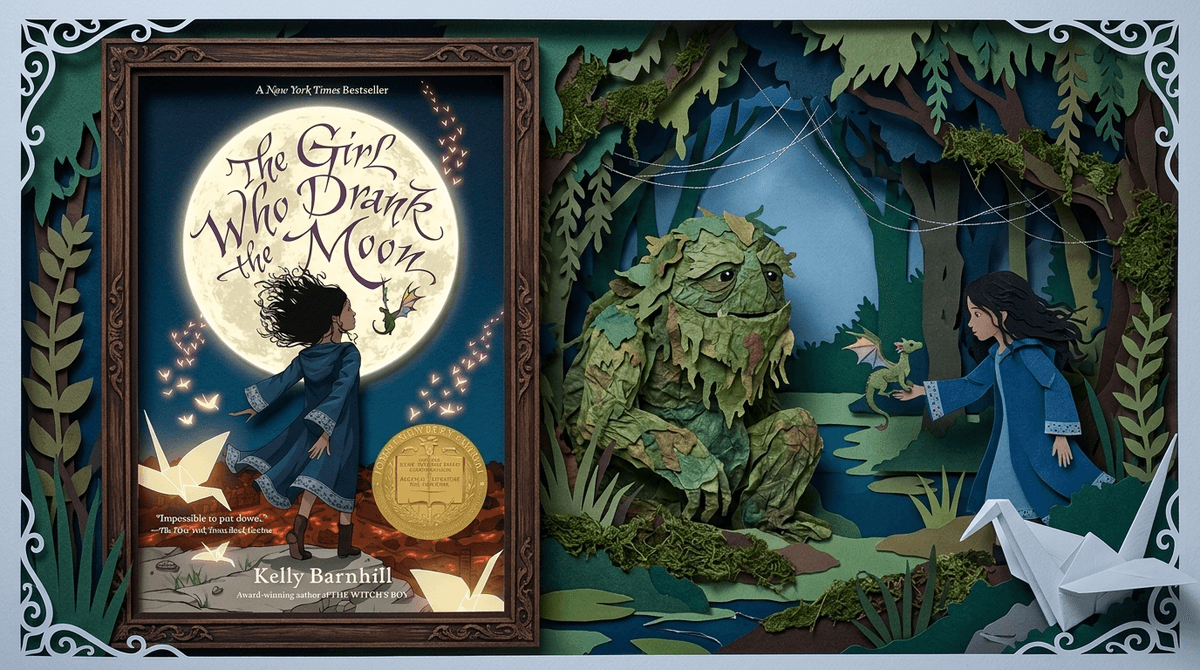
TL;DR: The Girl Who Drank the Moon is a rare "instant classic" that actually lives up to the Newbery Medal on its cover. It’s a lyrical, high-fantasy story about a baby accidentally infused with moonlight, a kind witch, a Swamp Monster who loves poetry, and a Perfectly Tiny Dragon. It’s perfect for kids ages 9-12 who are starting to realize that the world isn't just black and white, and that the "monsters" we’re told to fear are often just people we haven't met yet.
Check out our full list of best fantasy books for middle schoolers
Every year, the people of the Protectorate leave a baby in the woods as an offering to a "Witch" they believe will otherwise destroy them. It’s a somber, controlled society built on "The Sorrow"—a collective grief that the Elders use to keep everyone in line.
But here’s the twist: the Witch, Xan, is actually lovely. She rescues the babies, feeds them starlight, and delivers them to happy families on the other side of the forest. Except one year, Xan accidentally feeds a baby moonlight instead of starlight. Moonlight is pure magic, and it makes the baby, Luna, "enmagicked." Xan decides she has to raise Luna herself, alongside Glerk (the ancient Swamp Monster) and Fyrian (a dragon who thinks he’s giant but is actually the size of a kitten).
As Luna approaches her 13th birthday, her magic starts to leak out in unpredictable ways. At the same time, the Protectorate is starting to question the "Sacrifice," and a young man named Antain decides to go into the woods to kill the Witch and end the cycle of sorrow.
This isn't a fast-paced, "action-every-five-seconds" kind of book like Wings of Fire or Percy Jackson. It’s slower, more atmospheric, and deeply emotional.
The Magic System: Magic in this book isn't about spells or wands; it’s about wonder and memory. Kids who feel "too big" for their own skin—which is basically every 11-year-old—will find Luna’s struggle to contain her magic deeply relatable.
The Creatures: Fyrian the dragon provides much-needed comic relief. He is convinced he is a "Simply Enormous Dragon," and his relationship with the stoic, poetic Glerk is one of the best "odd couple" dynamics in middle-grade fiction.
The Mystery: There’s a genuine "whodunnit" element regarding the origins of the Protectorate and the identity of the "Sorrow Eater." It keeps the pages turning even when the prose gets a bit flowery.

In a digital age where kids are bombarded with 15-second TikToks and dopamine-heavy games like Roblox, a book like this is a brain-reset. It requires focus, empathy, and the ability to sit with complex feelings.
Kelly Barnhill uses fantasy to tackle some heavy-duty real-world concepts:
- Gaslighting and Control: The Elders in the Protectorate stay in power by making people afraid and sad. It’s a great entry point for talking about how information (or misinformation) is used to control people.
- The Metaphor of Puberty: Luna’s magic "exploding" out of her is a beautiful, if slightly chaotic, metaphor for the hormone-fueled changes kids experience in middle school.
- Grief as a Tool: The book explores how we can either let grief define us or process it to find hope.
Recommended Age: 9-12
While the writing is accessible, the themes are sophisticated.
- 9-10 Year Olds: They will love the dragon, the magic, and the adventure. They might need a little help keeping track of the multiple perspectives (Xan, Luna, Antain, and the mad mother in the tower).
- 11-12 Year Olds: This is the "sweet spot." They’ll pick up on the political allegories and the deeper emotional resonance of Luna growing up and Xan growing old.
- Content Warnings: There is some thematic heaviness. A mother is forcibly separated from her baby in the beginning, and she is locked in a tower where she slowly loses her mind (though she gains magic). There is also a "Sorrow Eater" who feeds on the misery of others. It’s not "scary" in a horror sense, but it is emotionally intense.
If your kid loved the vibe of The Girl Who Drank the Moon, they should check these out:
Similar "found family" vibes in the wilderness. It’s a bit more accessible for younger readers but carries the same emotional weight.
This has that same "timeless fairy tale" feel, drawing on Chinese folklore. It’s visually stunning (even the black and white interior art) and deals with themes of gratitude and fate.
If they liked the "interweaving stories" aspect and the lyrical writing, this is a must-read. It’s historical fiction with a thread of magic running through it.
For the classic "high fantasy with a moral core" feel. Xan’s sacrifice and the world-building definitely owe a debt to C.S. Lewis.
This book is not "brain rot." It’s the opposite. It’s "brain fertilizer."
However, be prepared: it’s a bit of a tear-jerker. The relationship between Xan (the grandmother figure) and Luna is beautiful, but it deals with the reality of aging and the passing of the torch from one generation to the next. If your family has recently dealt with the loss of a grandparent or a major life transition, this book might hit close to home.
A note on the prose: Kelly Barnhill writes like a poet. Sometimes, she’ll spend two pages describing how the moonlight feels on a character's skin. If your kid is a "just give me the plot" reader who loves Diary of a Wimpy Kid, they might find this "boring" or "too slow." That’s okay! Not every book is for every kid. But for the dreamer, the artist, or the kid who feels everything deeply, this will be their favorite book of the year.
If you’re reading this alongside your child (which I highly recommend—it’s a great read-aloud), here are some conversation starters:
- The Elders say "Sorrow is dangerous," but Xan thinks it’s just part of being human. Who do you think is right?
- Why does the Protectorate believe the Witch is evil without ever having met her? Does that happen in real life?
- If you could "drink" moonlight or starlight, which would you choose and what magic would you want it to give you?
- Xan loses her memories to keep Luna safe. Do you think that was a fair trade?
The Girl Who Drank the Moon is a 5-star read. It’s sophisticated, beautifully written, and respects the intelligence of its young audience. In a world of "disposable" media, this is a story that sticks to your ribs. It’s about the fact that stories have power—to trap us in fear or to set us free.
Next Steps:
- Check your local library or Libby app for the audiobook—it’s narrated wonderfully and makes the lyrical prose really sing.
- If your kid finishes it and wants more, look into Barnhill’s other work, like The Ogress and the Orphans.
- Take 20 minutes to talk about the "Sorrow Eater" and how we handle big feelings in our own house. It’s a great way to sneak in some emotional intelligence training without it feeling like a "lesson."