

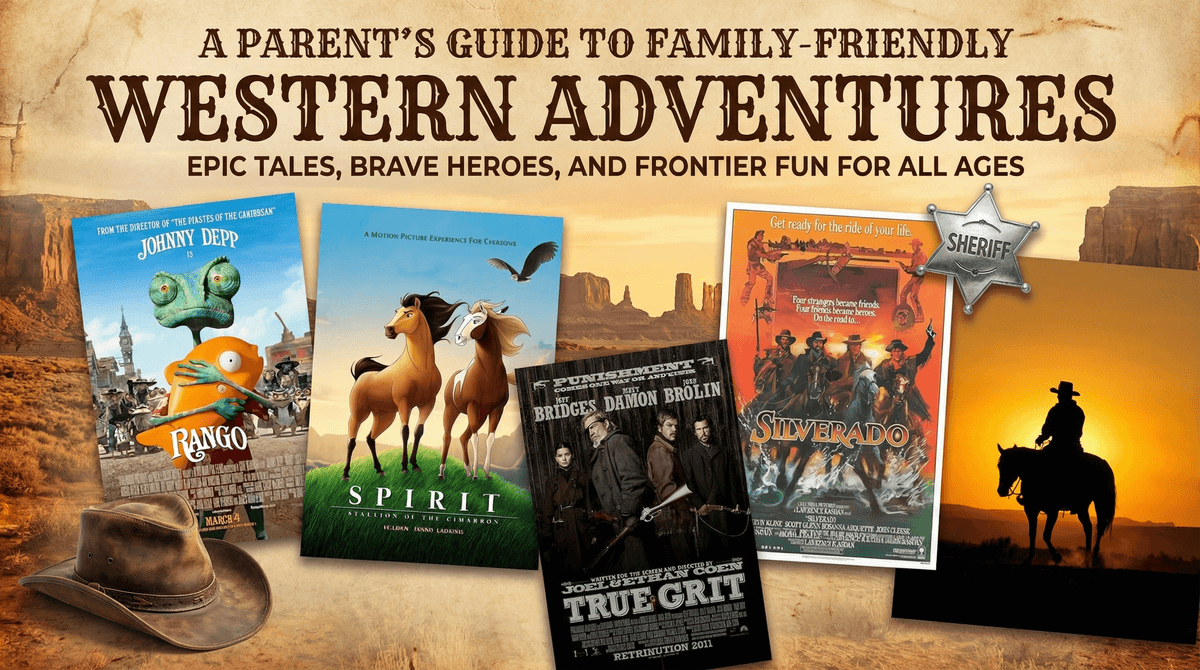
TL;DR: The Best Family Westerns
Looking for Westerns that won't have you diving for the remote during the violent bits? Here are the top picks that deliver adventure, heart, and those sweeping landscapes without the blood-soaked saloon floors:
Animated & Kid-Friendly:
- Rango (Ages 8+)
- Spirit: Stallion of the Cimarron (Ages 6+)
- An American Tail: Fievel Goes West (Ages 5+)
Classic Live-Action:
- True Grit (2010) (Ages 12+)
- The Man from Snowy River (Ages 8+)
- Silverado (Ages 10+)
Modern Takes:
- The Ballad of Buster Scruggs (Ages 14+ for select stories)
- The Ridiculous 6 (Ages 10+, if you can handle Adam Sandler)
Westerns are having a weird cultural moment right now. Your kids are probably hearing references to cowboys in everything from Fortnite skins to TikTok sounds, but most classic Westerns are... not exactly family viewing. Between the casual violence, outdated portrayals of Native Americans, and enough tobacco smoke to give an entire town emphysema, the genre can feel like a minefield.
But here's the thing: Westerns at their core tell stories about courage, frontier justice, chosen families, and finding your place in a vast, unforgiving landscape. Those are themes worth exploring with kids. You just need to find the ones that deliver the dusty boots and moral dilemmas without the problematic content that'll have you pausing every five minutes to provide historical context.
Before we dive into specific recommendations, let's talk about why Westerns are worth your time at all. The genre teaches visual storytelling in ways modern CGI-heavy films often don't. Wide shots of Monument Valley, the tension of a showdown, the symbolism of a white hat versus a black hat—these are filmmaking fundamentals that help kids understand how movies communicate meaning.
Plus, Westerns deal with moral complexity in accessible ways. The best ones ask: What does it mean to be brave? When is violence justified? How do communities form in harsh environments? These aren't just cowboy questions—they're human questions your kids are already grappling with in their own lives.
Ages 8+
This Johnny Depp-voiced chameleon movie is genuinely brilliant. Directed by Gore Verbinski (who made the Pirates of the Caribbean films), Rango is a love letter to classic Westerns that works on multiple levels. Kids get a funny story about an identity-confused lizard who becomes a reluctant hero. Adults get references to Chinatown, High Noon, and The Good, the Bad and the Ugly.
The animation is stunning—none of that glossy Pixar sheen, but rather a dusty, lived-in world that feels authentically Western. There's some mild peril and a few intense moments (a hawk attack scene that's legitimately scary), but nothing gratuitous. The humor is smart without being condescending, and the themes about finding courage when you're terrified? Chef's kiss.
What to know: Some darker moments and existential themes that might go over younger kids' heads. The snake villain is properly menacing. But this is the Western I'd show first to get kids interested in the genre.
Ages 6+
DreamWorks' 2002 film about a wild mustang resisting domestication is basically a Western from the horse's perspective. Matt Damon narrates Spirit's internal thoughts, but the horse doesn't actually talk, which gives the film a unique feel—more visual storytelling, less quippy dialogue.
The soundtrack by Bryan Adams is... a choice. Your kids will either love it or you'll be hearing "Get off my back" in your nightmares. But the animation of the American West is gorgeous, and the themes about freedom, friendship, and cultural respect (Spirit befriends a Lakota young man) are handled with more care than most classic Westerns ever managed.
What to know: Some intense scenes of horses in danger and cavalry violence, but nothing graphic. The Native American portrayal, while not perfect, is far more respectful than most Western media. Good entry point for younger elementary kids.
Ages 5+
The 1991 sequel to An American Tail transplants the Mousekewitz family to the Wild West, where Fievel dreams of becoming a lawman like his hero, Sheriff Wylie Burp (voiced by James Stewart in his final film role). It's gentler than the first film, with more humor and less of the heavy immigration themes.
The villain (a cat named Cat R. Waul, because puns) is deliciously over-the-top, and the music is catchy without being annoying. It's a solid introduction to Western tropes for the youngest viewers—the showdown, the frontier town, the idea of the West as a place of reinvention.
What to know: Very mild peril. Some sad moments but nothing traumatic. The animation hasn't aged as well as some other '90s films, but the story holds up.
Ages 12+
The Coen Brothers' remake of the John Wayne classic is the rare Western that centers a teenage girl's perspective. Hailee Steinfeld plays Mattie Ross, a 14-year-old who hires a U.S. Marshal (Jeff Bridges) to track down her father's killer. She's tough, smart, and doesn't take crap from anyone—a fantastic protagonist for middle schoolers.
The film is violent (it's about hunting a murderer, after all), but the violence isn't glorified. It's presented as brutal and consequential. The dialogue is period-appropriate and beautifully written, full of formal 19th-century speech patterns that feel authentic without being inaccessible.
What to know: Definitely the most intense film on this list. There's shooting, hanging, and some graphic injury scenes. But the moral center is strong—this is about justice, not revenge. Watch it with your kid and be ready to talk about the difference. Also, the ending has consequences that matter, which is refreshing.
Ages 8+
This 1982 Australian film is technically a Western (or "Eastern," as some call Australian frontier films), and it's a near-perfect family adventure. A young man must prove himself by capturing wild horses in the mountains, navigating class differences, and winning over the girl's disapproving father.
The famous downhill chase scene—where the protagonist rides his horse down an impossibly steep mountain—is absolutely breathtaking. No CGI, just incredible horsemanship and cinematography. The film has all the Western themes (proving yourself, man versus nature, finding your place) without the gunfights and saloon brawls.
What to know: Very mild content. Some tension and danger, but nothing scary. The Australian setting gives it a fresh feel while maintaining Western storytelling traditions. The score is sweeping and memorable. This is the film for horse-obsessed kids.
Ages 10+
Lawrence Kasdan's 1985 love letter to classic Westerns is pure fun. It's got an ensemble cast (Kevin Kline, Scott Glenn, Kevin Costner, Danny Glover), plenty of action, humor, and a straightforward good-versus-corrupt-sheriff plot. It feels like the Westerns of the '50s and '60s but with better pacing and more diverse casting.
The film doesn't reinvent the wheel—it just makes a really good wheel. Every Western trope is here: the showdown, the corrupt town, the unlikely heroes, the damsel who doesn't need that much rescuing. It's comfort food in Western form.
What to know: There's shooting and some deaths, but it's all very classic Western—people fall down, not much blood. The violence is more adventure-movie than graphic. Some mild language. The tone is lighter than True Grit but still has stakes.
Ages 14+ (select stories)
The Coen Brothers' Netflix anthology film has six Western stories of varying darkness. Here's the thing: the first story, starring Tim Blake Nelson as a singing gunslinger, is delightful and relatively family-friendly. It's funny, musical, and while there's violence, it's cartoonish.
The other stories? Significantly darker. Some are meditations on death, futility, and the cruelty of frontier life. But if you want to watch just the first segment with your older kids, it's a brilliant 20-minute short film that captures the absurdity and morality of Western myths.
What to know: Watch the first story, skip the rest until your kids are older teens. The tone shifts dramatically between segments. Some stories are genuinely bleak. But that first one? Gold.
Ages 10+
Look, I'm not going to pretend this Adam Sandler Netflix comedy is high art. It's not. It's juvenile, absurd, and full of Sandler's usual crew doing Sandler things. But if your kids like silly humor and you can handle some gross-out jokes, it's a surprisingly watchable Western parody.
The film was controversial for its portrayal of Native Americans (several Native actors walked off set), which is worth discussing with your kids. But it also features a diverse cast of heroes and pokes fun at Western tropes in ways that might help kids think critically about the genre.
What to know: Crude humor, some violence played for laughs, stereotypical characters. This isn't the Western to show kids to teach them about the genre—it's the one to watch after they understand what's being parodied. Consider it optional, and maybe read up on the controversy first.
You might be wondering: "What about The Searchers? High Noon? Shane? The actual classic Westerns?"
Here's the honest truth: most classic Westerns have content that requires significant context for modern kids. The portrayal of Native Americans ranges from absent to actively harmful. The gender roles are... of their time. The violence, while less graphic than modern films, is often more casual and consequence-free.
That doesn't mean you can't watch them—just that you need to be ready for conversations. If your teen is studying film history or you want to explore the genre's evolution, films like The Searchers or The Wild Bunch are important cultural artifacts. But they're homework, not popcorn entertainment.
For younger kids, stick with the films on this list. They capture what makes Westerns compelling without the baggage that'll have you explaining why everyone's being casually racist for two hours.
Ages 5-7:
- An American Tail: Fievel Goes West
- Spirit: Stallion of the Cimarron (with parent for intense scenes)
Ages 8-11:
- Rango
- The Man from Snowy River
- Silverado (for older end of range)
- The Ridiculous 6 (if your family tolerates crude humor)
Ages 12+:
- True Grit (2010)
- The Ballad of Buster Scruggs (first story)
- Any of the above, plus you can start introducing classic Westerns with discussion
Westerns are great for developing media literacy. Here are conversation starters:
Visual storytelling: "Notice how the camera shows us how small the people are compared to the landscape? What does that tell us about the story?"
Moral complexity: "The hero just shot someone. Was that the right choice? What else could they have done?"
Historical accuracy: "This is a movie about the Old West. What do you think is real and what's exaggerated?" (Spoiler: most of it is exaggerated. The real West was less shootouts, more dysentery.)
Representation: "Who's missing from this story? Whose perspective aren't we seeing?" This is especially important for older films.
Westerns teach kids about a genre that influenced everything from Star Wars (it's basically a space Western) to The Mandalorian (literally a space Western). Understanding Western tropes helps kids decode storytelling across media.
Start with the animated options for younger kids, graduate to The Man from Snowy River and Silverado for middle elementary, and save True Grit for when they're ready for more complex moral questions. Skip the classic Westerns until they're old enough to understand historical context—or you're ready to provide it.
The West might be wild, but with the right films, it doesn't have to be inappropriate. Now saddle up and find out if your kid is more of a Rango or a Mattie Ross. My money's on Rango—that chameleon is hilarious.
Want more family movie recommendations? Check out our guides on adventure movies for kids, historical films that don't bore kids to tears, or how to talk to kids about violence in media. And if your kids get obsessed with horses after Spirit, here's a guide to horse-themed games and apps that won't drain your bank account like actual riding lessons.