

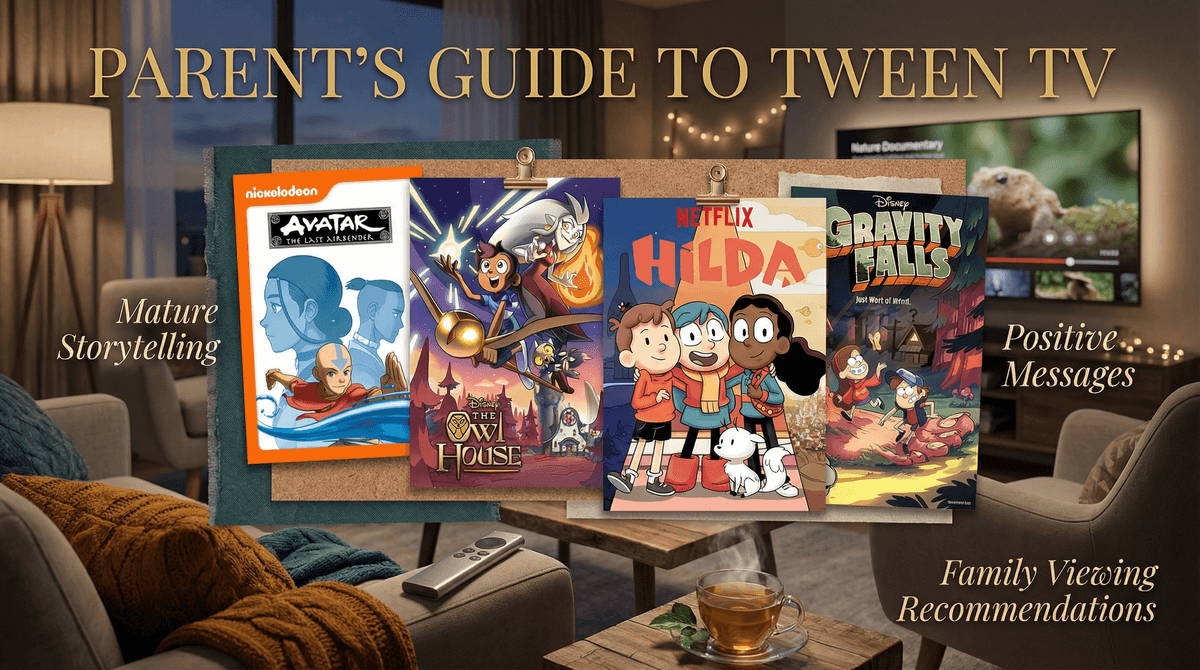
The Best TV Shows for Tweens in 2026
TL;DR: The sweet spot for tween TV is harder to find than you'd think. Too young feels babyish, too old ventures into territory they're not ready for. Here are shows that actually respect where 9-12 year olds are developmentally while still being genuinely entertaining:
Top picks: Avatar: The Last Airbender (Netflix), The Owl House (Disney+), Hilda (Netflix), Gravity Falls (Disney+), and The Dragon Prince (Netflix).
Tweens are in this weird in-between stage where Bluey feels too young but Stranger Things feels too intense (despite what they tell you). They're developing their own taste, forming opinions about storytelling, and honestly? They can tell when something is talking down to them.
The good news: there's actually a golden age of tween content happening right now, especially in animation. The bad news: it's scattered across every streaming platform, and the autoplay algorithm would rather serve up YouTube compilations of "funniest moments" than actual quality shows.
Before we get to the list, let's talk about what actually works for this age group. The best tween shows:
- Respect their intelligence without exposing them to content they're not ready for
- Feature characters solving real problems (not just manufactured sitcom drama)
- Have actual story arcs that reward paying attention
- Don't rely on mean humor or putting characters down for laughs
- Show diverse ways of being without making it an after-school special
Basically, shows that would hold up if you watched them too. Because let's be real, you're probably going to be in the room.
Ages 8-13 | Netflix
If you haven't watched this yet, stop reading and go start it. This is the gold standard for tween television. A 12-year-old boy discovers he's the Avatar (master of all four elements) and needs to save the world while also just being a kid who misses his home and doesn't want all this responsibility.
The show tackles war, loss, responsibility, and growing up without ever feeling heavy-handed. The humor lands, the action sequences are genuinely exciting, and the character development is better than most adult dramas. Plus, it's fully complete (3 seasons), so no cliffhangers or cancellations.
Parent note: There's some intense moments around war and loss, but it's handled thoughtfully. This is a show about a war, but it's not graphic.
Ages 9-14 | Disney+
A teenage girl stumbles into a magical realm and decides to become a witch instead of going to the conformity camp her mom signed her up for. It's funny, weird, and surprisingly emotional.
What makes this special: the main character Luz is neurodivergent-coded (though never explicitly stated), and the show celebrates her "weirdness" as a strength. Also features one of the most natural LGBTQ+ relationships in kids' media - it's just part of the story, not THE story.
The show got cut short by Disney (only 3 seasons instead of the planned more), but the creators wrapped it up well. Some genuinely scary moments in later episodes, but nothing gratuitous.
Ages 7-12 | Netflix
A blue-haired girl moves from the wilderness to the city and has adventures with trolls, elves, and other Scandinavian folklore creatures. It's cozy, beautiful, and surprisingly deep about friendship, anxiety, and finding your place.
This is perfect for tweens who aren't ready for high-stakes drama but have aged out of preschool shows. The art style is gorgeous (based on a graphic novel series), and there's something deeply calming about watching it. Great for anxious kids.
Ages 9-14 | Disney+
Twins spend the summer with their weird great-uncle and discover their small town is full of supernatural mysteries. This show is genuinely funny for both kids and adults, has an overarching mystery that rewards attention, and treats its characters with respect.
Fair warning: some episodes are legitimately creepy. Not nightmare-inducing for most tweens, but if your kid is particularly sensitive to scary content, watch a few episodes first. The show also deals with family dysfunction in realistic ways - the twins' parents are going through a rough patch, which is why they're away for the summer.
Ages 10-15 | Netflix
From one of the creators of Avatar: The Last Airbender, this fantasy epic follows two princes and an elf assassin trying to prevent a war. It's got the same thoughtful approach to conflict, war, and morality as Avatar, with gorgeous animation and genuinely compelling characters.
The show features a deaf general who communicates through sign language (voiced by a deaf actor), a king with a visible disability, and deals with themes of prejudice and cycles of violence in age-appropriate ways. Gets more intense in later seasons.
Let's be honest: most live-action tween shows are either cringey Disney Channel fare or they're actually teen shows marketed to tweens. But there are a few gems:
Ages 8-13 | Disney+
Four gifted orphans are recruited to go undercover at a mysterious institute. It's like a tween spy thriller meets Wes Anderson aesthetic. The show celebrates intelligence and different kinds of smart - one kid is book-smart, another has a photographic memory, one is street-smart, and one has emotional intelligence.
Based on a beloved book series, and the show actually captures the spirit of the books. Deals with themes of belonging, found family, and standing up to authoritarianism (the villain is literally using media to control people's minds, which is... relevant).
Ages 8-12 | Apple TV+
A ghost haunts a bookstore and communicates by rearranging letters, and a group of kids have to solve literary mysteries. Each arc focuses on a different book or story that's come to life - Alice in Wonderland, Frankenstein, etc.
This is genuinely clever and gets kids interested in classic stories without being educational in that heavy-handed way. The diverse cast feels natural, and the mysteries are actually engaging.
Ages 8+ | Netflix
Okay, hear me out. This baking competition show where amateur bakers try (and hilariously fail) to recreate professional cakes is actually perfect for tweens. Why? Because it celebrates failing, trying anyway, and laughing at yourself. The host Nicole Byer is genuinely funny, and there's something refreshing about a competition show where being bad at something is the whole point.
It's also a great family watch - no one is mean, everyone is supportive, and you'll probably want to try baking something together afterward.
Ages 12-14 | Netflix
This one is borderline - it's really more for older tweens and teens. Set in Northern Ireland during The Troubles (1990s), it follows a group of teenage girls navigating high school, friendship, and growing up against the backdrop of political conflict.
There's some language (not excessive but definitely present) and mature themes, but it's genuinely hilarious and surprisingly educational about a period of history most American kids know nothing about. The characters are self-absorbed teenagers who slowly realize the world is bigger than their problems. Watch a few episodes yourself first before deciding if it's right for your kid.
Let's address the elephant in the room: your tween probably wants to watch YouTube more than any of these shows. That's fine! YouTube isn't the enemy. But if you're trying to balance their media diet, these shows offer something YouTube often doesn't: complete narratives with beginning, middle, and end, character development, and stories that build on themselves.
That said, there are some great YouTube channels for this age group. Check out our guide to educational YouTube channels for tweens if you want to meet them halfway.
For 9-10 year olds: Start with Hilda, The Mysterious Benedict Society, or early seasons of Avatar: The Last Airbender. These have stakes and real emotion without being too intense.
For 11-12 year olds: They can handle most of these, but gauge their sensitivity to scary content before diving into Gravity Falls or later seasons of The Owl House. The Dragon Prince gets more intense as it goes, so you might want to watch ahead.
For mature 12-13 year olds: Derry Girls might work if they can handle some language and your family is comfortable with the content. Watch it first yourself.
The "just one more episode" factor is real: These shows are designed with binge-watching in mind. Unlike the episodic shows we grew up with, many of these have season-long arcs that end on cliffhangers. This is great for teaching delayed gratification ("we'll watch the next episode tomorrow") but requires you to actually enforce boundaries.
Animation isn't just for little kids: If your tween is resisting animation because they think it's "for babies," watch an episode of Avatar or The Owl House with them. The storytelling in these shows is often more sophisticated than live-action tween content.
These shows deal with real themes: Loss, war, prejudice, identity, belonging - these aren't light topics. But they're handled in age-appropriate ways that can actually open up great conversations. Don't be surprised if your kid wants to talk about what they're watching.
Representation matters, but it's not everything: Many of these shows feature diverse characters, LGBTQ+ relationships, and different family structures. This is just reality reflected on screen. If this is new territory for your family, here's how to talk about LGBTQ+ content in kids' media .
.
The tween years are when kids start developing their own taste in media, and that's actually a good thing. These shows offer entry points into more complex storytelling without the content concerns of teen/adult shows.
Your goal isn't to find the "perfect" show - it's to find shows that are entertaining enough that they'll actually watch them instead of doomscrolling through TikTok or YouTube shorts. These shows all have actual plots, character development, and themes worth discussing.
Next steps:
- Pick one show from this list and watch the first episode together
- Let your tween choose what sounds interesting to them (autonomy matters)
- Set clear boundaries about how many episodes per sitting
- Actually watch with them sometimes - these shows are good enough that you won't be bored
- Use what they're watching as conversation starters about bigger themes
And if they still want to watch Roblox YouTube compilations after? That's fine too. Balance, not perfection.