

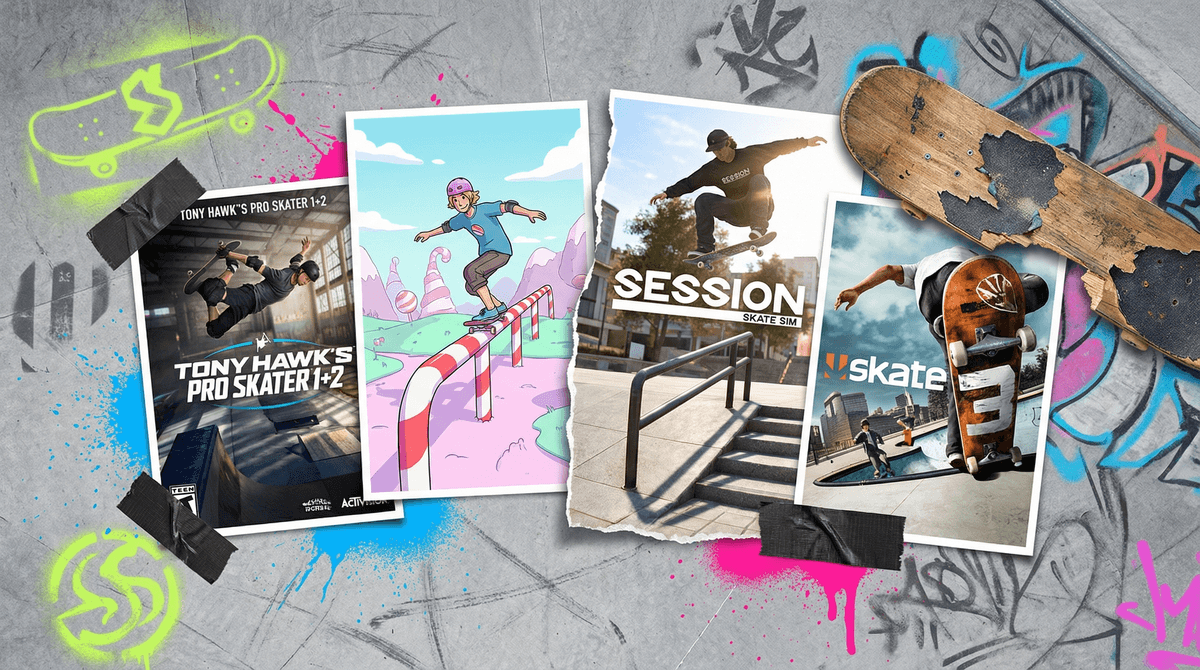
The Best Skateboard Video Games to Play Now: A Parent's Guide
TL;DR: Skateboard games range from realistic sims that teach actual trick names to chaotic arcade experiences where physics is just a suggestion. Tony Hawk's Pro Skater 1+2 is the gold standard for ages 10+, OlliOlli World works great for younger kids (7+), and Skate 3 appeals to teens who want something more grounded. If your kid just wants to mess around, Session: Skate Sim or the new Skater XL offer deep customization but steeper learning curves.
Skateboard games hit different than other sports games. They're not about winning championships or managing rosters—they're about flow state, creativity, and that dopamine hit when you finally land a combo you've been attempting for twenty minutes.
For kids, these games can actually teach persistence, spatial reasoning, and even some real skateboarding vocabulary (your 8-year-old will definitely start saying "kickflip" and "50-50 grind" at dinner). The question isn't whether skateboard games are worth playing—it's which ones match your kid's age, skill level, and tolerance for frustration.
Before we dive into specific titles, here's what separates the great ones from the forgettable:
Control scheme matters more than you'd think. Some games use simple button combos (press X to ollie, press square + direction for tricks). Others use the analog sticks to mimic actual foot movements on a board. The stick-based controls feel more "realistic" but have a brutal learning curve that will frustrate younger kids.
Tone and aesthetic vary wildly. You've got everything from cartoon-style games with talking animals to gritty street skating with realistic bail physics. Some have punk rock soundtracks and graffiti aesthetics; others feel like extreme sports documentaries.
Online features and community. Many modern skate games include online parks where players can skate together, share custom parks, or compete. This can be great for creativity but requires the usual online safety conversations.
Ages 10+ | Available on: PlayStation, Xbox, Nintendo Switch, PC
This 2020 remake is essentially a masterclass in how to update a classic. It takes the original 1999-2000 games that defined the genre and rebuilds them with modern graphics while keeping the arcade-style gameplay that made them legendary.
Why it works: The controls are intuitive enough that kids can start pulling off tricks within minutes, but the skill ceiling is high enough to keep them engaged for months. The two-minute timed runs create natural stopping points (helpful for "just one more turn" negotiations). The soundtrack is genuinely great—a mix of the original punk/hip-hop tracks plus new additions.
Parent heads-up: The game includes some mild language in songs (you can turn off explicit tracks in settings) and the skaters occasionally bail hard, but it's cartoonish rather than graphic. There's a robust online multiplayer mode where kids can compete or free skate together—standard online safety rules apply.
The real benefit: This game teaches kids about setting goals and working toward them. Each level has specific challenges (collect S-K-A-T-E letters, hit a certain score, find the secret tape), and watching kids strategize their runs to complete multiple objectives is genuinely cool to see.
Ages 7+ | Available on: PlayStation, Xbox, Nintendo Switch, PC
If Tony Hawk is about big air and massive combos, OlliOlli World is about flow and rhythm. It's a 2D side-scrolling game with a gorgeous, colorful art style that looks like a skateboarding cartoon come to life.
Why younger kids love it: The game is more forgiving than most skate games. You hold a button to crouch, release to ollie, and land by pressing at the right time. It's simple enough for elementary schoolers but has enough depth to stay interesting. The world is whimsical and weird—you're skating through magical lands to reach "Gnarvana" (yes, really).
The learning curve: OlliOlli World does an excellent job teaching mechanics gradually. Early levels are about basic jumps and grinds. Later levels introduce manuals, wall rides, and grab tricks. Kids naturally progress without feeling overwhelmed.
Co-op option: There's a local multiplayer mode where kids can take turns on the same levels, which works great for siblings who want to compete for high scores without the chaos of split-screen.
Ages 13+ | Available on: Xbox (backward compatible), PlayStation (via streaming)
Released in 2010, Skate 3 is older but still has a devoted following, especially among teens. It uses the "flick-it" control system where you use the right analog stick to perform tricks—flick it down then up for an ollie, down-left then up-right for a kickflip, etc.
Why teens gravitate toward it: It feels more "authentic" than arcade-style games. You're not pulling off impossible 50-trick combos—you're working to land a clean line down a realistic street spot. The game also has a quirky sense of humor and a create-a-park mode that's still impressive.
The physics... situation: Skate 3 became a meme for its glitchy physics. Skaters occasionally ragdoll in hilarious ways, bodies contort impossibly, and sometimes you'll launch into orbit. For teens, this is a feature, not a bug—the game spawned countless YouTube compilations of ridiculous bails.
Content note: The game includes some crude humor and the ability to "hall of meat" (intentionally bail as spectacularly as possible for points). There's also mild language and some suggestive content in the environment (posters, graffiti). It's rated T for Teen for good reason.
Ages 12+ | Available on: PlayStation, Xbox, PC
Session is for kids who want to really understand skateboarding. Each analog stick controls one foot independently. It's as close to actual skating as a game can get without requiring balance.
The appeal: For kids genuinely interested in skateboarding culture, Session is incredibly rewarding. Landing a simple kickflip feels like an achievement. The game focuses on realistic spots, filming your lines (you have a camera person following you), and creating montage-worthy clips.
The challenge: This game will frustrate casual players. The learning curve is steep, and you'll spend a lot of time just trying to roll around without falling. But for patient kids who love a challenge, it's uniquely satisfying.
Creative outlet: The replay editor lets kids create actual skate videos with different camera angles, filters, and effects. If your kid is into video editing or content creation, this scratches that itch while teaching them about skate culture.
Ages 12+ | Available on: PlayStation, Xbox, Nintendo Switch, PC
Similar to Session in its realistic approach but slightly more accessible. Skater XL also uses dual-stick controls but with a bit more forgiveness in the physics.
The modding community: On PC, Skater XL has an incredible modding scene. Players create custom maps, realistic skate spots from around the world, and even branded gear. If your teen is interested in game design or 3D modeling, this can be an entry point into that world.
Multiplayer note: The game added multiplayer modes where kids can skate together in free skate sessions. It's generally pretty chill—more collaborative than competitive.
Ages 6+ | Available on: Nintendo Switch, Xbox, PC
You're a tiny bird. Skateboarding. On household objects. It's adorable, weird, and genuinely fun for younger kids who aren't ready for realistic skate games. The physics are wonky (intentionally), and the whole vibe is "what if Tony Hawk but you're a budgie?" If your kid loves both Untitled Goose Game and skating, this is a perfect match.
Ages 8+ | Available on: Nintendo Switch, PlayStation, Xbox, PC
Okay, this is technically BMX, not skateboarding, but it scratches the same itch. It's a side-scrolling game about pulling off tricks on a bike. The controls are similar to OlliOlli but with a focus on timing your pumps (building speed) and landing smoothly. Great for kids who find traditional skate games too complex.
Ages 6-9: Start with OlliOlli World or Skatebird. The controls are manageable, the aesthetics are kid-friendly, and the frustration level stays reasonable. These games teach timing and coordination without requiring complex button combinations.
Ages 10-12: Tony Hawk's Pro Skater 1+2 is the sweet spot. It's challenging enough to feel rewarding but not so hard that they'll rage quit. The soundtrack is age-appropriate (with explicit filter on), and the gameplay loops are perfectly designed for this age group's attention span.
Ages 13+: Teens ready for more complexity can handle Skate 3, Session, or Skater XL. These games reward patience and offer deeper creative tools. They're also more connected to actual skate culture, which matters to teens trying to understand or participate in that scene.
These games teach real persistence. Unlike some games where you can brute-force your way through, skate games require practice and repetition. Your kid will attempt the same trick dozens of times. This is actually great for building frustration tolerance and celebrating small improvements.
The soundtracks are genuinely good. Most skate games feature punk, hip-hop, and alternative rock. You might actually enjoy what's coming from the TV. That said, some tracks have explicit lyrics—check the audio settings if that's a concern.
Online features require the usual conversations. Games with online parks or multiplayer need the standard online safety discussions. Most skate game communities are pretty chill, but you'll still want chat restrictions for younger kids.
They might want an actual skateboard. Fair warning: these games often inspire kids to try real skating. If that happens, helmet and pads are non-negotiable, and maybe start with just cruising around before attempting kickflips in the driveway.
The physics can be hilarious. Especially in older games like Skate 3, the ragdoll physics when characters bail can be absurdly funny. Kids will absolutely spend time intentionally crashing just to see what happens. It's silly but harmless.
Skateboard games offer something unique in the gaming landscape: they're about personal progression, creativity, and flow rather than competition or completion. A kid who gets into skate games is learning to set their own goals, practice deliberately, and find satisfaction in incremental improvement.
For most families, Tony Hawk's Pro Skater 1+2 is the best starting point—it's accessible, polished, and has that "just one more run" quality that makes it easy to play in short bursts. If your kid is younger or prefers something more whimsical, OlliOlli World is fantastic. And if you've got a teen who wants something more realistic and challenging, Session or Skater XL will keep them engaged for months.
The best part? These games have natural stopping points (end of run, completed challenge, landed a trick), which makes them easier to manage than open-world games where "just five more minutes" turns into an hour. Set a number of runs rather than a time limit, and you'll have much better success with transitions.
Want to explore more games that teach persistence and creativity? Check out our guides on cozy games for kids or creative building games.