

The Best Nintendo Switch Games for 8-Year-Olds
Eight is the sweet spot age where kids can handle more complex games but still need guardrails. Here are the top picks that balance fun, learning, and age-appropriateness:
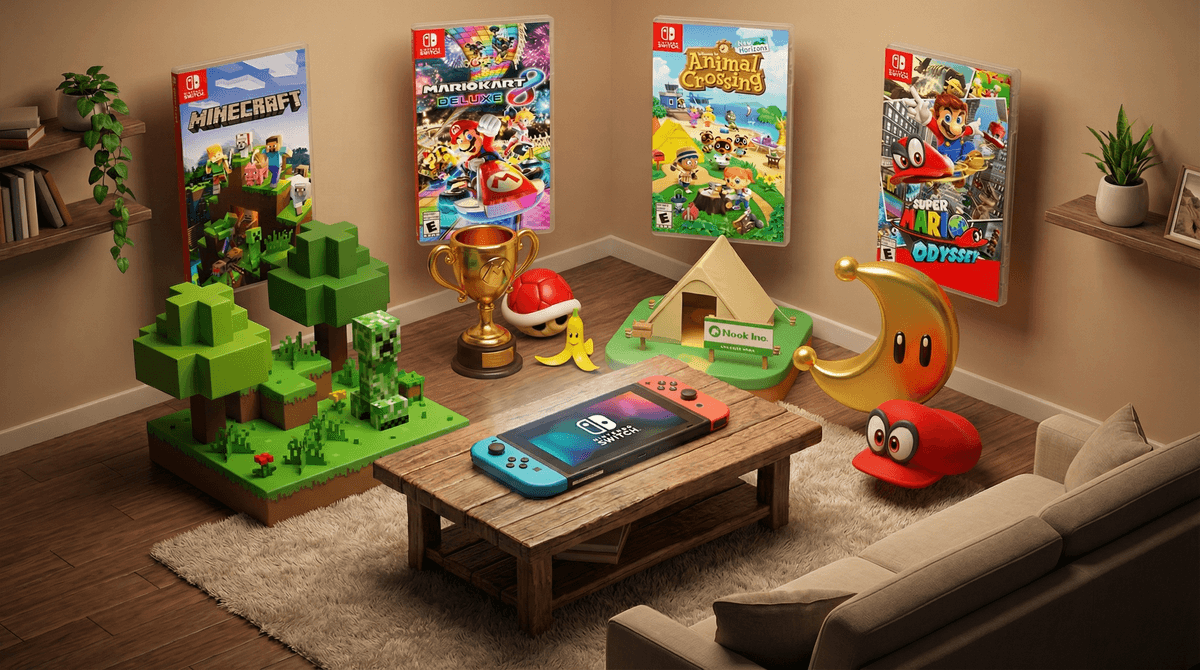
- Minecraft - Creative building that teaches spatial reasoning and problem-solving
- Mario Kart 8 Deluxe - Racing chaos that's perfect for family game nights
- Animal Crossing: New Horizons - Cozy life sim that teaches planning and design
- Super Mario Odyssey - Platforming adventure with just the right difficulty curve
- Pokémon Scarlet/Violet - Open-world exploration with strategy elements
The Nintendo Switch is genuinely the best gaming console for elementary-aged kids. Unlike other platforms, it doesn't push voice chat by default, most games are designed with younger players in mind, and the portability means you can actually see what they're playing. But with thousands of games in the eShop, finding the right ones for an 8-year-old can feel overwhelming.
Eight-year-olds are in this fascinating gaming zone. They're past the simple mechanics of preschool games but not quite ready for the complexity (or content) of teen-rated titles. They can handle failure better than they could at six, but a game that's too hard will still end in tears and thrown controllers. They're starting to care about playing what their friends play, but they're also still open to your suggestions.
The games on this list hit that sweet spot. They're engaging enough to hold an 8-year-old's attention, simple enough that they won't rage-quit, and have enough depth that they'll actually learn something while playing.
If your kid hasn't already discovered Minecraft, they will. It's basically mandatory at this age. The Switch version is actually perfect for 8-year-olds because it's easier to monitor than the PC version and doesn't have the same social pressure as Roblox.
Why it works for 8-year-olds: The creative mode is essentially digital LEGOs with no lose condition. Kids can build, explore, and experiment without the stress of survival mode's monsters. When they're ready, survival mode adds challenge without being overwhelming. The game teaches spatial reasoning, resource management, and basic engineering concepts—though your kid will just tell you they're "building a house for their dog."
Parent tip: Start them in creative mode. Survival mode can be scary for some 8-year-olds (those Creeper explosions are startling), but others love the challenge. You can also enable "peaceful" difficulty in survival mode, which removes monsters but keeps the resource-gathering gameplay.
Watch out for: If they want to play online multiplayer, you'll need to set up Nintendo Switch parental controls and decide if you're comfortable with them joining servers. Many families stick to local multiplayer or private realms with known friends at this age.
This is the game that makes the Switch worth owning. It's the perfect family game—simple enough that an 8-year-old can compete, deep enough that adults won't be bored, and chaotic enough that anyone can win on any given race.
Why it works for 8-year-olds: The "auto-accelerate" and "steering assist" features mean even kids who struggle with coordination can race competitively. As they improve, you can turn these assists off. The game is also brilliant for teaching sportsmanship because the item system means you're never truly out of a race—and also that you're never guaranteed to win. Learning to lose gracefully is a valuable life skill, and Mario Kart provides lots of practice.
Parent tip: This is one of the best games for family game nights. The ability to have four players on one console (or up to 12 with multiple Switches) means everyone can play together. Just be prepared for some heated competition and the occasional "that's not fair!" when a blue shell strikes.
Watch out for: Online play exists, but most 8-year-olds are fine just racing against computer players or family members. If they do want to race online, there's no voice chat, which makes it much safer than other online games.
This is the cozy game that took over the world during the pandemic, and it's still a fantastic choice for 8-year-olds. It's essentially a life simulator where you build and decorate your own island, catch bugs and fish, and befriend adorable animal villagers.
Why it works for 8-year-olds: There's no way to lose, no time pressure, and no violence. It teaches planning (saving up bells for that new furniture), design (decorating your house and island), and even basic economics (the "stalk market" for turnips is a gentle introduction to buying low and selling high). The game also runs in real-time, which naturally limits play sessions—you can only do so much in a day before you've exhausted the new content.
Parent tip: This is a great game for kids who get frustrated easily with traditional video games. The lack of failure states means they can just explore and create at their own pace. It's also excellent for developing delayed gratification—many items and upgrades require saving up or waiting for real-world days.
Watch out for: The real-time element can be a double-edged sword. Some kids get anxious about missing daily events or having weeds grow on their island. It's worth having a conversation about how it's just a game and it's okay to take breaks.
This is the best single-player adventure game for 8-year-olds on the Switch. It's a 3D platformer where Mario travels to different kingdoms, possessing various creatures and objects with his sentient hat (yes, really) to collect Power Moons.
Why it works for 8-year-olds: The difficulty curve is perfectly tuned. The main story is accessible enough that most 8-year-olds can complete it with some effort, but there are hundreds of optional moons for kids who want more challenge. The "Assist Mode" provides helpful arrows if they get stuck, and the two-player co-op mode lets a parent or sibling control the hat, making it a collaborative experience.
Parent tip: This is one of those rare games that's genuinely fun to watch. The kingdoms are creative and colorful, and Mario's possession mechanic leads to hilarious moments (controlling a T-Rex never gets old). If your kid gets stuck, you can usually help without taking over completely.
Watch out for: Some of the post-game content is genuinely difficult. Don't feel bad if your 8-year-old can't collect all 880 Power Moons—most adults can't either.
The latest Pokémon games are the first truly open-world entries in the series, and they're fantastic for 8-year-olds who are ready for a more structured adventure game.
Why it works for 8-year-olds: Pokémon has always been about collecting, strategy, and exploration, but the open-world format means kids can tackle challenges in any order. The turn-based combat system gives them time to think through decisions, teaching strategic thinking and type matchups. The games also have a surprising amount of reading, which can help with literacy skills (though be prepared for questions about what words mean).
Parent tip: These games are meaty—expect 30-40 hours for the main story. That's actually a good thing because it means you're getting value for money, but it also means your kid will be talking about Pokémon nonstop for weeks. Embrace it. Learn the type chart. Pretend to care about their team composition.
Watch out for: The games have some technical issues (frame rate drops, glitches), but they don't significantly impact playability for kids. Also, the Pokémon Company really wants you to buy both versions, but one is plenty.
An adorable 3D platformer that's slightly easier than Mario Odyssey, making it perfect for 8-year-olds who are newer to gaming. Kirby's copy abilities (he inhales enemies and gains their powers) are creative and fun, and the two-player co-op is genuinely cooperative rather than competitive.
If your kid loves Star Wars or LEGO (or both), this game covers all nine main movies with the gentle humor and accessible gameplay that LEGO games are known for. It's also great for co-op play, and the drop-in/drop-out system means you can play together without committing to the whole session.
This is Nintendo's take on online shooters, but instead of bullets, you're shooting ink, and instead of killing opponents, you're covering the map in your team's color. It's the perfect introduction to competitive online gaming because the stakes feel lower (you're painting, not shooting people) but the gameplay is genuinely strategic and skill-based.
Important note: This game does involve online multiplayer, so you'll want to set up parental controls and have conversations about online behavior. The good news is there's no voice chat with strangers, and the community is generally positive.
This game lets kids create their own Mario levels and play levels created by others around the world. It's part game, part creative tool, and it can teach basic game design principles. Some 8-year-olds love the creation tools, while others just enjoy playing the endless supply of user-created levels.
A spooky-but-not-scary adventure where Luigi explores a haunted hotel with his ghost-sucking vacuum. It's got puzzle-solving, light combat, and gorgeous animation. The co-op mode is fantastic for playing with a parent or sibling.
The elephant in the room: Fortnite is on the Switch, and your 8-year-old probably knows about it. Is it appropriate? That's a family-by-family decision, but here's what you should know:
- It's a third-person shooter, but the art style is cartoonish and there's no blood or gore
- It's primarily online multiplayer with voice chat (which you can and should disable)
- The game is free, but there's constant pressure to buy cosmetics and battle passes
- The skill ceiling is high, which means your 8-year-old will probably get eliminated quickly and often
Many families wait until 10-12 for Fortnite, but some 8-year-olds handle it fine, especially if they're playing in creative mode or with friends rather than competitive battle royale. If you do allow it, setting up Fortnite parental controls is essential.
Reading levels: Many Switch games involve reading. At 8, most kids can handle basic menu navigation and simple instructions, but games like Pokémon have substantial text. This can be a great reading practice opportunity, but it also means they might need help with vocabulary.
Difficulty and frustration: Eight-year-olds are still developing frustration tolerance. Games with frequent checkpoints and forgiving mechanics (like Kirby) work better for kids who get easily upset, while games with more challenge (like Mario Odyssey) are great for kids who enjoy mastering difficult tasks.
Play time limits: The Switch has excellent parental controls that let you set daily time limits, restrict games by rating, and even pause gameplay remotely from your phone. At 8, most experts recommend no more than 1-2 hours of recreational screen time per day, but every family is different. Learn more about setting healthy gaming limits .
.
Online interactions: Most of the games on this list don't require online play, but if your kid does want to play online, the Switch's parental controls let you restrict online communication. Nintendo's online environment is generally safer than PlayStation or Xbox, but supervision is still important.
The Switch has two versions: The standard Switch can dock to your TV or be played handheld. The Switch Lite is handheld-only and cheaper, but you can't play it on the TV or use it for games that require detached controllers (like Mario Kart with steering wheel accessories). For an 8-year-old, the standard Switch is usually worth the extra cost.
Physical vs. digital games: Physical cartridges can be shared, traded, or resold, but they can also be lost. Digital games are convenient but tied to your account. Many families do a mix—physical for expensive games they might want to trade later, digital for games that are frequently played.
The friend ecosystem: By 8, kids start caring about playing what their friends play. Before buying a game, it's worth asking what their friends have. That said, don't feel pressured to buy every trendy game—many of the best Switch games are single-player experiences.
Nintendo Switch Online: This $20/year subscription is required for online multiplayer in most games. It also includes access to a library of classic NES and SNES games, which can be a fun way to introduce your kid to retro gaming.
The eShop is a minefield: The Nintendo eShop has thousands of games, many of which are low-quality cash-grabs. Stick to games from reputable publishers or with strong reviews. The games listed in this guide are all quality titles worth your money.
The Nintendo Switch is genuinely the best gaming platform for 8-year-olds, and these games represent the cream of the crop for this age group. They're engaging without being overwhelming, challenging without being frustrating, and educational without being preachy about it.
Start with one or two games from this list based on your kid's interests. If they love building and creativity, go with Minecraft or Animal Crossing. If they want adventure and challenge, try Super Mario Odyssey or Pokémon. And Mario Kart is basically mandatory for family game nights.
Remember that gaming at this age isn't just about entertainment—it's teaching problem-solving, spatial reasoning, reading, and perseverance. The key is finding games that are appropriately challenging and monitoring both the content and the time spent playing.
And when your 8-year-old inevitably asks for Fortnite or whatever the hot new game is, you'll have plenty of quality alternatives to suggest first.
- Set up Nintendo Switch parental controls before handing over the console
- Check out more cozy games for kids if your child prefers low-stress gaming
- Explore alternatives to Minecraft if they've exhausted that game
- See if a specific game is appropriate for your 8-year-old you're considering