

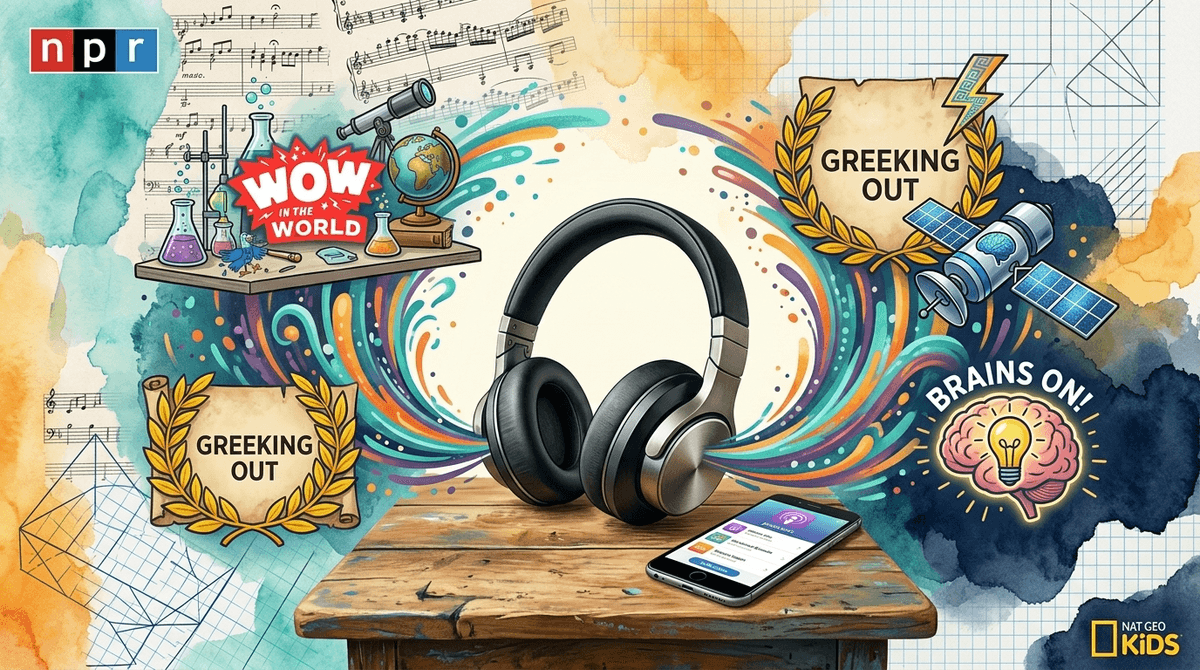
TL;DR: The Quick List If you're in the car right now and just need the noise to stop—but you want that noise to actually teach them something—here are the top picks:
- Best for Science (Ages 5-10): Wow in the World
- Best for Mythology Lovers (Ages 7-12): Greeking Out
- Best for Deep Thinkers (Ages 8-13): Brains On!
- Best for Middle School Curiosity (Ages 11+): Short Wave
- Best for History Buffs (Ages 10+): The Past and the Curious
Get a podcast playlist based on your kid's interests
We’ve all been there. You’re twenty minutes into a road trip, or maybe just stuck in the school pickup line, and the "brain rot" is reaching critical levels. Your kid is talking about "Skibidi" something-or-other, someone is asking for your phone to play Roblox, and you can practically feel their attention spans shrinking.
The beauty of podcasts is that they offer a "middle way." It’s not the passive, glazed-eye experience of watching YouTube Shorts, but it’s also not the "I’m bored" struggle of a silent car ride. Podcasts require active listening—kids have to build the world in their own heads, which is basically a workout for their imagination. Plus, research shows that audio storytelling can improve literacy skills and vocabulary just as much as reading physical books.
Here is the Screenwise-approved breakdown of the best educational podcasts that actually hold their own against the allure of a screen.
For the younger crowd, energy is everything. If a podcast sounds like a lecture, they’re going to tune out and start kicking the back of your seat. These picks are high-energy, funny, and legitimately educational.
Ages 5-10 This is the gold standard. Hosted by Guy Raz and Mindy Thomas, it’s basically a cartoon for your ears. They take a new scientific discovery—like "do fish fart?" or "how do trees talk to each other?"—and turn it into a zany adventure. It’s loud, it’s fast-paced, and it’s genuinely funny for parents too. If your kid is into National Geographic Kids, they will love this.
Ages 8-12 If Wow in the World is a little too "extra" for your kid, Brains On! is the perfect alternative. It’s co-hosted by a different kid every week, which makes it feel very relatable. They tackle serious science questions submitted by listeners, and they have a great segment called the "Mystery Sound" that keeps kids engaged. It’s a bit more grounded but never boring.
Ages 4-9 This one is perfect for the "Why?" stage. Why is the sky blue? Why do we have skin? Why are some words "bad"? It’s produced by Vermont Public Radio, so it has that calm, soothing NPR vibe that can actually help de-escalate a chaotic car ride.
Check out our guide on how to use podcasts to reduce screen time tantrums
If your kid is currently obsessed with Percy Jackson or spends hours building historical empires in Minecraft, these are the winners.
Ages 7-12 National Geographic Kids hit a home run with this one. It covers Greek, Roman, Egyptian, and Norse mythology in a way that is kid-friendly but doesn't "dumb down" the stories. It’s a fantastic companion for any kid who thinks "Ohio" is the weirdest thing ever but hasn't heard about what Zeus used to get up to.
Ages 8-13 This isn't your dry social studies textbook. It focuses on the "weird" parts of history—the people and events you’ve never heard of. It often features live music and a humorous tone that makes history feel like a series of interesting stories rather than a list of dates to memorize.
Ages 4-10 For the younger end of the elementary spectrum, Circle Round adapts folktales from around the world. It’s great for teaching empathy and diversity without being preachy. The production quality is top-tier, often featuring voices you’ll recognize from grown-up TV shows.
Middle schoolers are a tough crowd. They’re starting to move away from "kid" content and toward things that feel more "adult," but they aren't quite ready for the graphic nature of most True Crime or political podcasts. These picks hit the sweet spot of being sophisticated but safe.
Ages 11+ This is NPR’s daily science podcast. Each episode is about 10-15 minutes—perfect for the ride to soccer practice. It covers everything from the James Webb telescope to the science of why we like spicy food. It’s smart, fast, and makes kids feel like they’re in on the "grown-up" conversation.
Ages 10+ Alie Ward’s Ologies is one of the most popular podcasts in the world, but the original episodes can be a bit "spicy" (profanity and adult themes). Smologies are classroom-safe, edited versions of the best episodes. They interview experts (Ologists) about everything from bats to volcanoes to pumpkins. It’s a great way to show kids that "being a nerd" is actually a high-paying, fascinating career path.
Ages 12+ Josh and Chuck are like the cool uncles of the podcast world. While not specifically a "kids" show, most episodes are totally fine for middle schoolers. They explain the history and mechanics of... well, everything. How champagne works, how the Maya civilization collapsed, how disco worked. It’s great for building general knowledge and critical thinking.
Learn more about what middle schoolers are listening to in our community data report
While podcasts are generally a "safer" medium than YouTube or TikTok, there are still a few things to keep in mind:
- The "Explicit" Tag: Most podcast apps (Spotify, Apple Podcasts) have a little "E" next to episodes with profanity. However, "clean" doesn't always mean "age-appropriate." A podcast about real-life forensic science might be "clean" but still way too intense for a 10-year-old.
- True Crime: This is the most popular genre for adults, and many middle schoolers are drawn to it. Be careful here. Shows like Serial or Crime Junkie are not intended for kids. If they want mystery, steer them toward fictionalized podcasts like Mars Patel.
- Earbud Usage: If your kid is listening on headphones, keep an eye on the volume. Noise-induced hearing loss is a real thing. If they’re listening in a common area or the car, use a Bluetooth speaker so the whole family can engage.
One of the reasons we love podcasts at Screenwise is the low dopamine loop. Unlike TikTok, which uses visual flashes, rapid cuts, and algorithmic "surprises" to keep a kid’s brain hooked, podcasts require a longer attention span.
There’s no "infinite scroll" in an audio story. If a kid wants to know how the story ends, they have to stick with it for 20 minutes. This helps build "attentional stamina," which is exactly what kids need to succeed in school and life. It’s the perfect antidote to the "brain rot" of short-form video.
Don't just hit play and go silent. Use the podcast as a conversation starter:
- "Wait, did they just say that some spiders can fly? Is that actually true or are they exaggerating?"
- "That history story was wild. Do you think people back then were smarter or just different than us?"
- "If you had to host a podcast about one thing you’re an expert in—like Minecraft or Taylor Swift—what would your first episode be about?"
Podcasts are the "secret weapon" of intentional parenting. They turn dead time into growth time without the battle over screen limits. Whether you’re teaching them about the Roman Empire via Greeking Out or exploring the deep sea with Wow in the World, you’re giving them a way to engage with the world that doesn't involve staring at a piece of glass.
- Download a dedicated app: If you don't want them browsing your Spotify, try the Kids Listen app, which is a curated ecosystem of kid-safe podcasts.
- Pick one "Car Show": Let your kid pick one podcast that you only listen to in the car. It creates a ritual they’ll actually look forward to.
- Check the WISE scores: Before you dive deep into a new series, search our media database to see how other parents rate the educational value and safety of the show.