

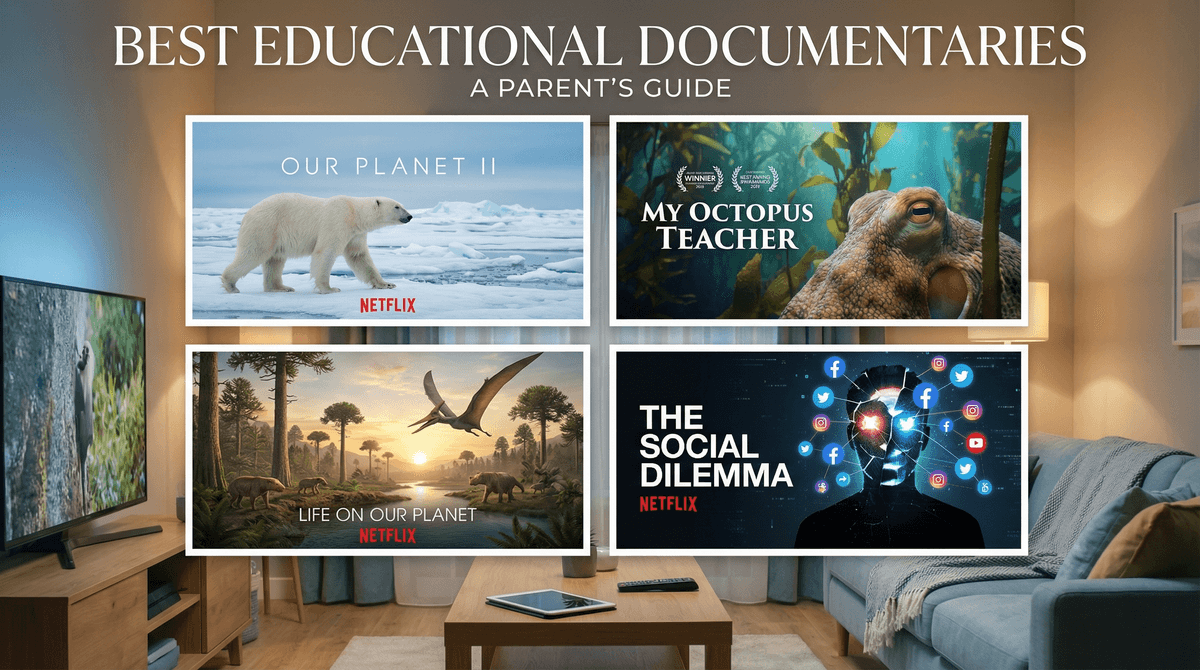
The Best Educational Documentaries for Kids on Netflix Right Now
TL;DR: Netflix has some genuinely incredible educational documentaries that will blow your kids' minds without feeling like homework. Here are the standouts worth your time:
For younger kids (5-9):
For middle grades (8-12):
- Life on Our Planet
- Secrets of the Elephants
- Ancient Apocalypse (with caveats, see below)
For tweens/teens (12+):
Not all screen time is created equal, and educational documentaries are genuinely one of the best uses of Netflix time. But the challenge? Netflix's "documentary" category is a chaotic mess that includes everything from legit nature docs to conspiracy theory garbage to true crime that's absolutely not for kids.
I've waded through the options so you don't have to. These picks are actually educational, age-appropriate, and engaging enough that kids will actually watch them (not just tolerate them while scrolling their phones).
Ages 6+ | 8 episodes, ~50 min each
The sequel to the wildly popular Our Planet, this series continues the David Attenborough tradition of absolutely stunning cinematography paired with accessible narration. The footage is legitimately jaw-dropping—how they got some of these shots is beyond me—and it covers ecosystems from deserts to oceans.
What makes it educational: Beyond just "look at the pretty animals," this series connects ecosystems, explains adaptation and survival strategies, and addresses climate change in an age-appropriate way. It's not preachy, but it doesn't shy away from reality either.
Parent note: There are predator-prey sequences (a cheetah hunting, etc.), but they're not gratuitously violent. Still, sensitive kids might need a heads up or the fast-forward button ready.
Ages 8+ | 8 episodes, ~50 min each
This is essentially a history of life on Earth, starting 4 billion years ago and working up to the present. It uses a mix of CGI recreations of extinct creatures and modern footage, narrated by Morgan Freeman (not Attenborough, for once).
What makes it educational: This is evolution education at its finest. Kids see how life adapted through mass extinctions, climate shifts, and changing continents. It's like a visual textbook for biology and earth science, but actually watchable.
Parent note: Some of the extinction events are intense—the asteroid impact that killed the dinosaurs, volcanic eruptions, etc. It's not scary per se, but younger kids might have questions about why everything died.
Ages 7+ | 4 episodes, ~45 min each
Part of National Geographic's "Secrets" series, this focuses entirely on elephant behavior, intelligence, and social structures across different species and habitats. Narrated by Natalie Portman.
What makes it educational: This goes deep into animal cognition and behavior in a way that's accessible for kids. They'll learn about mourning rituals, problem-solving, communication, and family dynamics. It's fantastic for sparking conversations about intelligence beyond humans.
Parent note: There's some discussion of poaching and habitat loss, but it's handled sensitively. No graphic violence.
Ages 10+ | 85 minutes
This Oscar-winning documentary follows a filmmaker who forms a relationship with an octopus in a South African kelp forest over the course of a year. Yes, it sounds weird. Yes, it's absolutely mesmerizing.
What makes it educational: Beyond the incredible footage of octopus behavior and intelligence, this is really about observation, patience, and the scientific process. It's also a meditation on connection with nature and what we can learn by slowing down and paying attention.
Parent note: The octopus dies at the end (natural life cycle), and there's a pretty intense shark attack sequence midway through. It's not gratuitous, but it's real nature, and sensitive kids should be prepared.
Ages 12+ | 79 minutes
This is a mind-bending exploration of the concept of infinity through mathematics, physics, and philosophy. It features interviews with mathematicians and physicists using creative animations to explain complex concepts.
What makes it educational: This is genuinely challenging content that will stretch how kids (and adults) think about math and reality. It's not dumbed down, but it's presented in a way that makes abstract concepts tangible.
Parent note: This requires focus and genuine interest in the topic. It's not background viewing. Best for kids who already show interest in math, science, or "big questions."
Ages 10+ | 64 minutes
This follows the development and launch of the James Webb Space Telescope, from the engineering challenges to the first images it captured.
What makes it educational: Kids see the actual process of scientific discovery and engineering problem-solving. It's not just "space is cool"—it's "here's how we actually explore space and what we're learning."
Parent note: Some of the scientific concepts are advanced, but the visuals carry the narrative well enough that younger kids can still engage with it.
Ages 12+ | 94 minutes
Former tech insiders explain how social media platforms are designed to be addictive and the societal consequences of that design. It's part documentary, part dramatization.
What makes it educational: If you have a tween or teen on social media (or about to be), this is essential viewing. It explains algorithms, data collection, and psychological manipulation in terms they can understand. It's not anti-technology, but it is critical in important ways.
Parent note: This should be watched together with discussion afterward. Some kids might feel anxious about it—that's actually appropriate given the content. Use it as a springboard for conversations about healthy social media use .
.
Ages 14+ | 100 minutes
Ava DuVernay's documentary explores the intersection of race, justice, and mass incarceration in the United States, named after the 13th Amendment.
What makes it educational: This is history and civics education at its most powerful. It traces a direct line from slavery through Jim Crow to modern criminal justice policy. It's challenging content, but it's essential for understanding American history and current events.
Parent note: This deals with racism, violence, and injustice explicitly. It's not graphic, but it's heavy. Best for high schoolers or mature middle schoolers, and definitely should be watched with discussion afterward.
Ancient Apocalypse
Ages 12+ | Controversial
Graham Hancock's series about advanced ancient civilizations is visually stunning and genuinely entertaining, but it's pseudoarchaeology dressed up as serious investigation. If your kid is into ancient history, they might enjoy it, but you'll need to have conversations about critical thinking and evaluating sources.
The issue: It presents fringe theories as equally valid to mainstream archaeology without giving viewers the tools to evaluate the evidence. It's not harmful per se, but it's not educational in the way actual science documentaries are.
If you watch it: Treat it as entertainment and use it as a teaching moment about the difference between speculation and evidence-based science.
Don't F**k with Cats / Tiger King / Most True Crime
These are technically documentaries, but they're absolutely not for kids. Netflix's true crime obsession has produced some genuinely disturbing content that's marketed as "documentary" when it's really exploitation. If your teen is interested in true crime, there are better options—but most of what's trending on Netflix isn't it.
The best educational documentaries aren't passive viewing—they're conversation starters. Here's how to get the most out of them:
Before watching:
- Give a brief preview of what the documentary covers
- Ask what they already know or think about the topic
- Set expectations (length, intensity, whether it's watch-together content)
During watching:
- Pause for questions (yes, this drives kids crazy, but it helps retention)
- Point out particularly impressive footage or ideas
- Connect to things they're learning in school or interested in already
After watching:
- Ask open-ended questions: "What surprised you?" "What do you want to know more about?"
- Look up additional information together on topics that sparked interest
- Connect to real-world actions or applications
For younger kids, breaking documentaries into shorter chunks over multiple days works better than marathon viewing. Their attention spans and processing abilities need time to absorb dense information.
Ages 5-7: Stick with nature documentaries focused on animals and ecosystems. Keep episodes to 30-45 minutes max. Be prepared to fast-forward through intense predator scenes if needed. Octonauts: Above & Beyond bridges the gap between educational shows and documentaries nicely for this age.
Ages 8-11: They can handle longer formats and more complex topics like evolution, extinction, and climate change. Nature docs are still the sweet spot, but you can introduce space and science topics. They're starting to think more abstractly but still need concrete examples.
Ages 12-14: Ready for social issues documentaries with guidance. They can handle challenging content about history, justice, and technology, but need help processing and contextualizing. This is the age where documentaries can really shape their understanding of the world, so choose thoughtfully.
Ages 15+: Can handle almost any documentary content, but that doesn't mean they should watch everything alone. Complex topics still benefit from discussion and context. They're developing their own critical thinking skills but still need modeling of how to evaluate sources and evidence.
Educational documentaries on Netflix can be legitimately amazing screen time—the kind that sparks curiosity, teaches critical thinking, and maybe even inspires a future scientist or historian. But "documentary" on Netflix doesn't automatically mean "educational" or "appropriate."
The nature documentaries from BBC/Attenborough and National Geographic are consistently excellent across age ranges. For older kids, the social issues docs can be powerful teaching tools, but they require more parental involvement and discussion.
Start with topics your kids are already interested in—if they love animals, go with Secrets of the Elephants. If they're space-obsessed, try Unknown: Cosmic Time Machine. The best educational content is the content they'll actually engage with.
And remember: watching a documentary together and talking about it afterward is infinitely more valuable than them watching alone while you scroll your phone. The education isn't just in the content—it's in the conversation.
Want more recommendations? Check out our guides on the best educational YouTube channels for kids and podcasts that make learning fun.