

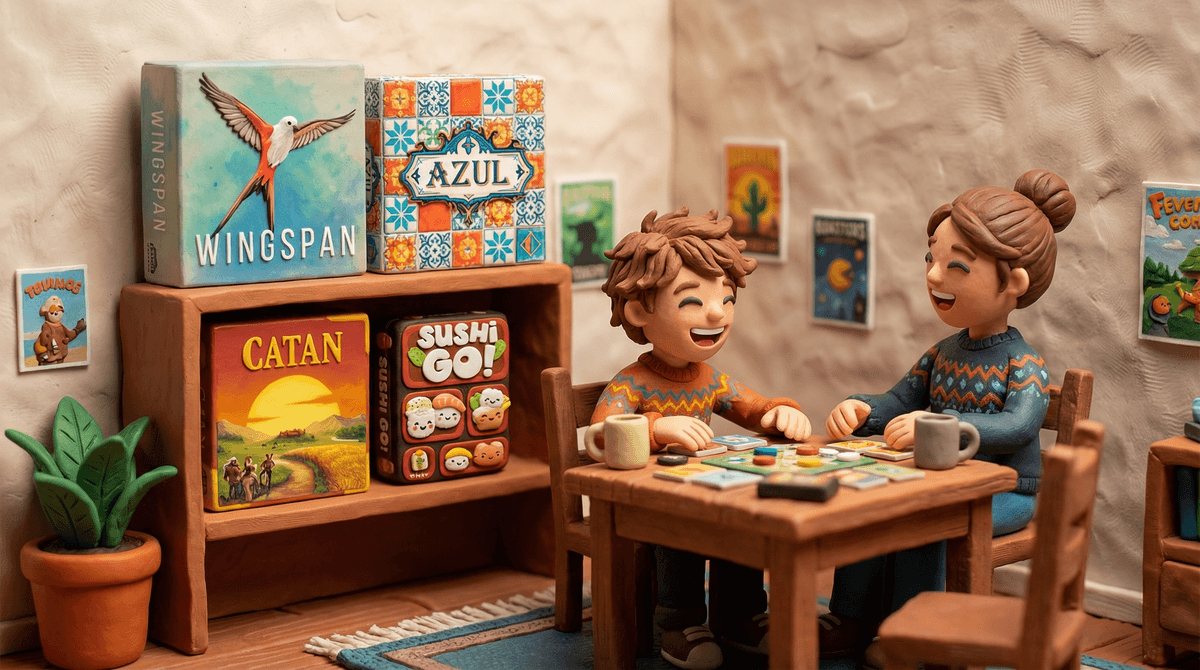
The Best Board Games for 11-Year-Olds: Screen-Free Fun That Actually Holds Their Attention
Eleven-year-olds are in that sweet spot where they can handle complex strategy but still love a good laugh. Here are the games that actually get played more than once:
Strategy & Competition:
- Catan – Resource trading that teaches negotiation
- Ticket to Ride – Geography + route planning
- Splendor – Gem collecting with surprising depth
Quick & Social:
- Codenames – Word association that gets everyone talking
- Exploding Kittens – Silly, strategic, and under 15 minutes
- Sushi Go Party! – Card drafting that's faster than ordering actual sushi
Deep Thinking:
Eleven is a fascinating age for board games. They're past the stage where Candy Land holds any appeal, but they're not quite ready to sit through a 4-hour campaign of Twilight Imperium. They want games with actual strategy, but the game can't take 45 minutes to explain. They're competitive but can (mostly) handle losing without flipping the board.
The right board game for this age hits a perfect balance: complex enough to stay interesting, social enough to feel fun, and fast enough that you can actually finish before someone needs to charge their phone.
Before we dive into specific games, let's acknowledge what's competing for your 11-year-old's attention. They could be playing Roblox, watching YouTube, or texting their friends. Board games need to actually deliver something better than screens to win their time.
Here's what good board games offer that screens don't:
Face-to-face social skills. Negotiating trades in Catan, reading opponents in Codenames, or trash-talking during Exploding Kittens – these are all real social interactions with body language, tone, and immediate feedback.
Strategic thinking without a tutorial. Video games hold your hand through every mechanic. Board games? You figure out the strategy by playing, losing, and trying again. That's a different kind of problem-solving.
Genuine family time. Not "everyone on devices in the same room" time. Actual conversation, laughter, and shared experiences that become family stories. ("Remember when Dad built that ridiculous route in Ticket to Ride and still lost by 50 points?")
Ages: 10+ | Players: 3-4 (5-6 with expansion) | Time: 60-90 minutes
This is the gateway strategy game for a reason. You're building settlements, trading resources, and racing to 10 victory points. What makes it perfect for 11-year-olds is the negotiation. They need to convince other players to trade wheat for ore, which means reading people, making deals, and sometimes breaking alliances.
The game teaches resource management, probability (those dice rolls matter), and long-term planning. Plus, it's competitive enough that winning feels genuinely satisfying.
Parent tip: The trading phase can get chaotic and loud. That's a feature, not a bug. Let them negotiate, argue, and figure it out.
Ages: 8+ | Players: 2-5 | Time: 30-60 minutes
You're building train routes across North America (or Europe, or other maps in different versions). It's simpler than Catan but still strategic. Do you claim short routes early or save your cards for longer, high-point routes? Do you block your opponent's path or focus on your own goals?
The geography element is sneaky educational. After a few games, your kid will know where Denver and Nashville are in relation to each other. They'll understand why certain routes are more valuable (longer distances = more points).
Why it works for 11-year-olds: Fast enough to hold attention, strategic enough to reward planning, and satisfying when you complete a long route before someone blocks you.
Ages: 10+ | Players: 4-8+ | Time: 15-20 minutes
This is the perfect party game that doesn't feel dumbed down. Two teams, each with a "spymaster" who gives one-word clues to help their team guess words on the board. The catch? Some words belong to the other team, and one word ends the game immediately if chosen.
What makes this brilliant for tweens: It rewards creativity and lateral thinking. The best clues connect seemingly unrelated words in unexpected ways. Your 11-year-old might be better at this than you are because their brain isn't locked into adult associations yet.
Family game night gold: This works with mixed ages. Younger siblings can play with help, adults aren't bored, and everyone gets to contribute ideas.
Ages: 8+ | Players: 2-4 | Time: 30-45 minutes
You're drafting colorful tiles to create patterns on your board. It looks like a simple matching game but there's real strategy in which tiles you take and which you leave for opponents. Take the tiles they need? Or focus on completing your own patterns?
The game is gorgeous on the table (those tiles are satisfying to handle), and the rules are simple enough to learn in 5 minutes. But the strategy takes games to master.
Perfect for: Kids who like visual puzzles, pattern recognition, and games where you can actively mess with your opponents' plans.
Ages: 10+ | Players: 1-5 | Time: 40-70 minutes
You're building bird habitats and attracting different species to your aviary. Each bird card has real facts about that species, and the artwork is stunning.
This is a engine-building game, meaning you're creating combinations of birds that work together to score points. It's more complex than the other games here, but for kids who love nature, animals, or just deep strategy, it's incredibly engaging.
Bonus: Your kid might actually learn something about bird species, habitats, and ecosystems. The education is a side effect of playing, not the point.
Parent note: This one has a learning curve. Plan for the first game to be a teaching game, not a competitive one.
Ages: 10+ | Players: 2-4 | Time: 30 minutes
You're collecting gems to buy cards that generate more gems, building an engine that lets you buy increasingly valuable cards. It's simple to teach but hard to master.
The strategy is all about timing. Do you buy cheaper cards to build your engine? Or save up for expensive cards that score more points? Do you take the gems you need or block your opponent?
Why 11-year-olds love it: Quick turns, clear goals, and that satisfying moment when your engine starts humming and you can suddenly afford cards that were impossible a few turns ago.
Ages: 7+ | Players: 2-5 | Time: 15 minutes
This is Russian Roulette with cats. You draw cards until someone draws an Exploding Kitten and is eliminated. Unless they have a Defuse card. Or unless they played an action card to skip their turn, see the future, or shuffle the deck.
It's silly, fast, and surprisingly strategic. The art is ridiculous (in a good way), and games are short enough that losing doesn't sting.
Perfect for: Kids who like Among Us or other games with bluffing and chaos. Also great for families who don't take game night too seriously.
Ages: 8+ | Players: 2-8 | Time: 20 minutes
You're drafting sushi cards, passing hands around the table, and trying to collect sets that score points. It's fast-paced card drafting with cute art and simple rules.
The "Party" version adds variety with different card types you can swap in, so the game stays fresh after multiple plays.
Why it works: Quick rounds, easy to teach, and that perfect mix of strategy (which cards do I keep?) and luck (what's in the next hand?). Also works great with larger groups.
Monopoly: Takes forever, ends in arguments, and teaches questionable lessons about bankrupting your family. There are better economic games.
Risk: Too long, too much downtime between turns, and the endgame drags. If your kid wants world domination, try Small World instead.
Cards Against Humanity: Not age-appropriate, and honestly, the humor gets old fast even for adults. If you want word games, stick with Codenames.
Start with shorter games. Exploding Kittens or Sushi Go Party! are 15-20 minutes. That's an easier sell than "let's play this game that takes 90 minutes to learn."
Let them win (but not obviously). If you crush them in Catan the first three games, they won't want a fourth. Play to teach strategy, not to dominate.
Make it social. Invite their friends over for game night. Codenames with four 11-year-olds is way more fun than with just family.
Don't force it. If board games aren't their thing, that's okay. Not every kid needs to be a board game enthusiast. But if you can find one game that clicks, it's worth having in your rotation as an alternative to screen time battles.
Most of these games say "10+" or "8+" on the box, and those recommendations are pretty accurate. An 11-year-old can handle the rules and strategy of everything on this list.
What about younger siblings? Games like Ticket to Ride, Sushi Go Party!, and Exploding Kittens work well with an 8-year-old. Catan and Wingspan might be too complex for kids under 9.
Competitive dynamics: Eleven-year-olds are old enough to handle losing, but they're still learning emotional regulation. If your kid struggles with competition, start with cooperative games like Pandemic where everyone wins or loses together.
The best board game for your 11-year-old is the one they'll actually play more than once. Start with something quick and accessible like Ticket to Ride or Codenames. If they get hooked, move to deeper strategy games like Catan or Wingspan.
Board games won't replace screens entirely (nor should they), but they offer something genuinely different: face-to-face interaction, strategic thinking, and family memories that don't involve a Wi-Fi password.
And when your 11-year-old asks to play Catan instead of scrolling TikTok? That's a parenting win worth celebrating.
Want more screen-free ideas? Check out our guides on outdoor activities for tweens or creative hobbies that aren't screens.