

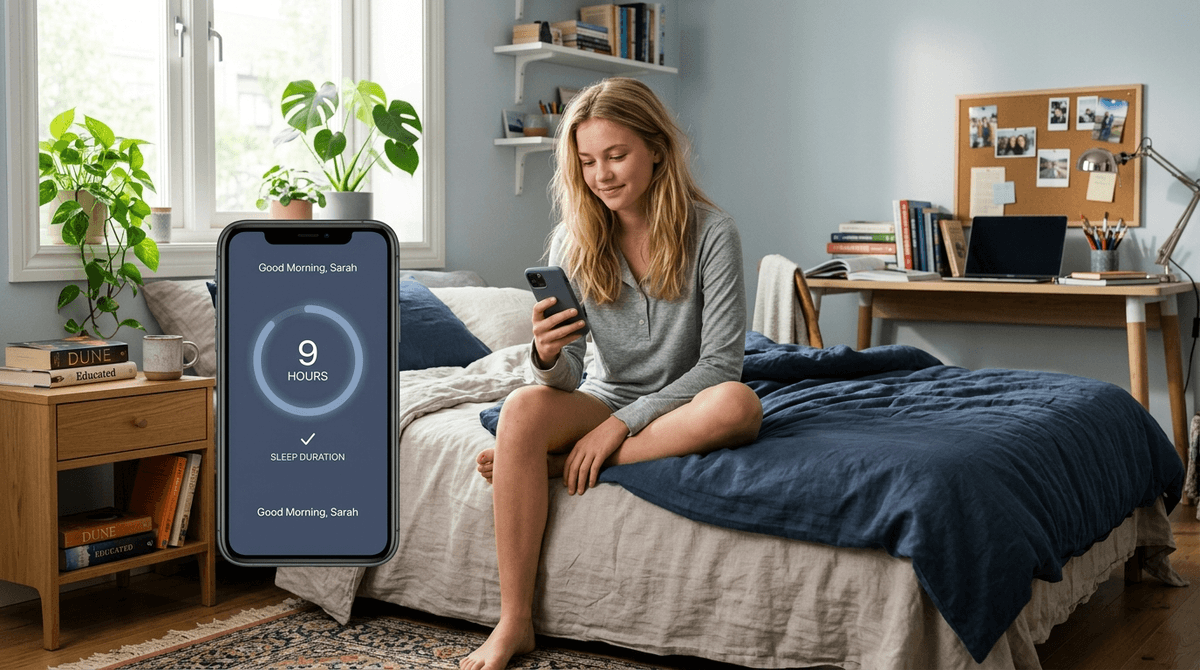
Teens from lower-income backgrounds reported massive improvements in sleep and mood when using an app that swapped medical jargon for "Sleep Stars" and peer-led science. By simplifying the language to a 4th-grade level and gamifying the experience, the study saw some adolescents jump from five hours of sleep to a full nine.
Adolescents increase their nightly sleep and improve their daily mood when using science-based apps that prioritize "gamified" rewards and simple language over clinical terminology. For teens who feel alienated by traditional medical advice or skeptical of social media influencers, these peer-designed digital tools provide a trusted middle ground that actually changes behavior.
Most sleep research and high-end health apps target affluent families, leaving "sleep deserts" for everyone else. If your teen is one of the many struggling with insomnia, they are likely stuck between two bad options: "shady" TikTok advice that lacks evidence or clinical medical guides that feel like homework.
This study proves that the delivery of the science is just as important as the science itself. When the interface feels like a game and the instructions are stripped of "doctor-speak," even the most sleep-deprived teens—those getting as little as three hours a night—can successfully adopt habits that move them toward a healthy nine-hour window.
Researchers were concerned that digital health interventions are leaving behind the people who need them most. Teens in socioeconomically deprived regions often face higher stress and more environmental sleep disruptions, yet they are rarely the focus of app development.
The "Sleep Solved" app was co-created with teens to address this gap. The goal was to see if "inclusive design"—meaning lower reading levels, relatable peer voices, and a heavy focus on rewards—could bridge the trust gap and make evidence-based techniques like Cognitive Behavioral Therapy for Insomnia (CBT-I) accessible to kids who don't have access to sleep specialists.
The results were "dramatic" for a demographic that is notoriously hard to reach in digital health research. After interviewing 63 UK adolescents, the researchers found a striking pattern of success among those who usually have the least support.
- Massive gains: Some participants reported moving from 3–5 hours of sleep per night to a healthy 7–9 hours after using the app’s techniques.
- Representation matters: About seven out of ten participants were from the most socioeconomically deprived regions, proving that these tools work outside of wealthy enclaves.
- The Trust Gap: Teens explicitly stated they found the app more reliable than TikTok or Instagram, which they viewed as "unreliable" or "shady."
- Gamification is the hook: The "Sleep Stars" reward system was the primary reason teens kept opening the app. Without the game element, the science was ignored.
- Favorite tools: The "20-minute rule" (leaving bed if you can't sleep) and progressive muscle relaxation were cited as the most effective "real world" changes they made.
The study suggests that teens are actually craving authority, but they are hyper-sensitive to tone. They want the "real science," but they don't want to feel like they are being treated in a hospital or lectured in a classroom.
There is a subtle "Goldilocks zone" for teen health tech. It has to be more professional than a random influencer’s post, but less intimidating than a medical journal. When an app hits this sweet spot—using simple 4th-grade English and a rewards system—teens stop viewing sleep hygiene as a chore and start viewing it as a "skill" they can level up.
The data is entirely self-reported through interviews. Because the researchers didn't use wearable trackers or medical-grade sleep monitors (actigraphy), we have to take the "dramatic" increases in sleep hours with a measure of caution. Teens might perceive they are sleeping better because they feel better, even if the actual minute-count hasn't shifted as much as they think.
There is also a "survivor bias" at play: the teens who volunteered for these interviews were likely the ones who had a positive experience with the app. Those who hated it or deleted it on day one weren't as likely to sign up for a follow-up interview.
- If your teen is lying awake for hours tossing and turning... suggest the "20-minute rule" mentioned in the study: if they aren't asleep in 20 minutes, they should get out of bed and do a quiet activity in dim light until they feel sleepy, rather than training their brain to be awake in bed.
- If your teen dismisses your advice as "lecturing"... look for apps or tools that use "gamified" elements like Sleep Stars or streaks. The research shows these dopamine-hits are more effective at changing teen behavior than explaining the long-term health benefits of sleep.
- If you are vetting a sleep app for your child... look at the reading level. If it uses medical jargon or complex "sleep cycle" explanations, it may be less effective than one that uses simple, direct language (aiming for a 4th or 5th-grade level).
- If your teen is getting their sleep "hacks" from social media... point them toward verified, science-based apps co-created by universities. The study shows teens are often secretly skeptical of TikTok advice and are open to "vetted" alternatives if they are easy to use.
Stop looking for complex medical solutions to teen sleep issues and start looking for better delivery. When you give adolescents science-backed tools that look like games and talk like peers, they are capable of making massive, self-directed improvements to their own health.
Bennett SE, Lewis GM, Chambers S et al. (2026). Inclusivity in Insomnia: Adolescents' Perspectives on the Sleep Solved App: Qualitative Interview Study. JMIR formative research. doi:10.2196/82410 — pubmed.ncbi.nlm.nih.gov