

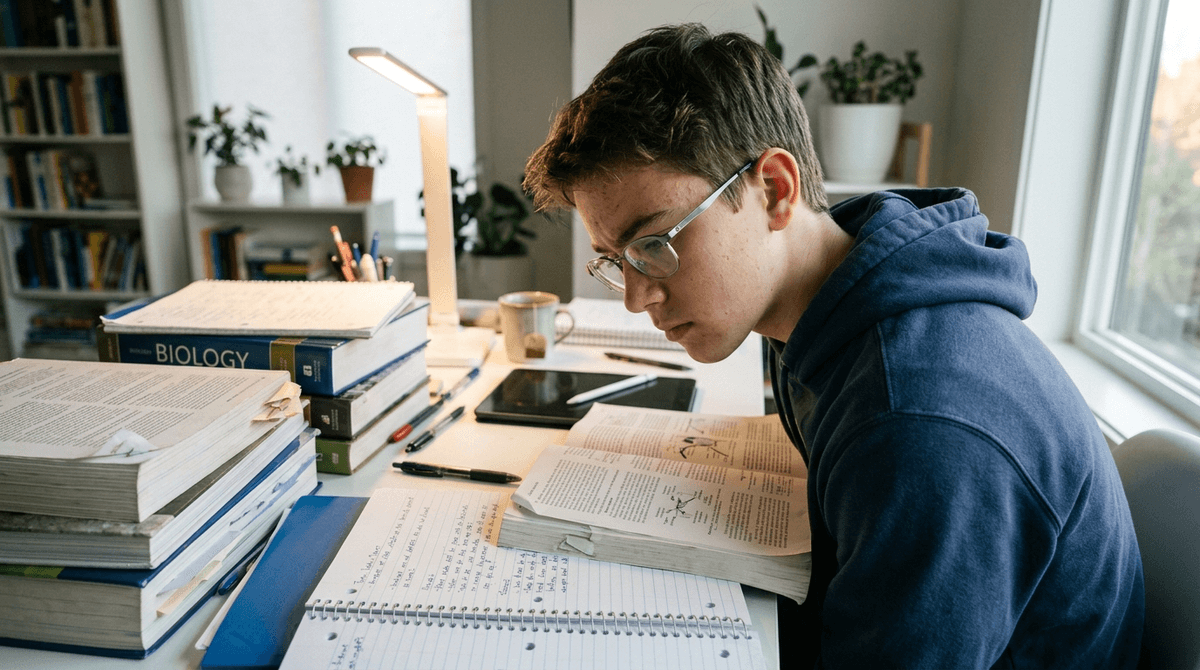

Nearsightedness in teenagers tracks closely with long study hours and older age, but headline-grabbing links to breakfast habits or classroom seating rest on shaky measurement tools.
Long study sessions increase nearsightedness risk in teens, but claims linking vision loss to skipping breakfast are likely statistical noise from flawed eye testing.
Heavy homework loads and intense close-up work consistently strain young eyes, but parents do not need to overhaul morning routines or worry about classroom seat assignments to protect vision. Basic vision screenings routinely mistake temporary eye muscle fatigue from intense studying for permanent nearsightedness.
Rates of teenage nearsightedness are climbing globally, prompting researchers to look beyond screen time toward broader daily habits. Machine learning tools allow scientists to evaluate dozens of lifestyle factors at once, but the reliability of those predictions depends entirely on how accurately vision is measured in the first place.
Near-work and age remain the clearest signals for vision changes in adolescents, while unexpected lifestyle associations raise more questions than answers.
- Study hours hit hardest: Extended after-school study time and infrequent classroom seat rotations emerged as strong behavioral predictors of poor distance vision.
- Age drives higher risk: Older teenagers faced a higher risk of nearsightedness, with each additional year of age increasing the likelihood by twenty percent.
- Surprise correlations appeared: Irregular breakfast habits were linked to a nearly three-fold increase in nearsightedness risk, while male students and boarding students showed lower rates overall.
Machine learning algorithms excel at finding complex patterns, but without biological safeguards, they easily mistake coincident habits for true causes. When AI sifted through self-reported survey data, it elevated bizarre correlations—like breakfast frequency—to the same statistical importance as established optical biology.
Un-dilated vision screenings routinely mistake temporary eye strain for permanent nearsightedness. Because the researchers did not use eye-dilating drops (cycloplegia) during testing, the focusing muscles in these teens' eyes could easily have locked up during heavy reading, inflating the rates of diagnosed nearsightedness. Additionally, 735 Tibetan adolescents self-reported their own daily habits, which introduces memory errors, and the single-snapshot study design cannot prove that any habit actually caused vision loss.
- If your teen spends hours on close-up studying or reading… ...encourage regular visual breaks every twenty minutes to relax the eye's focusing muscles.
- If you are booking a formal vision exam for your child… ...request an evaluation that uses dilating drops to ensure an accurate prescription rather than a false reading driven by eye fatigue.
- If you are tempted to alter household routines for eye health… ...focus on outdoor time and visual breaks rather than expecting breakfast schedules to protect distance vision.
Manage close-up study strain and insist on proper dilated eye exams rather than chasing dietary quick fixes for your teenager's vision.
Han J, Yang J, Suolang Y et al. (2026). Comprehensive behavioral and demographic correlates in myopia risk among Tibetan adolescents: a machine learning analysis using non‑cycloplegic refraction. Scientific reports. doi:10.1038/s41598-026-58744-z — pubmed.ncbi.nlm.nih.gov