

Screen-Free Summer Boredom Busters That Actually Work
Look, we all know how this goes. It's 10 AM on a Tuesday in July, you've got eight more weeks of summer stretching ahead, and someone small is already standing in front of you announcing "I'm bored" like it's a personal crisis requiring immediate screen-based intervention.
And honestly? Handing them a device is the path of least resistance. No judgment here—we've all done it. But if you're reading this, you're probably looking for some actual alternatives that don't involve you becoming a full-time cruise director or listening to "I'm bored" morph into "there's nothing to dooooo" for the fiftieth time before lunch.
Here's the thing: kids aren't wrong that summer feels boring compared to the school year. They've gone from a structured environment with built-in social interaction and varied activities to... whatever you've cobbled together between work, camps, and trying to keep them from becoming feral.
And screens are genuinely good at filling that void. Roblox provides social connection and creative outlets. Minecraft can be genuinely educational. YouTube offers endless entertainment. The problem isn't that screens are evil—it's that they become the only solution, and suddenly it's August and your kid has forgotten how to entertain themselves for more than 30 seconds without a glowing rectangle.
The goal here isn't zero screens (unless that's your thing, in which case, respect). It's about having a real toolkit of alternatives so "go watch something" isn't your default answer every single time.
This one actually works, but you have to set it up before the whining starts. Get a box (or bin, or drawer, whatever) and fill it with stuff that only comes out when someone declares boredom:
- Art supplies they haven't seen in months - New markers, fancy paper, those weird Model Magic clay things, paint-by-numbers kits
- Building materials - Cardboard boxes, duct tape, popsicle sticks, pipe cleaners (seriously, kids will build the weirdest stuff with this)
- Craft kits - Friendship bracelet supplies, origami paper with instructions, those diamond painting things, embroidery hoops
- Science experiment supplies - Baking soda, vinegar, food coloring, balloons, instructions for simple experiments
The key is that this stuff is special—they can't just access it whenever. Boredom is literally the price of admission.
Ages 5-8: Keep it simple and mess-contained. Think coloring books, play-doh, simple building toys.
Ages 9-12: They can handle more complex projects. Actual craft kits, coding projects on paper, origami, model building.
Ages 13+: Yeah, this probably won't work for teens. Keep reading.
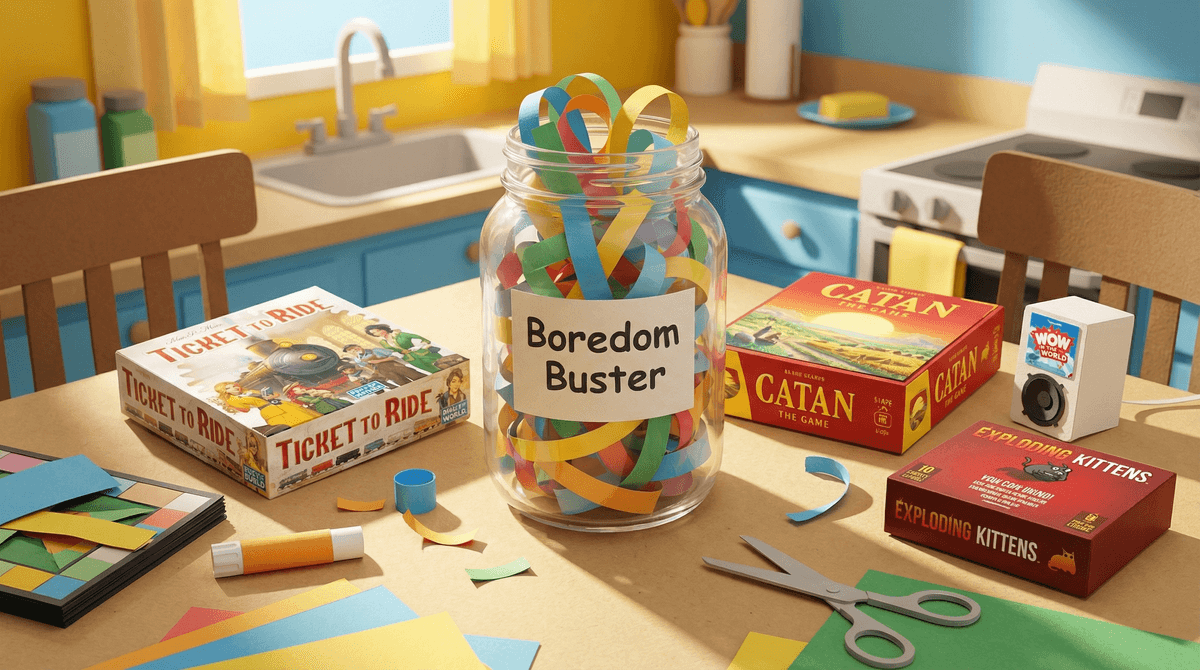
You've probably seen those Pinterest jars full of activity ideas written on popsicle sticks. Most of them are terrible because they're full of things like "organize your closet" or "write a thank you note" and kids aren't stupid.
Instead, fill yours with things that are actually appealing:
- Make slime (yes, it's messy, that's why it's special)
- Water balloon fight
- Build a fort and read in it for 30 minutes
- Bake cookies (and you get to eat them)
- Have a dance party to three songs
- Learn a TikTok dance (screen time, but active and time-limited)
- Sidewalk chalk obstacle course
- Freeze toys in ice and excavate them
- Make friendship bracelets
- Call a friend and talk for 15 minutes (revolutionary, I know)
The rule: if you pull it, you have to do it. No putting it back because you "don't feel like it."
"Go play outside" works great if you live somewhere with other kids around and a safe yard. For everyone else, here's what actually gets kids out the door:
Scavenger hunts with actual prizes - Print a list of specific things to find (a heart-shaped rock, something purple, a leaf bigger than your hand), set a timer, winner gets to pick dinner or choose the movie later.
Outdoor art projects - Nature collages, rock painting, stick sculptures, mud kitchen setups for younger kids.
Water-based everything - Sprinklers, water balloons, washing the car, washing bikes, washing the dog, washing literally anything. Kids love water.
Backyard camping - Tent in the yard, sleeping bags, flashlights, tell scary stories. Even if they come inside at midnight, it counts.
Sports skill challenges - How many times can you bounce a ball? Can you learn to juggle? How long can you keep a balloon in the air? Make it competitive with siblings.
Cardboard box architecture - Save your Amazon boxes. Give kids tape, markers, scissors. They'll build forts, cars, robots, entire cities.
Cooking and baking projects - This is life skills disguised as fun. Look up kid-friendly recipes , give them some autonomy, accept that your kitchen will be a disaster.
Board game tournament - Pull out Catan, Ticket to Ride, Exploding Kittens, whatever you've got. Make a bracket. Award prizes.
Audio entertainment - Podcasts and audiobooks count as screen-free even though they're technically digital. Try Brains On!, Story Pirates, or Wow in the World for younger kids. Older kids might like Radiolab or mystery podcasts.
The reading challenge - This works better if there's an incentive. For every book finished, they earn something—extra screen time, staying up late, a small prize, whatever motivates your particular child.
Real talk: teens are harder. They're not going to get excited about a boredom jar. But they will respond to:
Money-making opportunities - Babysitting, dog walking, lawn mowing, selling stuff they make. Suddenly boredom becomes entrepreneurship.
Skill-building that feels adult - Learning to cook actual meals, photography, learning an instrument, working out, teaching themselves something from YouTube tutorials (yes, this involves screens, but it's active learning).
Social activities - They need to be with friends. Help facilitate this—drive them places, host hangouts at your house, be the cool parent who provides snacks.
Volunteer work - Some teens genuinely enjoy this, especially if it's with animals or kids or something they care about.
Here's the thing nobody wants to hear: some boredom is actually good.
Kids who never experience boredom never learn to generate their own ideas for entertainment. They never develop that internal creative spark that says "I wonder what would happen if..." They become dependent on external stimulation—whether that's screens or you constantly entertaining them.
So sometimes the answer to "I'm bored" can just be "Yeah, boredom happens. What are you going to do about it?" And then you walk away. It feels mean. It's not. You're teaching them that boredom is a problem they can solve themselves.
(Obviously this doesn't work with very young kids who might actually need help. But a 10-year-old? They'll figure it out.)
You don't need to eliminate screens entirely or become a Pinterest parent with elaborate activity plans. You just need:
- A few reliable go-to activities that don't require your constant involvement
- Some structure so "screen time" isn't the default answer to every moment of unscheduled time
- The willingness to let them be bored sometimes without immediately solving it for them
Summer is long. You're not going to win every battle. Some days will be more screen-heavy than others, and that's fine. But having these tools in your back pocket means you at least have options beyond "sure, watch YouTube for the next four hours."
And honestly? The kids who learn to entertain themselves without screens are the ones who show up to middle school able to focus, create, and think independently. So you're not just surviving summer—you're actually teaching them something useful.
This week: Set up your boredom box or jar. Get the supplies while you're motivated.
When they say "I'm bored": Resist the urge to immediately solve it. Try "What are you going to do about that?" first.
If you need more ideas: Check out our guide to screen-free activities by age or Get screen-free summer activity ideas for kids.
You've got this. And if all else fails, there's always Bluey—which honestly, as screen time goes, is pretty solid.