

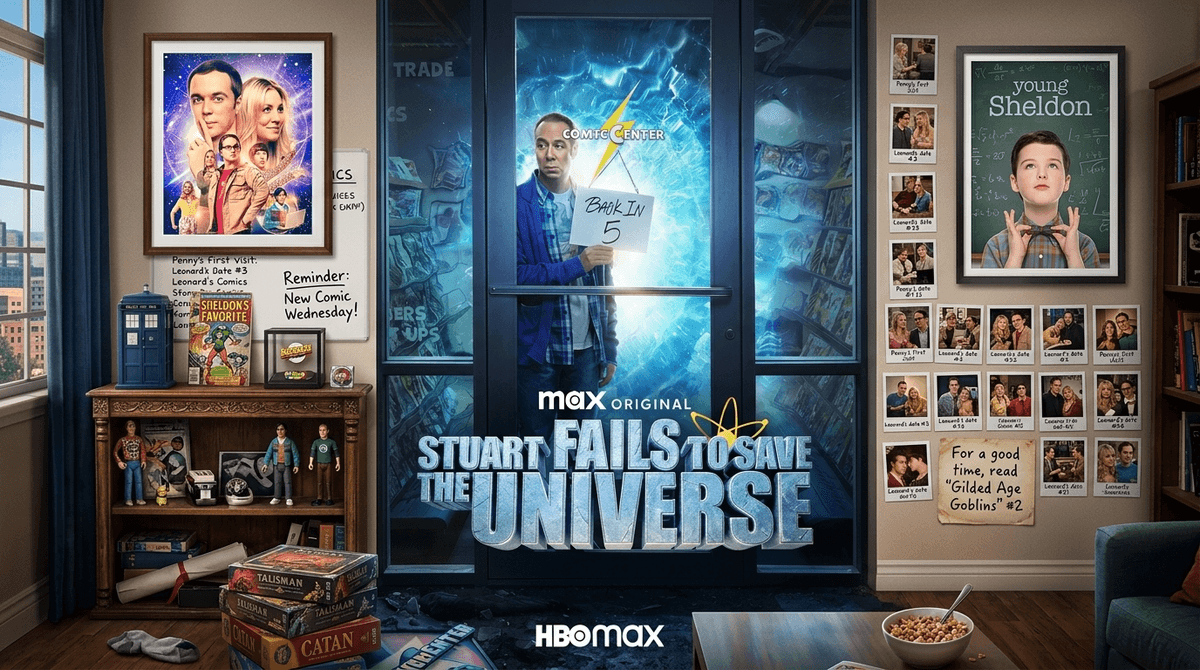
Stuart Bloom spent twelve seasons of The Big Bang Theory as the human equivalent of a "sad trombone" sound effect, but his solo outing is something nobody saw coming: a high-concept, multiverse-hopping sci-fi epic. Stuart Fails to Save the Universe isn't a sitcom; it’s a genre-bending pivot that ditches the laugh track for existential dread and literal world-ending stakes. If your kid is expecting another round of "Bazinga," they’re in for a massive tonal shock.
TL;DR
Stuart Fails to Save the Universe is a sharp departure from its sitcom roots, trading the multi-cam format for a cinematic sci-fi adventure where the stakes are actually real. It’s Stuart Bloom’s time to shine as an accidental interdimensional hero, making it a great pick for fans of Doctor Who or The Good Place. While it keeps the nerd-culture DNA, the shift toward "Armageddon" means more tension and fewer easy punchlines.
For years, Stuart was the guy who lived in the back of the comic book store and survived on expired protein bars. In this new series, that pathetic energy is his superpower. The premise is simple but ambitious: Stuart discovers that his comic shop is actually a "nexus point" for the multiverse, and because he’s so unremarkable, he’s the only person who can slip between realities without being detected by whatever cosmic force is trying to delete them.
It’s a bold move for the franchise. While Young Sheldon proved the Big Bang universe could handle single-camera storytelling and genuine heart, Stuart Fails to Save the Universe goes full Marvel-meets-Douglas-Adams. It’s weird, it’s visually dense, and it treats its sci-fi concepts with a level of respect the original show usually reserved for making fun of them.
If your kid is the type who has The Hitchhiker's Guide to the Galaxy on their nightstand or spends hours debating the logic of Loki, this show is built for them. It leans heavily into the "competent but overwhelmed" trope. Stuart isn't a hero because he’s strong or smart; he’s a hero because he’s used to things going wrong.
The show rewards attention. There are background gags involving alternate-reality versions of DC and Marvel characters that will keep the eagle-eyed fans busy, and the dialogue trades the broad "nerd" stereotypes of the original series for actual, specific references to physics and comic lore. It’s a "glow-up" for the character and the writing.
The biggest thing to prep for is the "Armageddon" of it all. In The Big Bang Theory, the worst thing that could happen was Stuart’s shop burning down or Sheldon getting a B on a paper. Here, entire timelines are being erased.
It’s not "dark" in a gritty, prestige-TV way, but there is a persistent sense of peril. The comedy comes from the absurdity of the situation rather than a setups-and-punchlines rhythm. If your kid is sensitive to "end of the world" themes or existential "what if I don't exist?" questions, you might want to watch the first episode together to see how they handle the stakes.
If the "ordinary guy in an extraordinary universe" thing is hitting the right notes, there are some deeper cuts worth exploring that hit that same sweet spot of humor and high stakes:
For younger readers who like the "average kid survives the apocalypse" vibe, this series is the gold standard. It’s funny, action-packed, and handles the "end of the world" with a lot of charm.
If the appeal of Stuart is his "unbothered underachiever" energy, this game is a perfect companion. It’s a low-stakes, beautiful exploration game about a bird just trying to get cell service on a mountain. It’s the ultimate "anti-superhero" experience.
This is the spiritual ancestor of the show. If your kid is old enough to appreciate dry, British wit and the idea that the universe is fundamentally ridiculous, Douglas Adams is required reading.
For the multiverse bureaucracy and the "fixing the timeline" plot beats, Loki is the most direct comparison. It’s a bit more polished and "Marvel," but it shares that DNA of a character finding their purpose in the chaos of time travel.
The show is a great springboard for talking about resilience. Stuart is a character who has failed at almost everything in his life, yet he’s the one chosen to save everything.
Ask your kid: "Why do you think the universe chose Stuart instead of someone like Sheldon or Leonard?" The conversation: It’s a chance to talk about how "success" isn't always about being the smartest person in the room—sometimes it’s just about being the person who is willing to keep trying when things get weird.
Q: Is Stuart Fails to Save the Universe appropriate for kids who haven't seen The Big Bang Theory? Absolutely. While there are Easter eggs for longtime fans, the show is a complete reboot of Stuart’s world. You don't need to know the history of the comic book store to understand that he's a guy in over his head.
Q: How much violence is in the show? It’s mostly "sci-fi violence"—think laser beams, disappearing into thin air, and cosmic explosions. It’s less about blood and more about the "peril" of being erased from existence. It generally sits in the TV-PG to TV-14 range.
Q: Is it funnier than the original show? It’s a different kind of funny. It’s not "set-up, set-up, laugh track." It’s more situational and dry. If your kid likes Young Sheldon, they’ll likely appreciate the humor here more than the original multi-cam sitcom.
Q: Does the rest of the Big Bang Theory cast show up? Without spoiling too much: the multiverse premise allows for "variants" of familiar faces, but this is firmly Stuart's show. Don't expect a full reunion every week.
Stuart Fails to Save the Universe is a rare spinoff that actually tries something new. It takes a character who was a punchline and gives him a soul, a mission, and a multiverse to break. It’s a win for intentional parents because it moves away from the cynical "nerd-face" humor of the early 2010s and into a more imaginative, adventurous space.
- Check out our best shows for kids list for more sci-fi recs.
- Explore our digital guide for middle schoolers to see where this fits in the 11-13 age bracket.
- Get help picking a next sci-fi series
