

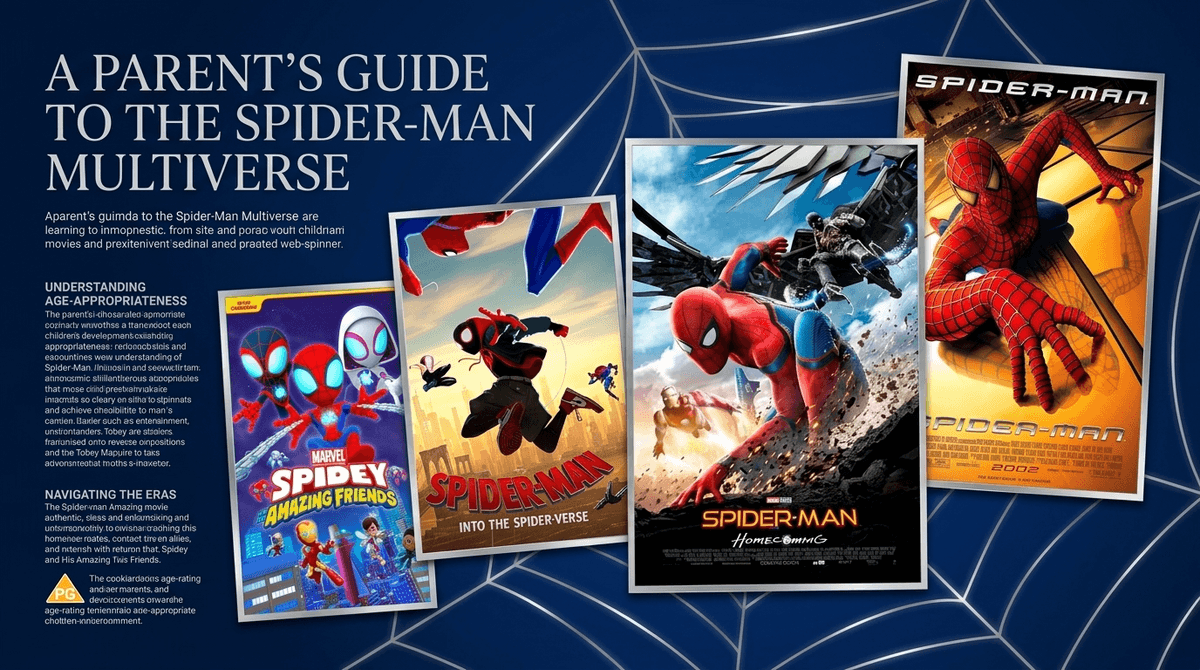
TL;DR: The Spidey Cheat Sheet
If you’re short on time and just need to know what to put on for Friday night movie night, here is the quick breakdown:
- Ages 3-6: Stick to the Disney Junior vibes with Spidey and His Amazing Friends.
- Ages 7-10: The animated Spider-Man: Into the Spider-Verse is the gold standard for quality and age-appropriateness.
- Ages 10-12: Start the live-action journey with Spider-Man: Homecoming.
- Ages 13+: You’re safe with the full MCU trilogy and the darker The Amazing Spider-Man films.
The animated series fill the gaps between those bands — see what to put on right after Into the Spider-Verse.
Get a Spider-Man watch order for an 8-year-old
Screenwise Parents
See allWe’ve all been there. Your seven-year-old comes home talking about "Spider-Gwen" because they saw a backpack at school, or they’ve been watching "brain rot" YouTube shorts of Spider-Man doing the Griddy. You think, "It’s Spider-Man, he’s the friendly neighborhood hero, right? How bad can it be?"
Then you turn on the original 2002 movie and realize the Green Goblin is actually a sleep-paralysis demon in a plastic suit, and there’s a scene where people are literally turned into skeletons.
Spider-Man media spans over 20 years of live-action films, plus high-octane animation and preschool shows. The "vibe" shifts from "primary colored fun" to "existential multiversal dread" pretty quickly. At Screenwise, we see a lot of parents assuming all PG-13 movies are created equal. They aren't. A PG-13 in 2002 hits different than a PG-13 in 2024.
Here is how to navigate the Spider-Verse without accidentally traumatizing your second grader.
If your kid is in the "Ohio" phase of life (where everything is just "weird" or "cool" without context) and they want Spidey, this is your only real stop. It’s bright, it’s short, and the "villains" are mostly just mildly annoying neighbors like Doc Ock who wants to steal all the lollipops. It’s pure "edutainment" and safe for the littlest eyes.
This is arguably the best superhero movie ever made. For parents, it’s a relief because it’s visually stunning. For kids, Miles Morales is a much more relatable entry point than the older Peter Parker.
- The Vibe: High energy, comic-book aesthetic, incredible soundtrack.
- Parental Note: There is some "cartoon" peril and a significant character death that might require a hug, but it’s handled with a lot of heart.
The sequel is a masterpiece, but it’s heavy. It deals with the idea of "canon events"—basically the idea that bad things must happen to you to make you a hero. It also ends on a massive cliffhanger that might frustrate younger kids who want a neat resolution. Check out our guide on the Spider-Verse themes
The Marvel Cinematic Universe (MCU) version of Peter Parker is designed to feel like a modern high schooler. These are generally the most "approachable" live-action films for tweens.
This is the most "low stakes" of the live-action movies. It’s basically a John Hughes high school movie with a superhero subplot. Michael Keaton’s Vulture is intimidating, but he’s a "guy in a suit" rather than a monster.
This one gets a bit trippy. The villain, Mysterio, uses optical illusions that can be genuinely scary for kids—think giant zombie Iron Man crawling out of a grave. If your kid is sensitive to "horror-lite" imagery, maybe preview the illusion sequences first.
This is the "Avengers-level" event. It brings back villains from every previous Spider-Man movie. It’s incredibly emotional and features some heavy grief. It’s a "must-watch" for the culture, but it’s a long movie (almost 2.5 hours), which is a lot for a kid’s attention span.
The OG Tobey Maguire movie. It’s campy and fun, but the Green Goblin is genuinely frightening. There’s also more "early 2000s" edge here—some suggestive comments and more visceral violence than the modern Disney-fied MCU.
Widely considered one of the best, but it has a "hospital scene" involving Doc Ock’s mechanical arms that plays out like a straight-up horror movie. If your kid isn't ready for jump scares, skip the first half of this one or watch it with them.
Andrew Garfield’s version is a bit more "emo" and brooding. These movies are darker visually and tonally. The sequel, The Amazing Spider-Man 2, has an ending that is notoriously devastating. It’s the kind of ending that leads to a very long, sad car ride home if your kid isn't prepared for it.
Spider-Man isn't just a movie series; it's an ecosystem. Once your kid watches the movies, they are going to want to play the games.
- Marvel's Spider-Man 2 on PS5 is a technical marvel, but it’s rated T for Teen. It features much more realistic violence and some heavy themes about addiction and loss.
- Roblox Spider-Man sims are everywhere. Most are harmless "swinging" simulators, but be wary of the ones that are just cash-grabs for Robux.
When you're deciding if your kid is ready for the jump from animation to live-action, look for these three things:
- The "Scare" Factor: Animated villains are easier to process. When Willem Dafoe is screaming in a mirror in live-action, it hits different.
- The Romantic Subplots: The Raimi movies (2002-2007) have a lot of "pining" and soap-opera drama. The MCU movies handle romance like modern awkward teenagers.
- The Concept of Death: Every Spider-Man movie deals with Uncle Ben (or an Uncle Ben figure). If your family has recently dealt with loss, these movies can be a great way to talk about it—or they might be a bit too "close to home."
In the recent Across the Spider-Verse, the movie explicitly discusses "Canon Events"—the idea that everyone has to go through something hard to become who they are.
This is actually a fantastic talking point for intentional parents. You can ask your kids: "Do you think Peter had to lose his uncle to be a hero? Or could he have chosen to be good anyway?" It’s a great way to move past the screen time and into a real conversation about character and choice.
Spider-Man is the rare franchise that actually grows with your child. You can start with the "Amazing Friends" on Disney Junior, move into the artistic brilliance of the "Spider-Verse," and eventually share the "No Way Home" nostalgia together.
Just don't assume that "Spider-Man" equals "Safe for 5-year-olds." Take the extra five minutes to check the Screenwise guide for the specific movie you're looking at.
- Take the Survey: If you haven't yet, walk through the Screenwise habits survey to see how your family's media consumption stacks up against your community.
- Plan a Marathon: Use our guide to the best superhero movies for tweens to plan your next month of movie nights.
- Check the Games: If they’re asking for the PS5 game, read our review of Marvel's Spider-Man 2 first.