

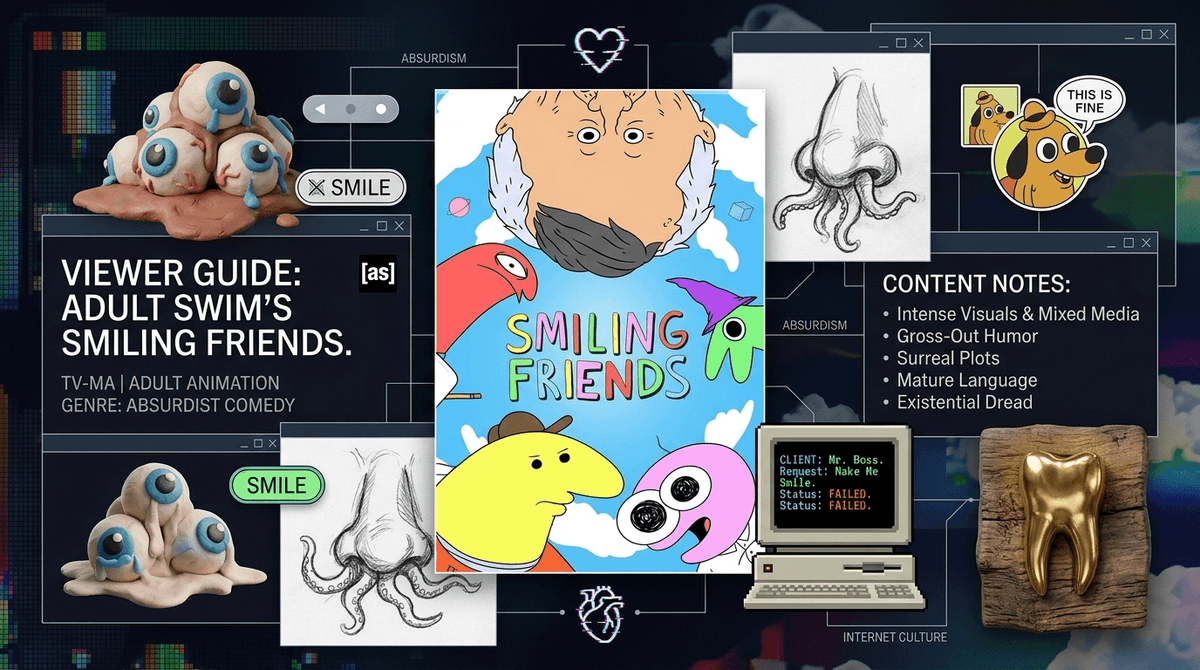
TL;DR: Smiling Friends is a surreal, fast-paced, and often dark animated series on Adult Swim. While it looks like a cartoon and has a "wholesome" premise—employees at a small company trying to make people smile—it is firmly for older teens (16+) and adults. It features gross-out humor, references to mental health struggles, and chaotic animation. If your kid is obsessed with TikTok memes or "weird" internet humor, they’ve definitely seen it.
Ask our chatbot if Smiling Friends is right for your teen
If you’ve walked past your kid’s laptop lately and seen a small, nervous pink creature or a cynical yellow guy who looks like he hasn't slept since 2012, you’ve officially met the cast of Smiling Friends.
As of early 2026, this show has transitioned from a "cult hit" to a cornerstone of internet culture. With the series nearing its final episodes, the hype is at an all-time high. But for parents, it’s one of those shows that is incredibly hard to "read" at a glance. Is it a sweet show about helping people? Is it "brain rot"? Is it something that’s going to give your middle-schooler nightmares?
Let’s break down the chaos.
Created by internet animation veterans Zach Hadel and Michael Cusack, Smiling Friends follows the daily lives of Pim, Charlie, Allan, and Glep. They work for a non-profit dedicated to—you guessed it—making people smile.
On the surface, that sounds like a PBS Kids plot. But this is Adult Swim. The "clients" they try to help include a suicidal man in the pilot episode, a washed-up celebrity frog, and various eldritch horrors that live in the walls.
The animation is a frantic mix of traditional 2D, 3D CGI, stop-motion, and even live-action clips. It feels like someone took the last twenty years of internet memes, put them in a blender, and hit "liquefy." It’s visually stimulating, often "ugly" on purpose, and moves at a breakneck speed that matches the attention span of a generation raised on YouTube Shorts.
To understand why this show is everywhere, you have to understand "Post-Irony."
Gen Z and Gen Alpha humor often thrives on the "anti-joke"—things that are funny because they are awkward, weird, or strangely mundane in the middle of a crisis. Smiling Friends nails this.
- The Creators are Internet Royalty: Hadel and Cusack come from the world of Newgrounds and early YouTube animation. They speak the language of the internet fluently.
- Meme-ability: Every frame of the show is a potential meme. Whether it’s Glep doing a little dance or Charlie’s deadpan reactions, the show is designed to be clipped and shared on TikTok.
- It’s Surprisingly Relatable: Despite the monsters and the gore, the dialogue feels like a real conversation between two friends. It captures the specific anxiety of modern life in a way that feels more authentic than many "serious" teen dramas.
The big question: Can my kid watch it?
The show is rated TV-MA, though many parents of older teens (15+) find it acceptable. However, it is not for younger children, despite the colorful characters.
Safety & Content Considerations:
- Violence/Gore: While it’s "cartoonish," the show features sudden, graphic bursts of violence. Think exploding heads, realistic blood, and body horror. It’s meant to be funny in a "shock humor" way, but it can be jarring.
- Language: Frequent profanity. It’s not "constant" like some other adult cartoons, but it’s definitely there.
- Themes: The show deals with heavy topics like depression, cults, and failure. The pilot episode literally involves the main characters trying to stop a man from ending his life. It’s handled with an absurdist lens, but the premise is mature.
- The "Cringe" Factor: There is a lot of "second-hand embarrassment" humor. If your child is sensitive to awkward social situations, this show might actually be stressful for them.
You might hear parents call shows like this "brain rot." In the Screenwise world, we try to look past the labels.
"Brain rot" usually refers to content that is high-stimulation but low-substance (think Skibidi Toilet). Smiling Friends is high-stimulation, but it actually has a lot of craft behind it. The writing is sharp, the animation techniques are diverse, and it often functions as a satire of modern media.
However, because the show is so fast and chaotic, it can contribute to that "dopamine loop" where kids want more and more high-intensity content. If you notice your teen is becoming more cynical or only communicating in "weird" absurdist quotes after watching, it might be time to balance the scales with something a bit more grounded.
If they like the "weirdness" but need a break:
If your teen loves the surrealism of Smiling Friends but you want to nudge them toward something with a little more emotional payoff (or less gore), consider these:
- The gold standard for "weird but meaningful." It starts as a silly cartoon but grows into a massive, philosophical epic.
- A massive hit on YouTube. It’s surreal and dark, but generally stays within a "PG-13" vibe.
- Similar "two buddies in a weird world" energy, but much more accessible for younger teens.
- If they need a "palate cleanser" from the chaos, this game offers the same "helping the community" vibe but in a peaceful, constructive way.
If your teen is watching Smiling Friends, don't lead with "This is garbage." That’s a one-way ticket to them closing their door.
Instead, try these conversation starters:
- "The animation in this is wild. How do they actually make this? Is it claymation or just digital?" (This acknowledges the craft).
- "That Charlie guy is a total mood. Why do you think everyone on the internet is obsessed with him?"
- "Some of the stuff they joke about is pretty dark. Does that ever feel a bit much, or do you just see it as a joke?"
By engaging with the why of the show, you’re showing them that you’re "Screenwise"—you get the culture, even if you aren't going to go buy a Glep plushie for your own bed.
Smiling Friends is the ultimate "Internet Era" show. It’s fast, weird, and definitely not for kids. For older teens, it’s a relatively harmless (if gross) way to engage with the humor of their peers.
As the show nears its final episodes, expect it to dominate the conversation even more. If you have a 14-year-old begging to watch it, maybe watch an episode with them first. You’ll know within five minutes if it’s a "yes" or a "not in this house" for your family.
Next Steps:
- Check the Smiling Friends media page for specific content warnings.
- If you're okay with the show, set boundaries on where it's watched (maybe not on the big TV during dinner with the 8-year-old).
- Take our survey to see how your family's media choices compare to your community.