

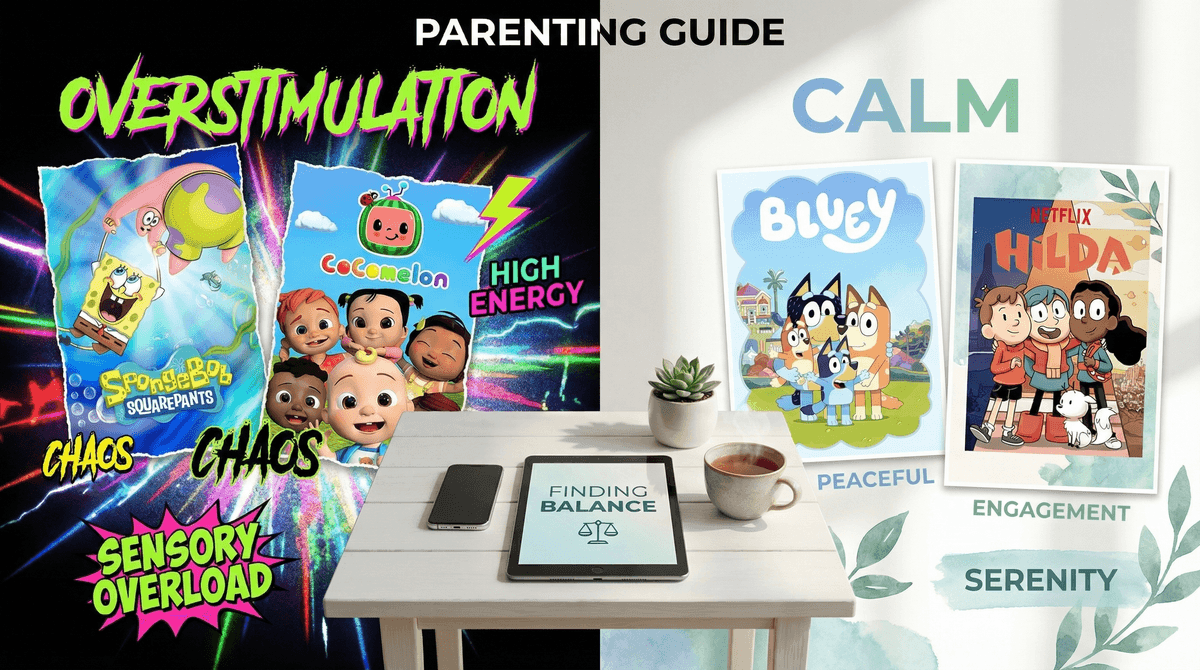
Is SpongeBob Making Your Kid Hyper? Signs of Cartoon Overstimulation
Fast-paced cartoons can absolutely affect kids' behavior, attention, and sleep—but it's not always obvious what you're looking at. Here's what overstimulation actually looks like, which shows are the biggest culprits, and what to do about it without becoming the fun police.
The worst offenders: SpongeBob SquarePants, Teen Titans Go!, The Loud House
Better alternatives: Bluey, Hilda, Gravity Falls
You know that feeling when your kid finishes an episode of something and they're suddenly bouncing off walls, talking at hyperspeed, or melting down over absolutely nothing? That's not just "kids being kids"—that's overstimulation, and the show they just watched might be the culprit.
The research on this is actually pretty clear. A 2011 University of Virginia study found that just nine minutes of SpongeBob significantly impaired 4-year-olds' executive function compared to kids who watched slower-paced shows or drew pictures. We're talking measurable differences in attention, problem-solving, and impulse control—from less than ten minutes of TV.
But here's the thing: not all fast-paced shows affect all kids the same way, and "fast-paced" doesn't automatically mean "bad." Understanding what overstimulation actually looks like in your specific kid is way more useful than just banning entire categories of shows.
Overstimulation from cartoons isn't just "hyperactivity." It shows up in different ways for different kids, and sometimes the signs are counterintuitive:
The obvious stuff:
- Can't settle down after the show ends
- More aggressive play (hitting, rough housing, yelling)
- Talking louder and faster than usual
- Difficulty transitioning to the next activity
- More defiant or argumentative behavior
The less obvious stuff:
- Suddenly exhausted or "crashing" 30 minutes later
- More emotional—crying over small things, quick to frustration
- Actually getting quieter and more withdrawn (some kids internalize overstimulation)
- Trouble falling asleep that night, even hours later
- Decreased attention span for books, puzzles, or calm activities
- More "I'm bored" complaints despite having just been entertained
The tricky part? A lot of these signs look like normal kid behavior. The key is noticing patterns. If your kid consistently acts differently after certain shows compared to others, that's your data.
Not all fast-paced content is created equal. Here's what makes certain shows more likely to overstimulate:
Scene changes: Shows that cut to a new scene every few seconds keep the brain in constant "alert" mode. SpongeBob averages a scene change every 11 seconds. Compare that to Bluey, which might hold on a scene for 30-45 seconds.
Audio chaos: Constant sound effects, music changes, characters yelling, and overlapping dialogue. Teen Titans Go! is basically an auditory assault course.
Visual intensity: Bright, saturated colors that change rapidly, lots of movement in every frame, exaggerated expressions. Your kid's visual cortex is working overtime.
Emotional whiplash: Shows that ping-pong between emotions (happy-scared-angry-silly) every 30 seconds don't give kids time to regulate. The Loud House is exhausting partly because the emotional tone is constantly shifting.
Meanness and conflict: Shows where characters are constantly yelling at each other, being sarcastic, or playing pranks don't just overstimulate—they model dysregulated behavior. Kids absorb that energy.
Let's be specific. These shows consistently show up in parent complaints about post-viewing behavior changes:
The OG overstimulation culprit. It's not that SpongeBob is evil—it's genuinely funny and creative. But the pacing is relentless, the audio is chaotic, and SpongeBob himself is a character in a constant state of hyperarousal. For kids under 7, this is a lot. Even for older kids, it's probably not a great before-bed choice.
This show is like if someone distilled ADHD into 11-minute episodes. The characters literally scream at each other constantly, the plots are deliberately nonsensical, and the pacing is designed to be as chaotic as possible. Some kids think it's hilarious. Some kids become completely unhinged after watching it.
The premise is chaos (11 siblings in one house), and the execution matches. Constant yelling, constant conflict, constant noise. If your kid is already prone to sibling conflicts, this show is basically a masterclass in how to escalate them.
For the toddler crowd, Cocomelon deserves special mention. It's not fast-paced in the traditional sense, but it's relentlessly stimulating—bright colors, constant music, scene changes every few seconds. Many parents report their toddlers becoming almost trance-like while watching, then completely dysregulated afterward. Read more about Cocomelon's specific effects .
.
The good news: there are plenty of genuinely good shows that kids love that won't leave them (and you) frazzled.
Bluey (Ages 2-8)
The gold standard. Slower pacing, realistic family dynamics, emotional regulation modeled on-screen. Kids come away from Bluey wanting to play imaginatively, not bounce off walls.
Hilda (Ages 6-12)
Beautiful animation, thoughtful pacing, genuine storytelling. It's engaging without being overwhelming. The whole vibe is calming while still being adventurous.
Avatar: The Last Airbender (Ages 7+)
Yes, there's action, but it's purposeful. The show takes time to breathe, characters process emotions, and the pacing serves the story. This is what "quality animation" actually means.
Gravity Falls (Ages 8+)
Funny, clever, well-paced. There's mystery and excitement, but the show doesn't rely on chaos to keep kids' attention.
Daniel Tiger's Neighborhood (Ages 2-5)
For younger kids, this is the anti-Cocomelon. Slow, gentle, explicitly teaching emotional regulation. Some kids find it boring—that's kind of the point.
Check out our full guide to calm shows for kids for more options.
Ages 2-5: This age group is most vulnerable to overstimulation. Their brains are still developing executive function, so they literally can't regulate the way older kids can. Stick to slower-paced shows like Bluey, Daniel Tiger, or Elinor Wonders Why. Save SpongeBob for when they're older.
Ages 6-8: Kids this age can handle more variety, but they're still learning to recognize their own dysregulation. This is a good age to start teaching them to notice how different shows make them feel. You can watch some faster-paced stuff, but maybe not right before homework or bedtime.
Ages 9-12: Most kids this age can watch pretty much anything without becoming dysregulated—but not all. If your 10-year-old still gets wound up from certain shows, that's not immaturity, that's just how their nervous system works. Honor that.
All ages: Context matters more than age. The same show might be fine on a lazy Saturday morning but a disaster at 7pm when everyone's already tired and you need to get through the bedtime routine.
Track patterns: Keep mental (or actual) notes about which shows correlate with difficult behavior. You're looking for patterns, not one-off bad days.
Time it right: If certain shows do wind your kid up but they genuinely love them, watch them when you have time and space for the aftermath. Saturday morning, not before dinner.
Transition buffer: Build in 10-15 minutes of calm activity after screen time before expecting kids to transition to something that requires focus or cooperation. This isn't "rewarding" screen time—it's just practical.
Talk about it: For kids 5+, you can actually explain this. "I notice you have a harder time after we watch Teen Titans Go!. Your body gets really revved up. Let's try Gravity Falls instead and see if that feels different."
Don't make it a moral issue: This isn't about "bad" shows corrupting your child. It's about nervous system regulation. Some kids can watch anything. Some kids are more sensitive. Neither is better or worse.
Consider the whole day: A kid who's already had a stimulating day (birthday party, lots of activities, big emotions) is more likely to get overstimulated by a show that would normally be fine.
Fast-paced cartoons can absolutely affect kids' behavior, attention, and emotional regulation—but it's not universal, and it's not permanent. The goal isn't to ban all stimulating content forever. It's to notice what works for your specific kid and make intentional choices.
SpongeBob isn't going to ruin your child's brain. But if you notice your kid consistently struggles after watching it, you have permission to say "let's try something else" without feeling like you're being overprotective.
The best show for your kid is the one that doesn't leave everyone exhausted and dysregulated afterward. Everything else is just details.
- Experiment: Try swapping one overstimulating show for a calmer alternative for a week and see if you notice any difference in behavior
- Check out our alternatives to overstimulating shows for age-specific recommendations
- Still not sure what's causing the chaos? Get help figuring out if your kid's shows are overstimulating about your specific situation—we can help you identify patterns