

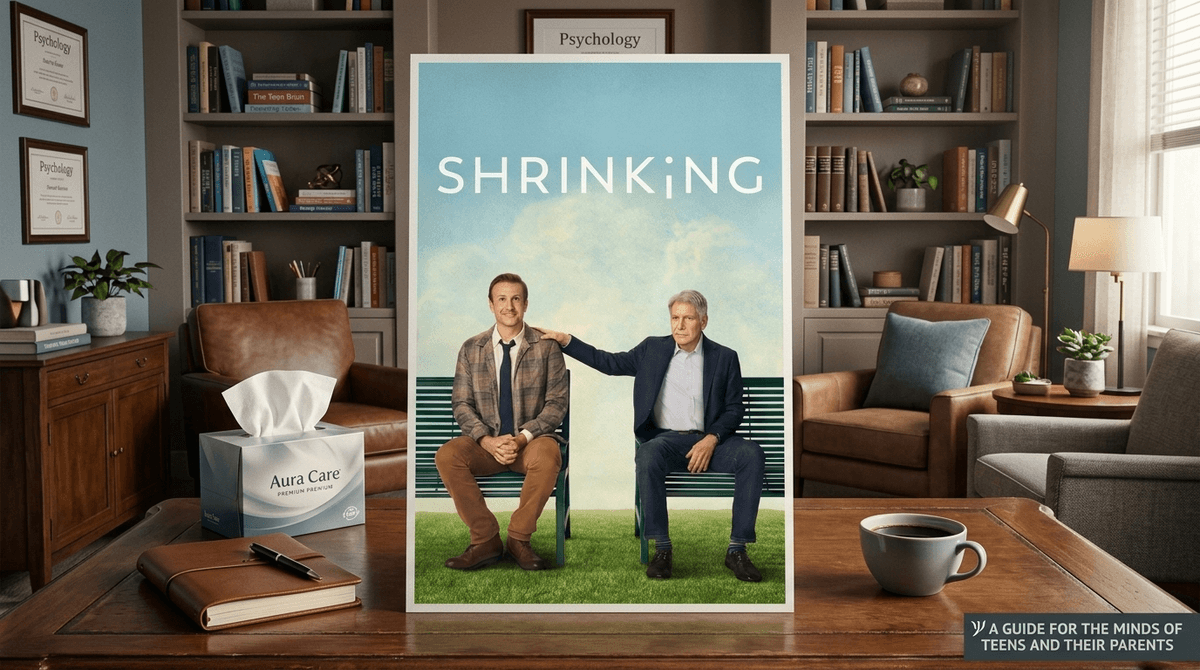
TL;DR: Shrinking is a masterclass in "sad-com" that’s perfect for older teens (15+) who are navigating big emotions, but it comes with a TV-MA rating for a reason. Expect a constant stream of F-bombs, frank discussions about sex, and some casual drug use. If you loved Ted Lasso but wished it was a little more cynical and set in a therapist’s office, this is your show.
Find more shows like Shrinking
If you’ve been scrolling through Apple TV+ lately, you’ve definitely seen Harrison Ford looking grumpy next to a very tall, very expressive Jason Segel. That’s Shrinking, and as we dive into Season 3, it’s officially cemented itself as the show that makes us laugh while we’re crying about our own childhood trauma.
But for parents, the question is always: Is this a "watch together" show, or a "wait until they’re in college" show?
As a parent navigating the digital age in 2026, you know the drill. Our kids are exposed to "brain rot" on TikTok and "Ohio" memes every five seconds, so when a show like this comes along that actually treats mental health with some gravity, it’s tempting to hit play immediately. Let's break down whether Season 3 is a fit for your family.
The premise is simple but chaotic: Jimmy (Jason Segel) is a therapist grieving the sudden death of his wife. He’s been a "ghost" parent to his daughter, Alice, for a year, and he finally snaps. He decides to start telling his patients exactly what he thinks—no more "how does that make you feel?" nonsense. He becomes a "psychological vigilante," which is as ethically questionable as it sounds.
Meanwhile, his mentor Paul (Harrison Ford) is dealing with Parkinson’s disease and his own estranged family dynamics. It’s a show about people who are "broken" trying to fix each other, often failing, but always trying.
There’s a reason this show has a massive following among the 16-24 demographic.
- The Alice Factor: Jimmy’s daughter, Alice, is one of the most realistic portrayals of a grieving teen on TV. She isn't just a "troubled kid" trope; she’s smart, biting, and deeply hurt. Teens see themselves in her struggle to manage a parent who is falling apart.
- Mental Health Transparency: We live in an era where therapy is no longer a taboo topic. Shrinking takes the mystery out of the therapist's office. It shows that even the "experts" don't have their lives together.
- The Humor: It’s genuinely funny. The banter between Harrison Ford and Jessica Williams (who plays Gaby) is elite. It’s the kind of fast-paced, smart comedy that appeals to kids who grew up on The Good Place.
While the show is heartwarming, it is rated TV-MA. Here is how that breaks down for different ages:
Ages 13-14: Proceed with Caution
At this age, the heavy themes of grief and the very adult relationship drama might feel a bit slow or "cringe." More importantly, the sexual humor is frequent and very explicit. If your 14-year-old is particularly mature and you're okay with them hearing every swear word in the book, you might consider it, but generally, this is a "wait a year or two" situation.
Ages 15-17: The Sweet Spot
This is the prime audience for the show's deeper messages. Teens in high school are often dealing with their first brushes with real-world grief, friendship breakups, and the realization that their parents are just flawed humans. Season 3 specifically dives deep into the "messy middle" of recovery—where the initial shock of a tragedy has worn off, but the long-term work of being a person remains.
Ages 18+: Green Light
If they’re headed to college, this is practically required viewing for a lesson in "how not to be a therapist" but "how to be a friend."
Language
If you have a "no swearing" rule in your house, Shrinking is your worst nightmare. The F-bombs are used as punctuation. It’s not aggressive or violent language, but it is constant.
Substance Use
Jimmy spends a good chunk of Season 1 and parts of Season 2 numbing his pain with pills and alcohol. While the show doesn't necessarily glorify it—it clearly shows his life falling apart because of it—it is portrayed as a common coping mechanism. There’s also casual marijuana use among the adult characters.
Sexual Content
There is no graphic nudity, but there is a lot of "shacking up." Characters have casual flings, talk openly about their sex lives, and there are several scenes of characters in bed together. It’s handled with humor, but it’s definitely "adult."
Professional Ethics (The "Don't Try This at Home" Factor)
As a parent, the biggest "red flag" to discuss is Jimmy’s behavior. In the real world, a therapist moving a patient into their guest house (yes, that happens) would lose their license in a heartbeat. If your teen is interested in psychology, it’s worth a conversation about why Jimmy’s "vigilante therapy" is actually super dangerous.
If you decide to watch Shrinking with your teen, or if they’re watching it on their own, here are a few conversation starters that aren't totally "mid":
- On Grief: "Alice and Jimmy both lost the same person, but they’re grieving totally differently. Who do you think is handling it 'better,' or is there even a 'better' way?"
- On Boundaries: "Jimmy thinks he’s helping his patients by getting involved in their personal lives. Why do you think therapists usually have such strict rules about that?"
- On Paul’s Journey: "Harrison Ford’s character is struggling with losing control of his body (Parkinson’s). How does that change how he interacts with his daughter?"
If you love the vibe but want something a bit "cleaner" or aimed at a younger audience, check these out:
- Inside Out & Inside Out 2: Don't roll your eyes—these are the gold standard for explaining emotional regulation to kids (and honestly, adults).
- The Good Place: Deals with ethics, death, and being a better person, but with a TV-14 rating and much more "forking" whimsical humor.
- Atypical: A great look at a teen on the autism spectrum navigating high school and therapy. It has heart and humor without the constant F-bombs.
- Stardew Valley: If your kid is feeling overwhelmed by the heavy themes of a show like Shrinking, suggest this game. It’s the ultimate "healing" media where you just farm, make friends, and recover from the "corporate" soul-crushing world.
Shrinking Season 3 continues to be one of the most thoughtful, hilarious, and profane shows on television. For an intentional parent, it’s a great tool to open up doors to conversations about mental health, provided your teen is old enough to handle the "adultness" of the dialogue.
It’s not "brain rot." It’s not a mindless sitcom. It’s a show that respects its audience’s intelligence—and in 2026, that’s a breath of fresh air. Just maybe don't watch the "boop" scenes with your own parents nearby. Trust me on that one.
- Check the WISE score: Head over to the Shrinking media page to see how other parents in the Screenwise community have rated Season 3.
- Audit the Watchlist: If your teen is into Shrinking, they might also be looking at Euphoria. (Heads up: those are very different levels of "mature.")
- Take the Survey: Not sure where your family stands on TV-MA content? Take our family digital habits survey to get a personalized guide on setting boundaries that work for your specific community.