

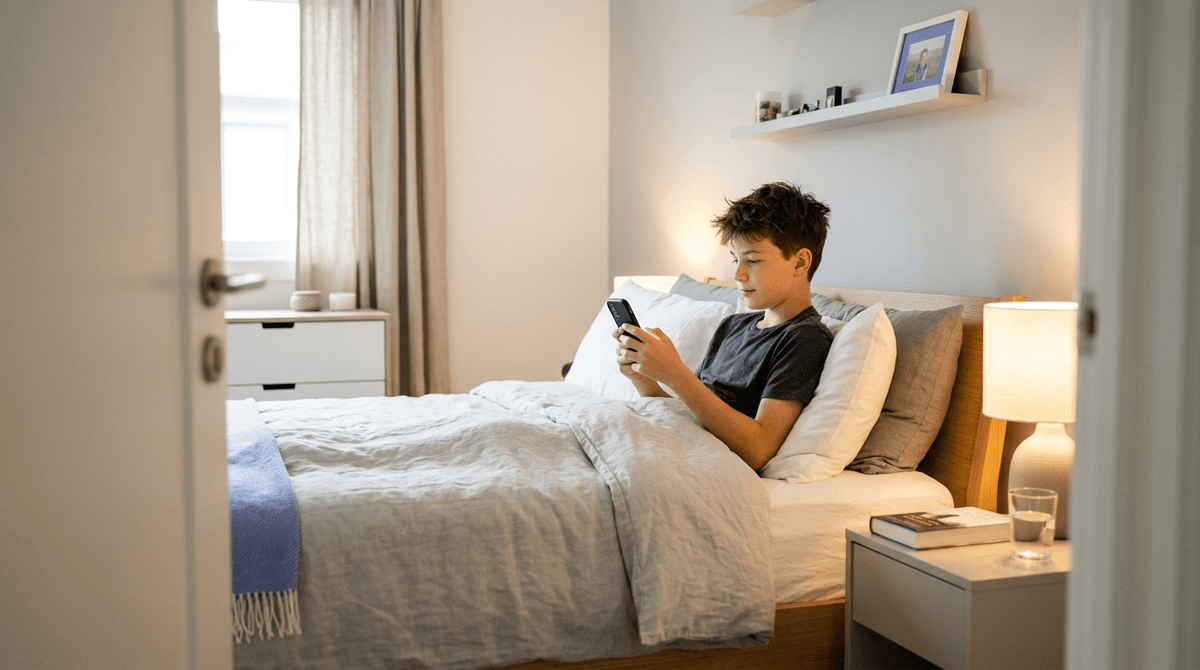

Knowing that screens wreck a child's sleep isn't enough to keep devices out of the bedroom. A vast majority of parents recognize the dangers of evening screen time, yet fewer than four in ten consistently enforce rules to turn them off.
Parents know blue light and late-night scrolling ruin sleep, but knowing doesn't automatically translate into firm bedtime boundaries—especially when kids push back.
Knowing digital hygiene rules won't protect a child's sleep—only enforced household boundaries will. More than four in ten parents report that screen time actively causes their kids to miss bedtime, leading directly to daytime moodiness and behavioral struggles.
If a family relies on awareness rather than clear rule enforcement, the child pays for it in lost sleep and daytime meltdowns.
Bedtime screen boundaries frequently collapse under evening fatigue. Parents understand that device use delays sleep, but after a long day, enforcing strict device cutoffs creates friction that exhausted adults often avoid.
Parents see the damage clearly, but few successfully stop it.
- Awareness is almost universal: Over nine out of ten parents recognize that smart devices cause sleep issues.
- Rules are rarely enforced: Only about a third of parents report always setting firm time limits for device use.
- Bedtimes are regularly missed: About four in ten parents report that screens directly cause their children to miss scheduled bedtimes.
- Behavior changes are widespread: Nearly two-thirds of parents noticed visible behavioral issues in their children linked to screen time.
- The youngest kids suffer most: Parents identified toddlers and preschoolers under age six as the most vulnerable to screen-induced sleep disruption.
Public health campaigns targeting parents are missing the mark. Parents do not need more education on blue light risks; they need concrete strategies to make boundary enforcement automatic. When rules rely on pure parental willpower at 8:30 PM, the device wins.
These findings come from a survey of 400 parents in a single city in Saudi Arabia, mostly mothers, relying on self-reported memory. While bedtime routines differ across cultures, the gap between knowing a habit is bad and actually stopping it is universal. Additionally, because the study is observational, it shows that screen habits and sleep issues happen together, but it cannot formally prove causation.
- If your child is under age five, establish strict screen-free bedtime boundaries immediately. Preschoolers are the most vulnerable to screen-driven sleep disruption, so building early non-screen habits protects early development.
- If your child regularly misses bedtime because of devices, switch from verbal reminders to a physical charging dock outside the bedroom. Over four in ten kids miss sleep windows due to screens because passive awareness fails against late-night device temptation.
- If your child displays daytime behavioral problems or irritability, audit evening screen timing before changing other routines. Two-thirds of parents report clear behavioral issues linked to screen time, making late-night device use a primary suspect for mood shifts.
Awareness doesn't protect a child's sleep—physical boundaries do. Stop trying to persuade kids to log off, and start removing devices from bedrooms entirely before bedtime.
Al-Shammary AA, Aldawsari NF, Alharfi RA et al. (2026). Parental Awareness and Practices Regarding Electronic Devices' Effects on Children's Sleep: A Cross-Sectional Study. Public health challenges. doi:10.1002/puh2.70300 — pubmed.ncbi.nlm.nih.gov