

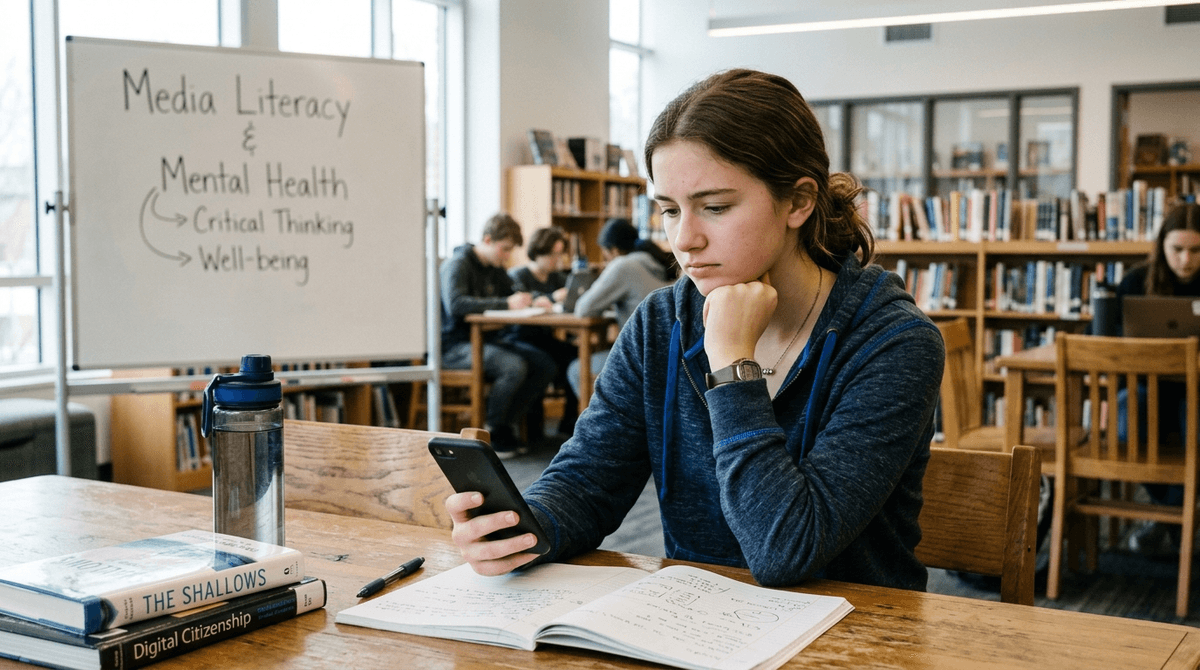

Researchers are evaluating whether school-based "media literacy" lessons actually protect teenage mental health—or if current internet-safety programs just teach technical tricks while ignoring emotional well-being.
Schools cannot assume that traditional digital-safety lessons improve student mental health, as researchers launch a comprehensive review to pinpoint which online literacy programs actually safeguard adolescent well-being.
Most parents assume the "digital citizenship" modules taught in middle and high school protect kids from online harm. In reality, most school programs are fragmented, tackling cyberbullying one week and body image the next, without addressing how four to six daily hours of screen time impact overall emotional stability.
As schools pivot toward "digital well-being" curricula, parents need to know which frameworks build genuine psychological resilience rather than just teaching kids how to adjust privacy settings or spot fake news.
Adolescent mental health has declined sharply over the past decade, with roughly one in five teenagers meeting the criteria for a probable mental health disorder. At the same time, teens spend an average of four to six hours online every day, making digital platforms their primary social arena.
Despite thousands of online safety workshops delivered over the last two decades, educators still lack clear evidence on which specific teaching techniques shift real-world behavior and improve long-term mood.
Researchers from the UK are launching a systematic review analyzing school-based experimental data from the year 2000 to the present to evaluate well-being outcomes.
- The mental health crisis: About one in five adolescents currently faces probable mental health disorders.
- Screen saturation: Daily online time for secondary students now averages four to six hours.
- Fragmented focus: Existing school programs target single, isolated issues like body image or cyberbullying instead of overall emotional well-being.
- The new benchmark: The review will determine whether teaching "socioemotional" digital skills—like emotional regulation online—yields better mental health outcomes than traditional safety lectures.
School administrators often purchase off-the-shelf "digital literacy" curricula to check a safety box, but critical thinking about media doesn't automatically equal better mental health. Recognizing that an image is photoshopped doesn't necessarily prevent a teenager from feeling insecure while looking at it. The shift toward "digital well-being" acknowledges that emotional management—not technical knowledge—is the real bottleneck for teenage mental health online.
This publication is a research protocol, outlining the plan for a systematic review rather than reporting final experimental results. The authors have not yet established which specific school interventions are most effective. Additionally, the review only includes English-language studies, which could omit successful digital literacy frameworks developed in other cultures.
- If your child's school offers an online safety program… ask administrators whether the curriculum covers emotional self-regulation online or just technical rules and cyberbullying policies.
- If you want to build healthy digital habits at home… focus discussions on how social media makes your child feel emotionally, rather than solely lecturing on privacy settings or online safety rules.
- If your child spends four or more hours online daily… establish clear screen-free boundaries around sleep and meals rather than relying on school programs to offset high screen time.
Don't rely on basic school internet-safety assemblies to protect your teen's mental health. Look for approaches that teach socioemotional resilience online, and reinforce healthy boundaries around daily screen use at home.
Tibbs M, Francis G, Mountain J et al. (2026). Wellbeing-focused media literacy interventions in secondary schools: A systematic review and meta-analysis protocol. BMJ open. doi:10.1136/bmjopen-2026-119555 — pubmed.ncbi.nlm.nih.gov