

Rosie Revere, Engineer: Building Resilience Through Failure
Rosie Revere, Engineer by Andrea Beaty is a picture book that does something genuinely important: it teaches kids that failure isn't the opposite of success—it's part of the process. Through rhyming verse and charming illustrations, young Rosie learns that her "flop" inventions are actually stepping stones to something great. Perfect for ages 4-8, this book is a fantastic conversation starter about persistence, creativity, and why mistakes matter.
Related reads: Iggy Peck, Architect and Ada Twist, Scientist (part of the same series)
Andrea Beaty's Rosie Revere, Engineer tells the story of a shy girl who loves to invent things from trash and odds and ends. She dreams up elaborate contraptions but keeps them secret after a relative laughs at one of her creations. The turning point? Her great-great-aunt Rose (a nod to Rosie the Riveter) encourages her to embrace failure as part of the invention process.
The book's core message—"Your brilliant first flop was a raging success!"—is one that honestly resonates just as much with adults as it does with kids. How many of us grew up terrified of getting things wrong? How many times have we watched our own kids give up on something after one failed attempt?
What sets this book apart from generic "you can do it!" messages is its specificity. Rosie doesn't just "believe in herself." She builds, tests, fails, learns, and tries again. That's the actual engineering design process, and it's a framework that applies to everything from learning to code to mastering a new video game level to figuring out how to make slime that doesn't immediately turn into a sticky disaster.
The rhyming text has that read-aloud magic that makes kids want to hear it again and again. David Roberts' illustrations are quirky and detailed—kids love spotting all the contraptions in Rosie's room and the blueprints scattered throughout the pages.
But beyond the fun presentation, kids relate to Rosie's fear of being laughed at. That moment when someone dismisses her cheese-copter invention? It's devastating, and it rings true for any kid who's ever been teased or shut down when they were excited about something.
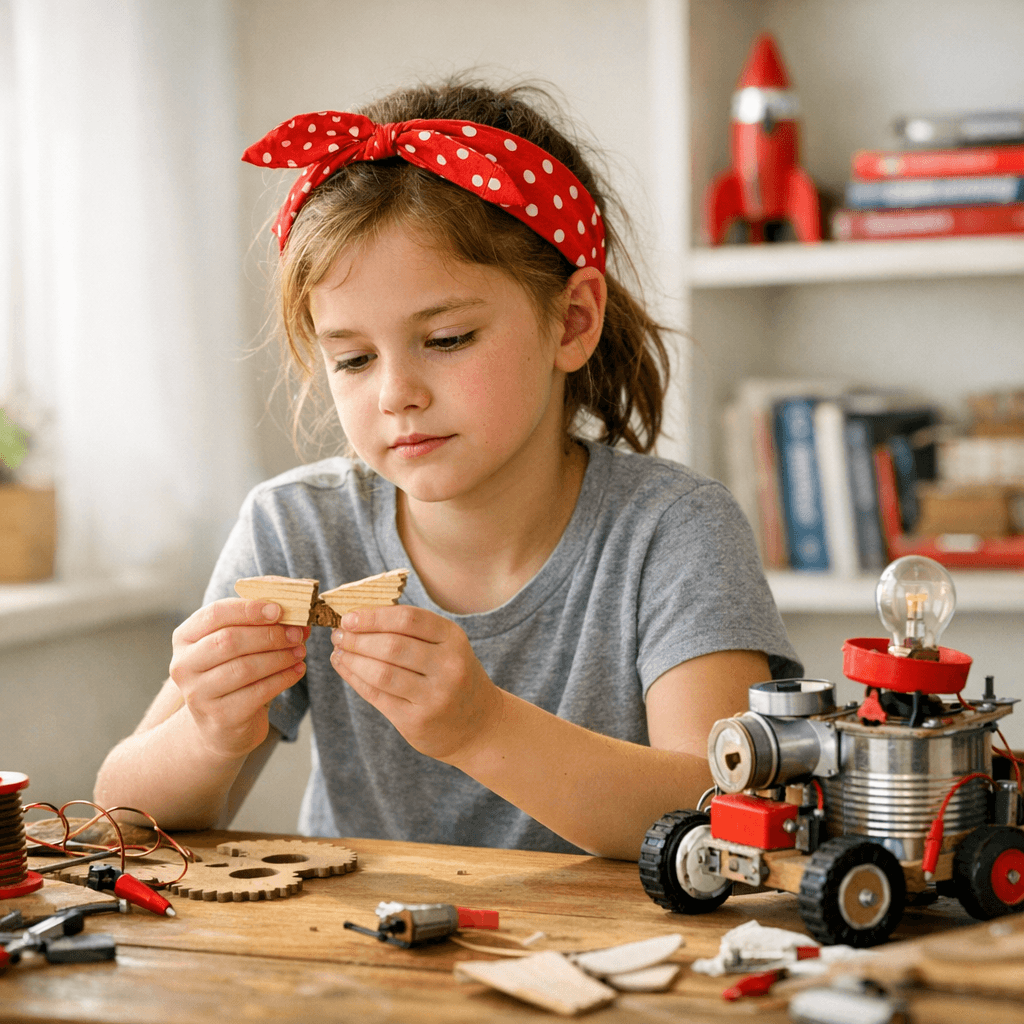
The book also normalizes tinkering and making a mess in pursuit of an idea. In an era where so much of kids' play is digital and pre-programmed, seeing a character who builds things from random materials and isn't afraid to get her hands dirty feels refreshing.
If you've heard the term "growth mindset" thrown around at school conferences or parenting blogs, this book is essentially a picture-book version of that concept. Carol Dweck's research shows that kids who believe abilities can be developed through effort and learning from mistakes perform better than those who think talent is fixed.
Rosie Revere, Engineer embeds this idea naturally into the story. Great-great-aunt Rose doesn't just tell Rosie she's smart or talented—she reframes the failure itself as valuable data. The cheese-copter didn't fly for long, but it did fly. That's progress.
This is such a useful framework for parents navigating everything from homework meltdowns to kids rage-quitting video games. Instead of "you're so smart" or "you can do anything," we can point to specific efforts and learning moments: "You tried three different approaches—that's exactly what engineers do."
Make it hands-on: After reading, set up a simple engineering challenge. Can your kid build a bridge out of paper and tape that holds a toy car? Can they design a boat from aluminum foil that floats with pennies in it? The goal isn't perfection—it's iteration.
Talk about your own flops: Share age-appropriate stories about times you failed at something and what you learned. Maybe that time you tried to bake a cake and it collapsed, or when you couldn't figure out a work problem on the first try.
Connect it to their interests: If your kid loves Minecraft, talk about how their first house probably wasn't perfect, but they learned and built better ones. If they're into Roblox, discuss how game developers test and revise their creations constantly.
Watch the Netflix show: There's an animated series called Ada Twist, Scientist based on another book in this series. It expands on these themes with more diverse characters and problem-solving adventures. Ages 4-7 will eat it up.
Ages 3-5: They'll love the rhythm and pictures. The failure concept might be a bit abstract, but you can keep it simple: "Rosie's invention didn't work the first time, but she tried again!"
Ages 6-8: This is the sweet spot. Kids this age are starting to feel real pressure about performance at school and in activities. They can grasp the nuance that failure isn't bad—it's information. Use this book to introduce the engineering design process as a framework.
Ages 9+: Older kids might find the picture book format babyish at first, but the message still lands. Consider pairing it with books about real inventors and their failures, or biographies of people like Thomas Edison who famously reframed failure.
Andrea Beaty has created a whole universe of characters in this style:
- Iggy Peck, Architect – about a kid obsessed with building structures
- Ada Twist, Scientist – about a girl who asks endless questions and conducts experiments
- Sofia Valdez, Future Prez – about community activism and leadership
- Aaron Slater, Illustrator – about finding your creative voice
Each book tackles a different aspect of STEAM (Science, Technology, Engineering, Arts, Math) and features diverse characters with different strengths and challenges. They're also available as chapter book versions called "The Questioneers" for kids ready for longer stories.
This book won't magically make your kid resilient overnight. If your child melts down every time something doesn't go perfectly, one read-through of Rosie Revere isn't going to fix that. But it can give you a shared language and reference point.
When your kid gets frustrated, you can say, "Remember what Great-great-aunt Rose said? Your first flop is a raging success!" It becomes shorthand for a bigger conversation about effort, iteration, and the value of trying.
Also worth noting: this book celebrates making things, tinkering, and hands-on creativity. If your family's screen time feels out of balance, this can be a gentle nudge toward maker activities and offline projects. Not as a guilt trip, but as inspiration.
Rosie Revere, Engineer is one of those rare kids' books that delivers a genuinely important message without being preachy or heavy-handed. It's fun to read, visually engaging, and opens up conversations about failure, creativity, and persistence that extend far beyond the pages.
In a world where kids are often afraid to try new things because they might not be immediately good at them—whether that's a new sport, a challenging video game level, or a school project—this book offers a different narrative. Failure isn't something to avoid. It's part of the process. And that's a lesson worth learning early.
Next steps: Grab the book, read it together, and then set up a simple building challenge. Let your kid fail at it. Let them try again. And when they do, remind them: that brilliant first flop? It's a raging success.
Explore more books that teach resilience | Find hands-on STEAM activities | Find growth mindset resources