

TL;DR
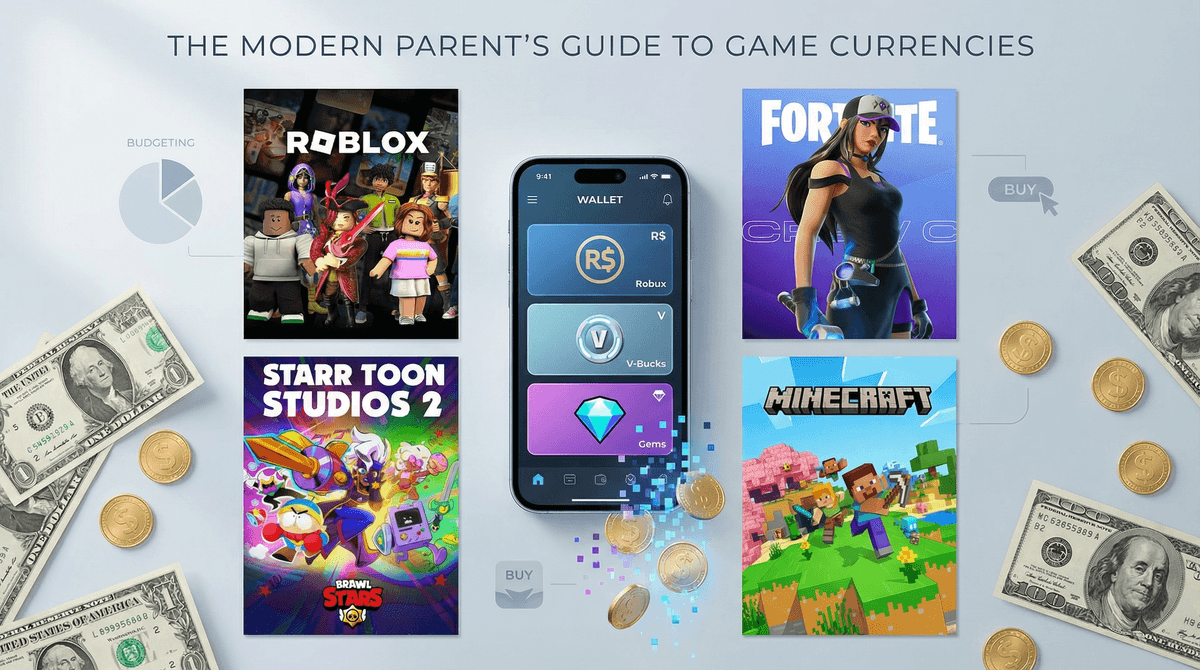
Digital currencies like Robux, V-Bucks, and Gems are the new chore money, but they come with a psychological twist designed to keep kids spending. While it’s easy to dismiss "skins" as digital junk, they represent status and identity in your child’s social circle. Use this as a low-stakes way to teach budgeting, but keep a tight grip on the "Buy" button to avoid "accidental" $100 charges.
Quick Links:
- Roblox (Robux)
- Fortnite (V-Bucks)
- [Brawl Stars](https://screenwiseapp.com/media/brawl-stars-app (Gems/Bling)
- Minecraft (Minecoins)
- How to set up Roblox parental controls
- Is Fortnite safe for kids?
If you’ve ever had a 9-year-old look you dead in the eye and explain why they need 1,000 Robux to look "less like a noob," you’ve entered the digital currency era. To us, it looks like Monopoly money. To them, it’s the difference between being the "skibidi" king of the server or being totally "Ohio" (which, for the uninitiated, means weird or cringe).
The struggle is real: you want to be the "cool" parent who understands their world, but you also don’t want to be the parent who finds a $400 bill from Apple because your kid "accidentally" bought a legendary dragon in Adopt Me!.
Digital currencies are essentially a layer of abstraction between real money and the things kids want. By turning $10 into 800 shiny gold coins, game developers make it much easier for a child’s brain to bypass the "is this worth it?" filter.
Most games use a "freemium" model. The game is free to download, but the "fun" (or at least the social standing) is locked behind a paywall. Here are the heavy hitters your kids are likely asking for:
The king of digital currencies. Roblox isn't just one game; it's a platform with millions of games. Robux can be used to buy "Game Passes" (special powers in specific games), clothing for their avatar, or even to create their own games.
Learn more about how Robux is in fact real money
V-Bucks are used primarily for "skins" (outfits), "emotes" (dances), and the "Battle Pass." In Fortnite, these items are purely cosmetic—they don’t actually make you play better—but the social pressure to not be a "default" (someone using the free, basic skin) is massive.
[Gems (Brawl Stars & Clash of Clans)](https://screenwiseapp.com/media/brawl-stars-app
In games like [Brawl Stars](https://screenwiseapp.com/media/brawl-stars-app or Clash of Clans, gems are often used to speed up progress. Want that building finished now instead of in 24 hours? Use gems. Want to unlock a new "Brawler" without grinding for weeks? Use gems. This is where the "pay-to-win" frustration usually kicks in.
It’s easy to think, "Why would you spend $20 on a digital shirt you can't even wear?" But for Gen Alpha, their digital identity is just as real as their physical one.
- Digital Status: In the same way we might have wanted the right brand of sneakers in middle school, kids today want the "Limited Edition" skin in Fortnite.
- The "Battle Pass" Grind: Most games now offer a "Battle Pass." You pay once (usually around $10), and then you "earn" rewards by playing. It turns the game into a job, but one they actually want to do.
- FOMO (Fear Of Missing Out): The "Item Shop" in these games usually refreshes every 24 hours. If that cool skin is there today, it might be gone for six months tomorrow. This creates a sense of urgency that kids are developmentally unequipped to handle.
Game developers use a few "dark patterns" to keep the cash flowing:
- Obfuscation: By selling Robux in odd increments (like 400, 800, or 1,700), it’s hard for a kid (or a tired parent) to do the mental math. 400 Robux is roughly $5.00, but when a game item costs 120 Robux, the "real world" cost is intentionally blurry.
- The "Sunk Cost" Trap: Once a kid has spent $10 on a Battle Pass, they feel they must play every day to "get their money's worth."
- Loot Boxes: Some games use "Gacha" mechanics (like in Genshin Impact), where you pay for a chance to get a rare item. This is essentially gambling-lite.
Ages 5-8: The "No-Fly Zone"
At this age, kids have zero concept of digital value. They will click "Buy" because the button is shiny.
- Strategy: Password-protect every purchase. If they want something, you do the transaction. Better yet, stick to games with no in-app purchases, like Toca Life World (though even that has "packs" you can buy).
- Talk about it: "This shiny coin costs real money that we use for groceries."
Ages 9-12: The Digital Allowance
This is the sweet spot for learning. Many parents in the Screenwise community use digital currency as a reward for chores or as a monthly allowance.
- Strategy: Give them a set amount (e.g., $10 of Robux a month). Once it’s gone, it’s gone. If they blow it all on a "skibidi" hat on day one, they learn a hard lesson about budgeting.
- Safety: This is the age they start looking for "Free Robux" scams on YouTube. Explain that there is no such thing as free Robux—it’s always a scam to steal their account.
Ages 13+: The Entrepreneurial Phase
Teens might actually start earning their own digital currency. On Roblox, kids can actually create items and sell them for Robux, which can eventually be converted back into real USD (though the exchange rate is brutal).
- Strategy: Encourage the "creator" side. If they want more V-Bucks, maybe they can learn to edit videos or help with a neighborhood job to earn the cash.
- Budgeting: Help them track their spending. Seeing that they spent $150 on Fortnite over six months can be a huge eye-opener.
Beyond the bank account, there are real safety risks associated with these currencies:
- Account Phishing: Scammers target kids by promising "glitches" to get free currency. They’ll ask for the kid’s password, and then—poof—the account (and all the money spent on it) is gone.
- Predatory Trading: In games like Adopt Me!, kids trade virtual pets. Older or more experienced players often "scam" younger kids out of rare items that cost real money. It’s a harsh world out there.
- Third-Party Sites: Never buy Robux or V-Bucks from a random website. Only buy through the official game app or reputable retailers (like a physical gift card from Target).
Instead of "Why are you wasting money on this garbage?", try:
- "I see you really like that skin. What makes it cooler than the one you have?"
- "If you spend your $10 on this today, you won't be able to get the next Battle Pass in three weeks. Which one do you want more?"
- "Let's look at how much you've spent on [Brawl Stars](https://screenwiseapp.com/media/brawl-stars-app this year. Does that feel like a good value to you, or would you rather have had a new LEGO set?"
Digital currency is here to stay. Whether it's the "Gems" in Clash Royale or the "Minecoins" in Minecraft, your kids are going to be navigating these virtual economies for years.
Don't pull your hair out over it. Instead, treat it like a training simulator for the real world. It’s much better for them to learn that "impulse buys are usually a letdown" when it costs $5 of Robux than when it costs $5,000 on a credit card in their 20s.
Next Steps:
- Audit the Apps: Check your phone’s settings to ensure "Ask to Buy" is turned on.
- Set a Budget: Decide if digital currency is a "gift-only" item or part of a regular allowance.
- Play with them: Jump into Roblox for 20 minutes. You might still think it's brain rot, but at least you'll understand why they want that "epic" sword.