

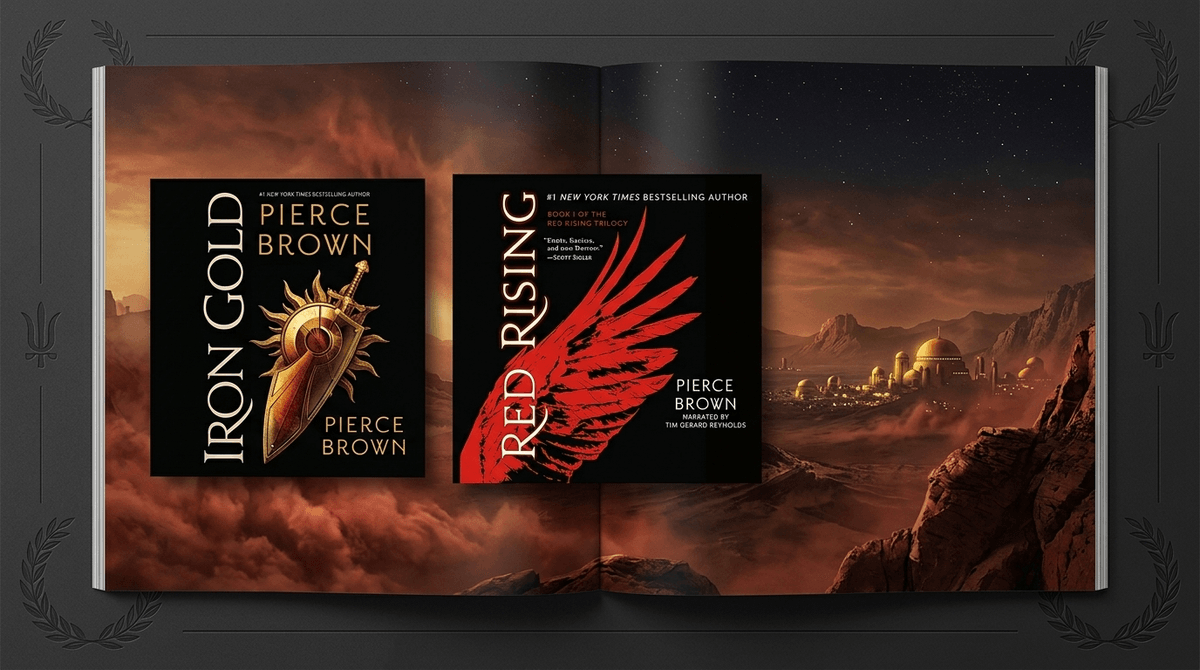
If your teen is asking to read Red Rising, you should know it’s basically a "hard 14"—it’s significantly more violent and sweary than The Hunger Games, but for a mature high schooler, it’s one of the most compelling sci-fi stories written in the last decade. While it's often shelved in the Young Adult section, the visceral descriptions of "the passage" and the brutal class warfare mean it leans much closer to "New Adult" or adult sci-fi.
TL;DR
The Red Rising series by Pierce Brown is a high-octane sci-fi epic best suited for ages 14 and up due to its extreme graphic violence, heavy themes of class warfare, and frequent profanity. While it's often compared to The Hunger Games, it's significantly more brutal and complex, making it a fantastic pick for mature teens who can handle intense action and moral ambiguity. Screenwise generally recommends this for high schoolers who have already graduated from lighter dystopian series.
Set in a color-coded caste system on a terraformed Mars, Red Rising follows Darrow, a "Red" miner who discovers his entire life has been a lie. The "Golds" (the ruling elite) have been living in luxury on the surface for generations while the Reds toil underground believing they are pioneers. Darrow undergoes a physical transformation to infiltrate the Gold Institute—a brutal training ground that makes the Hunger Games look like a summer camp—to tear the system down from the inside.
Think of it as a mix of Roman history, Dune, and Lord of the Flies. It’s fast-paced, incredibly smart, and doesn’t pull any punches when it comes to the cost of revolution.
There’s a reason this series has such a cult following in 2026. For a teen, Darrow is the ultimate underdog. He’s driven by grief and a sense of justice, but he also has to become the very thing he hates to win. It’s a high-stakes power fantasy that feels "grown-up" without being inaccessible.
The world-building is also top-tier. Pierce Brown uses a lot of "in-universe" slang—calling things "gory" or "slag"—which makes the world feel lived-in. It’s the kind of series that teens stay up until 3:00 AM reading because the cliffhangers are genuinely stressful.
If you’re deciding whether your 12 or 13-year-old is ready, here is the "no-BS" breakdown of what’s actually in these pages.
The Violence is Graphic
This is the biggest hurdle. In the first book alone, there are scenes of hanging, blunt-force trauma, and "the passage," where students are forced to kill a peer with their bare hands just to enter the school. Unlike some YA where the violence is stylized or glossed over, Brown describes the blood, the breaking bones, and the psychological trauma that follows. By the later books like Iron Gold, the scale of war involves millions of deaths and some truly stomach-churning torture scenes.
Language and "Gory" Slang
The characters swear. A lot. They use standard profanity (f-bombs included), but they also use world-specific slurs like "low-color" or "pixie." If your teen is sensitive to language, this might be a bit much, but most 15-year-olds have likely heard worse in a Call of Duty lobby.
Complex Themes
This isn't a simple "good guys vs. bad guys" story. It deals with the ethics of terrorism, the corruption of power, and whether a "good" person can lead a violent revolution. It’s heavy stuff that is great for a 16-year-old’s developing critical thinking skills, but might just be depressing for a younger kid who wants a simple adventure.

If your teen is diving into the "Society," use it as a bridge to talk about real-world issues. The "Color" system is a very thin allegory for racial and socio-economic hierarchies.
- Ask them about the Golds: "Do you think the Golds actually believe they are helping the other colors, or are they just making excuses for their own power?"
- The cost of winning: "Darrow has to do some pretty terrible things to achieve his goals. At what point does the hero become a villain?"
- The Roman influence: If they’re into history, point out the Roman names and structures. It’s a great way to make those ancient history lessons feel relevant again.
If you think Red Rising is a bit too intense for your middle-schooler right now, there are some great "stepping stone" books that offer similar vibes with a bit less gore:
- Scythe by Neal Shusterman: Deals with death and society in a very cool, slightly less "bloody" way.
- The Hunger Games: The classic for a reason. If they haven't read it, start here.
- Legend by Marie Lu: Fast-paced, dual perspectives, and very teen-friendly.
- Skyward by Brandon Sanderson: If they want the sci-fi/pilot vibes without the "I'm going to have nightmares" violence.
Q: Is Red Rising appropriate for a 12-year-old?
Probably not. While every kid is different, the level of graphic violence—including a scene where a character is forced to kill a friend with their bare hands—is generally too intense for most 12-year-olds. Screenwise recommends waiting until at least 14.
Q: Is there sexual content in Red Rising?
There is some romance and mentions of "Pink" slaves (who are bred for beauty and sex), but the books are not sexually explicit in the way "romantasy" novels are. Most sexual encounters are "fade-to-black," though the implications of the caste system are dark and worth discussing with your teen.
Q: Is the Red Rising series finished?
As of 2026, the main "Hexalogy" (the two trilogies) is complete, concluding with Red God. It’s a massive commitment, but for a teen who loves binge-reading, it’s a goldmine of content.
Q: How does it compare to The Hunger Games?
Think of The Hunger Games as the PG-13 version and Red Rising as the R-rated version. The stakes are higher, the world is bigger (the whole solar system), and the political maneuvering is much more complex.
Red Rising is a "Tier 1" sci-fi series. It’s brilliant, it’s emotional, and it’s incredibly violent. If your teen is 14 or 15 and has a solid handle on the difference between "fictional brutality" and "real-world values," they are likely ready to join the Rising. Just be prepared for them to start using words like "prime" and "gory" around the dinner table.