

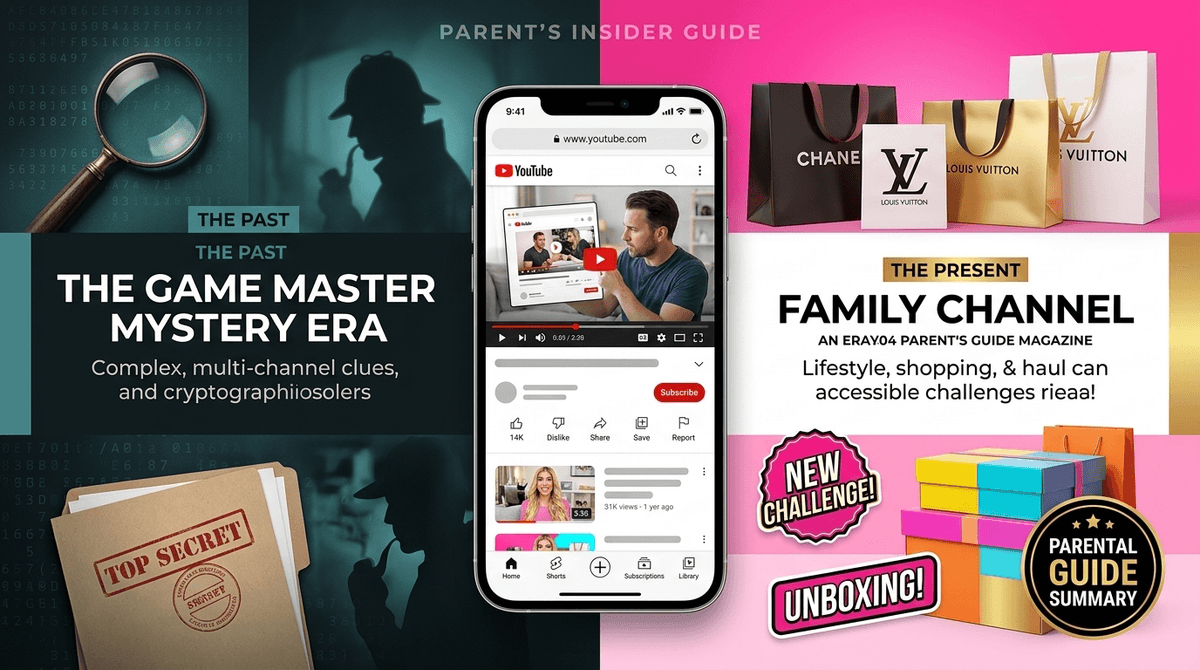
From Game Master to Mean Pranks: The Truth About Rebecca Zamolo's Family Channel
Your kid isn't watching Rebecca Zamolo for the Game Master stuff anymore — she's deep in the family channel videos, and honestly, that's the part worth paying attention to.
The Game Master era was goofy spy-mystery content. Weird, sure, but mostly harmless. What's pulling kids in now is something different: haul videos, "mean girl" challenge formats, over-the-top reactions to expensive things, and a steady drip of interpersonal drama that models some genuinely concerning social behavior. If you've noticed your daughter getting a little more obsessed with brand names, or practicing some sharp-tongued "jokes" on her siblings, there's a decent chance the family channel content is in the mix.
TL;DR: Rebecca Zamolo's family channel content has shifted heavily toward materialism, shopping hauls, and challenge videos that sometimes model unkind behavior. The Game Master mystery arc is largely background noise now. Here's what's actually in the videos your kid is watching — and how to have a real conversation about it.
Rebecca Zamolo started as a gymnastics-and-stunts YouTuber, then exploded with the Game Master Network — an elaborate, serialized mystery format where she and her husband Matt Slays were always being chased, trapped, or tested by some shadowy organization. Kids loved it. It was basically a YouTube soap opera with obstacle courses.
But the channel has evolved, and the family content has taken center stage. We're talking:
- Shopping hauls and "I bought everything in ___" videos — the format where the entire premise is spending money and reacting to stuff
- Challenge videos with interpersonal stakes — "Who knows me better?", "Last to ___", and formats that involve winners, losers, and sometimes pretty pointed commentary
- Lifestyle content that showcases a very specific, very expensive version of life
- Drama-adjacent content where conflict between people is the entertainment engine
The audience skews ages 7–12, heavily female, and the content hits at exactly the developmental moment when kids are starting to figure out social hierarchies, what's "cool," and how they measure up to others.
1. The Materialism Loop
The haul-and-reaction format is a genuinely effective machine for making kids feel like stuff = happiness. It's not Rebecca Zamolo specifically — it's the entire genre. But when your kid watches someone squeal with delight over a $200 mystery box for the 40th time, the implicit message lands: wanting things and getting things is exciting, and having more is better.
Research on parasocial relationships (the one-sided "friendship" kids feel with YouTubers) suggests kids are more susceptible to the values modeled by creators they feel close to than they are to advertising they know is advertising. The haul video is essentially a commercial your kid doesn't recognize as one.
If your daughter has started asking for more stuff, being less satisfied with what she has, or measuring her happiness by things she wants — this content format is worth examining.
2. The "Mean Girl" Challenge Energy
This is the one that's trickier to articulate but very real. Some of the challenge and prank content in the family channel sphere — not just Zamolo, but the whole ecosystem she's part of — involves:
- Pointed "jokes" that have a clear target
- Ranking people or their choices as part of the game format
- Reactions that model contempt — eye rolls, dramatic disgust, dismissiveness — as entertainment
- Social exclusion as a punchline
None of it is overtly cruel. It's all wrapped in "just kidding!" energy. But kids in the 7–12 window are incredibly good at absorbing the social scripts they see modeled, and "I was just joking, why are you so sensitive?" is a script that causes real damage on playgrounds and in group chats.
Based on Screenwise community data, 42% of kids are watching YouTube solo — no adult in the room, no co-viewing, just a kid and an algorithm. Another 38% watch with some supervision. Only 20% of families have opted out of YouTube entirely.
That 42% solo-viewing number matters here, because the family channel content on YouTube is designed to autoplay into more of the same. A kid who starts on a Game Master video can be three or four videos deep into haul content and challenge drama before anyone notices. The YouTube Kids app, which only 20% of families in our community are using, would filter a lot of this — but most kids Rebecca Zamolo's audience age have already aged out of it or refuse to use it.
Average screen time in our community sits at 4.2 hours on weekdays and 5 hours on weekends. That's a lot of time for these content patterns to accumulate.
The worst move here is banning it cold and making it forbidden fruit. The better move is watching some of it with her and letting the conversation happen naturally.
Some questions that open things up without feeling like a lecture:
- "Do you think they actually bought all that stuff, or is some of it sent to them for free?" (This one is genuinely interesting — most kids don't know about brand deals and gifted products)
- "That challenge seemed kind of rough on [person]. Did you notice that?"
- "If you were on that show, how do you think you'd feel if you lost?"
- "What do you think their house is actually like when the cameras are off?"
You're not trying to get her to stop watching. You're building the muscle of watching critically — which is a skill that will serve her across every piece of media she ever consumes.
Get tips on how to talk to kids about influencer culture
If you're looking for YouTube content that scratches the same itch — personality-driven, fun, slightly dramatic — without the materialism loop or the mean-girl energy, a few options worth knowing:
- Smarter Every Day — same "wow, look at this!" energy, but aimed at the world being genuinely interesting
- Emily Tube — crafts and creativity content with a similar audience
- Marques Brownlee (MKBHD) — for slightly older kids who like the "reaction to cool stuff" format but want it grounded in actual information
- Simone Giertz — builds ridiculous robots, incredibly funny, models persistence and self-deprecating humor instead of contempt
Or honestly — if she's drawn to the interpersonal drama and social dynamics, that's a completely normal developmental interest. Books like The Clique series or Wonder by R.J. Palacio channel that exact interest into something that actually builds empathy rather than eroding it.
Explore YouTube alternatives for tween girls
The Game Master content is mostly a non-issue. It's serialized, goofy, and the "danger" is theatrical. If that's what she's watching, you can mostly relax.
The family channel content is worth your attention. Not because it's going to ruin your kid, but because it's a consistent drip of values — about money, about social status, about how you treat people when it's "just a joke" — and drips add up.
YouTube's algorithm is not your friend here. It will reliably serve more of whatever she's already watching. Setting up YouTube parental controls or using the supervised account feature can help you see what's in her watch history and set some guardrails without going full lockdown.
She's not doing anything wrong by watching it. Half the kids her age are watching similar content. This is about helping her watch it with a little more awareness — and making sure it's not the only input she's getting about what's cool, what's funny, and how to treat people.
Learn more about parasocial relationships and kids
Q: Is Rebecca Zamolo appropriate for a 7-year-old?
The Game Master content is generally fine for ages 7+, though it's a bit intense for sensitive kids. The family channel and challenge content is more appropriate for ages 9–10+, mostly because of the social dynamics and materialism themes that younger kids absorb without much filtering. Co-viewing and occasional check-ins are worth it at age 7.
Q: What happened to the Game Master Network on Rebecca Zamolo's channel?
The Game Master mystery arc has largely wound down as a central format — it still appears but isn't the main driver of content anymore. The channel has shifted toward family lifestyle, challenge, and reaction content, which is what's pulling in most of the current viewership.
Q: Why does my daughter want to buy everything after watching YouTube?
Haul videos and reaction content are specifically designed to make products feel exciting and desirable — and because kids feel a genuine connection to their favorite YouTubers, the influence lands harder than traditional advertising. Learn more about how influencer marketing affects kids and some concrete ways to talk about it without turning into a lecture.
Q: Is YouTube Kids a good alternative for kids who watch Rebecca Zamolo?
YouTube Kids would filter out most of the family channel content, but kids in the 8–12 range often reject it as "babyish." The supervised accounts feature on regular YouTube is a better middle ground — it lets you approve channels and see watch history without the stigma of the Kids app. Our community data shows only 20% of families are using YouTube Kids, which tracks with this exact dynamic.
Q: How do I know if the YouTube content my kid watches is affecting her behavior?
Watch for increased requests for specific products or brands, dismissive or contemptuous humor toward siblings or friends ("I was just joking"), and a general sense that what she has is never quite enough. None of these are definitive proof, but if multiple things are showing up at once, it's worth spending some time watching the content together and having a real conversation about what she finds appealing about it.
Rebecca Zamolo isn't a monster, and your kid isn't being corrupted. But the family channel content she's currently hooked on is doing some quiet work on how your daughter thinks about stuff, status, and how you treat people when it's "just for fun." That's worth a conversation — not a ban, not a panic, just a conversation.
The good news: kids this age are genuinely capable of thinking critically about media when adults engage with them as intelligent people rather than just shutting things down. Watch a video together. Ask real questions. Let her be the expert on what she likes about it, and then gently introduce some friction.
That's the whole game.