

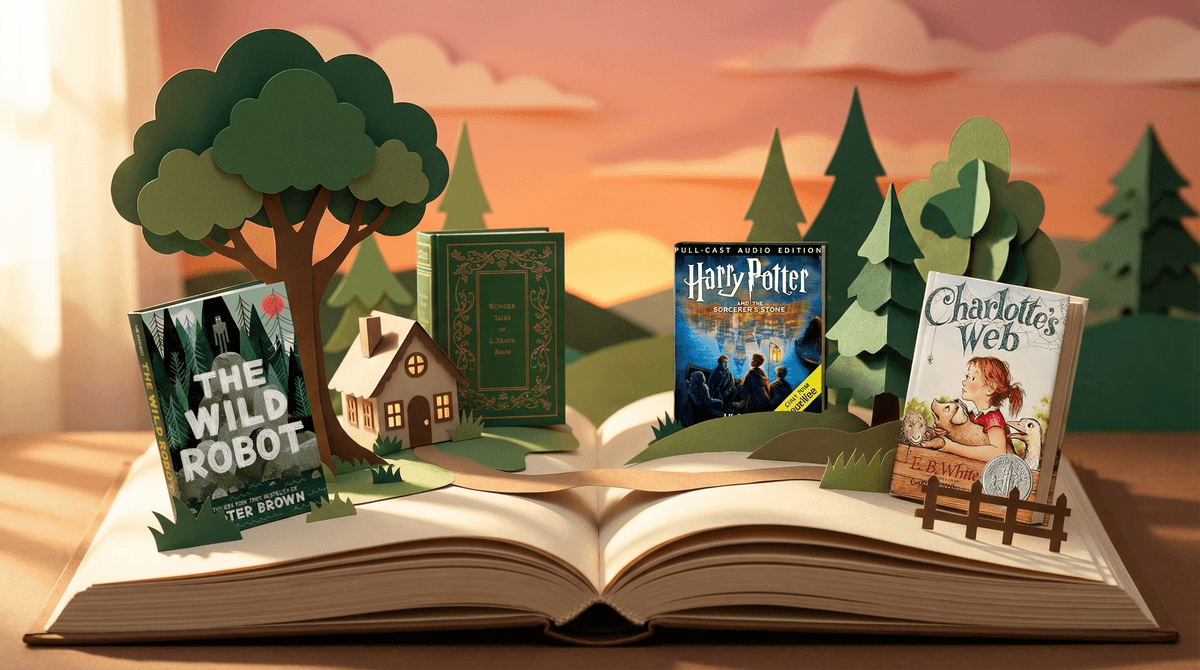
Read-aloud books are exactly what they sound like — books you read out loud to your kids. But here's the thing: this isn't just a bedtime routine for toddlers. Elementary-age kids (we're talking K-5, roughly ages 5-11) benefit enormously from being read to, even after they can read independently.
The magic happens because listening comprehension develops faster than reading comprehension. A second-grader who's slogging through early chapter books on their own can follow (and love) Harry Potter when you read it aloud. You're essentially giving them access to richer vocabulary, more complex plots, and bigger ideas than they could tackle solo.
Screenwise Parents
See allPlus, in an age where we're all worried about screen time, this is the ultimate analog activity that actually holds kids' attention. No notifications, no autoplay, just you, them, and a good story.
Let's be real: getting kids to put down Roblox or Minecraft for literally anything else feels like an uphill battle. But read-aloud time is one of those rare activities that can compete with screens because it offers something screens often don't — genuine connection and your full attention.
Research consistently shows that kids who are read to regularly have larger vocabularies, better focus, and stronger empathy (because stories literally help us practice seeing the world through other people's eyes). But beyond the academic benefits, this is about creating a ritual. Twenty minutes of reading together can be the calm in the chaos of homework, activities, and yes, the inevitable "just one more YouTube video" negotiations.
And here's something nobody talks about enough: read-aloud time is when kids ask the big questions. Something in the story will spark a conversation about friendship, fairness, fear, or family dynamics in a way that "how was school?" never will.
Early Elementary (K-2, ages 5-7): These kids are just learning to read independently, so your read-aloud choices can be way more sophisticated than what they're tackling in school. Think chapter books with 5-10 minute chapters.
- The Wild Robot by Peter Brown — A robot learning to survive on an island. Themes of belonging and kindness without being preachy.
- Ivy + Bean series by Annie Barrows — Two very different girls become friends. Short chapters, genuinely funny.
- The Ramona books by Beverly Cleary — Still holds up. Ramona's family feels real in a way that's refreshing.
- Charlotte's Web by E.B. White — Yes, it's a classic for a reason. Fair warning: have tissues ready.
Middle Elementary (3-4, ages 8-10): These kids can handle more complex plots, moral ambiguity, and longer reading sessions. This is prime time for series that become family obsessions.
- Percy Jackson series by Rick Riordan — Greek mythology meets middle school. Funny, fast-paced, and the main character has ADHD and dyslexia (represented authentically).
- Wonder by R.J. Palacio — A kid with facial differences starts mainstream school. Will absolutely generate conversations about kindness and what it means to be brave.
- The Wild Robot Protects by Peter Brown — If they loved the first one, this sequel goes deeper.
- Hatchet by Gary Paulsen — Survival story that's genuinely gripping. Great for kids who like action.
Upper Elementary (5th grade, ages 10-11): Fifth graders are in this interesting space where they're not quite middle schoolers but definitely not little kids anymore. They can handle nuance, humor with bite, and stories that don't tie everything up in a neat bow.
- The Giver by Lois Lowry — Dystopian classic that sparks incredible discussions about freedom, memory, and what makes life meaningful.
- Holes by Louis Sachar — Multiple storylines that weave together brilliantly. Funny and sad and satisfying.
- Refugee by Alan Gratz — Three kids, three time periods, all fleeing danger. Heavy topics handled accessibly.
- The Phantom Tollbooth by Norton Juster — Clever wordplay and big ideas about curiosity and learning. Some kids find it slow, but the right kid will be obsessed.
"My kid says they're too old to be read to." This is where you get creative with framing. Call it "audiobook time but live" or "story time" instead of "reading to you." Some families make it a whole-family thing after dinner. The key is making it feel special, not babyish.
"We start books and never finish them." That's actually fine! If a book isn't working after a few chapters, bail. There are too many good books out there to force your way through something nobody's enjoying. That said, some books have slow starts — give it at least three chapters before deciding.
"I don't have time for this." Fair. But consider: 15-20 minutes of reading aloud can replace 15-20 minutes of YouTube or TikTok (for them or for you). It's not about adding to your day, it's about being intentional with time you're already spending together — maybe during dinner prep, or right before bed, or on weekend mornings.
"What about audiobooks?" Audiobooks are great! They're not quite the same as reading aloud together (you lose the snuggled-up connection part), but they're still way better than passive screen time. Some families do a hybrid: read aloud on weeknights, audiobooks in the car or during quiet time on weekends.
Representation matters. Look for books where your kids can see themselves and books where they see others. If your family is white, make sure you're reading books by authors of color with protagonists of color. If your kid has a disability or a learning difference, find stories where those experiences are centered authentically, not as inspiration porn.
Read-aloud time is one of the simplest, most powerful tools you have as a parent. It builds literacy, sure, but it also builds connection. It's a shared experience that becomes part of your family's story — the book that made everyone cry, the series you couldn't stop talking about, the character you still reference years later.
In a world where so much of childhood is mediated by screens, reading aloud is radically analog. It's slow, it's intentional, and it requires nothing but a book and your attention.
Start tonight. Pick a book from this list, or ask your librarian for recommendations. Read for 15 minutes. See what happens. The worst case? You spend quality time with your kid. The best case? You create a reader, a thinker, and a tradition that lasts for years.
- Hit your library. Librarians are wizards at matching kids with books. Tell them your kid's age, interests, and reading level — they'll hook you up.
- Try a series. Kids love having something to look forward to, and series keep the momentum going.
- Make it cozy. Blankets, a special spot, maybe tea or hot chocolate. Make the ritual something everyone wants to show up for.
- Ask your kid's teacher. They often have great recommendations based on what's popular with their class.
And if you want more specific recommendations based on your kid's interests — whether they're into sports, fantasy, science, or graphic novels — Find book recommendations for your specific kid .
.