

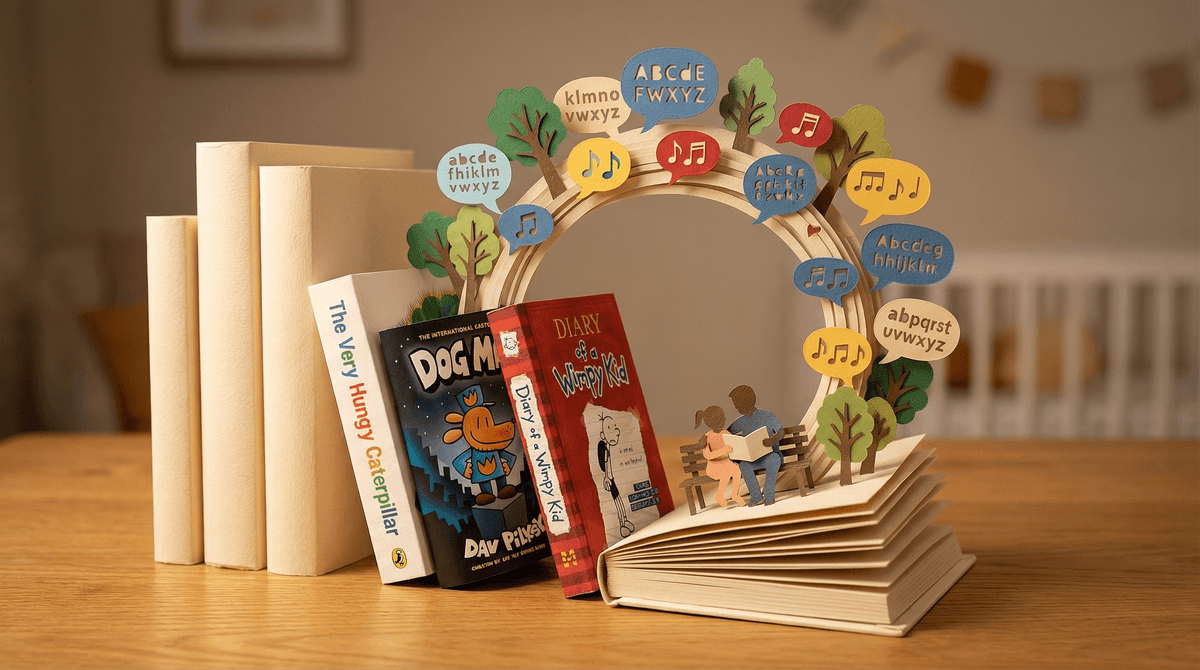
Look, we're all trying to figure out how to raise kids who can actually focus for more than 8 seconds in a world designed to fragment their attention. And if you're raising multilingual kids? You've got an extra layer of complexity — because learning a second (or third) language requires sustained attention, repetition, and genuine engagement.
Here's the thing: books are secretly one of the most powerful language-learning tools you have. Not Duolingo. Not some $200 "immersive" app with gamified lessons. Just regular old books.
And the best part? Reading together in multiple languages doesn't just build vocabulary — it builds connection, cultural identity, and a kind of deep focus that's increasingly rare in childhood.
I know, I know — there are some genuinely good language learning apps out there. Duolingo has its place. But here's what books do that screens can't:
1. They force real conversation. When you read together, you're naturally stopping to explain words, ask questions, make connections. That back-and-forth is where language actually gets learned — not in a gamified loop of "tap the correct translation."
2. They build cultural context. A book set in your heritage country, with characters who look like your family and eat the foods you eat? That's not just language learning — that's identity formation. Kids don't just learn words; they learn why those words matter.
3. They create rituals. Bedtime stories in Mandarin. Saturday morning picture books in Spanish. These aren't just language lessons — they're the emotional scaffolding of childhood. And when language learning is tied to warmth and connection, kids actually want to engage with it.
4. No autoplay. You know what doesn't happen with a book? Your kid doesn't "accidentally" end up three hours deep in unboxing videos when you just wanted them to practice their French vocabulary.
Let's be honest: raising multilingual kids is hard. Especially if you're doing it in an English-dominant environment where your kid's school, friends, and every screen they encounter is reinforcing one language over the others.
The most common struggle? Kids resist. They don't want to read in the "hard" language. They don't want to sit through a book when they could be on Roblox or watching YouTube. And if you're exhausted from work and just trying to get through dinner and bedtime, it's really easy to let it slide.
But here's the thing: consistency matters more than perfection. You don't need to read in the target language every single night. You don't need to ban English-language books. You just need to create regular, low-pressure opportunities for your kids to engage with books in the language you're trying to preserve.
Ages 0-5: Make It Sensory and Fun
This is the golden window. Their brains are primed for language acquisition, and they're not yet self-conscious about sounding "weird" or making mistakes.
- Picture books with rhythm and repetition are your best friend. Think The Very Hungry Caterpillar but in your target language.
- Tactile books (lift-the-flap, touch-and-feel) keep little hands engaged while you narrate in the second language.
- Don't worry about "reading" the words. At this age, you can just describe the pictures, ask questions, make animal sounds — whatever keeps them engaged with the book and the language.
Ages 6-10: Leverage Their Interests
This is where it gets tricky. They're starting to realize that English is "easier," and they might resist books in the minority language.
Your move: find books about things they're already obsessed with. If they're into dinosaurs, get dinosaur books in Mandarin. If they're into soccer, find Spanish-language chapter books about kids who play soccer. If they're into Minecraft? Yes, there are Minecraft tie-in books in multiple languages.
Also: graphic novels and comics are your secret weapon. The visual context helps with comprehension, and they feel less intimidating than a wall of text. Look for translations of popular series like Dog Man or Diary of a Wimpy Kid.
Ages 11+: Give Them Autonomy (But Keep the Routine)
Tweens and teens are going to resist anything that feels like homework. So don't make it homework.
- Let them choose the books. Take them to a bookstore (or browse online) and let them pick what looks interesting — even if it's "below their reading level" in the target language. The goal is engagement, not perfection.
- Audiobooks count. If they're willing to listen to a book in the minority language while drawing or doing chores, that's a win. Audible and Libby have huge multilingual catalogs.
- Connect it to identity. At this age, kids are figuring out who they are. Books by authors from their heritage culture — especially YA novels that deal with identity, immigration, or straddling two worlds — can be incredibly powerful.
1. Start with just 10 minutes a day. Seriously. You don't need an hour-long immersive reading session. Just 10 minutes before bed, in the target language, is enough to maintain momentum.
2. Use the library. Most public libraries have multilingual collections, and if they don't have what you need on the shelf, they can often do interlibrary loans. You can also use Libby to access ebooks and audiobooks in dozens of languages.
3. Make it a trade. "We'll read one book in Spanish, then one in English." Kids are more willing to engage if they know their preferred language is coming next.
4. Read books you loved as a kid. If you grew up reading certain books in your heritage language, share them with your kids. Your enthusiasm will be contagious, and it's a way to pass down your own childhood.
5. Don't stress about perfect pronunciation. If you're not a native speaker, or if you're rusty, that's okay. Your kid is still getting exposure to the language, and you can always supplement with audiobooks narrated by native speakers.
You know those books with English on one page and the target language on the other? They're... fine. But honestly, they're not ideal.
Here's why: kids will default to the easier language. If English is right there on the page, they'll read that and tune out the rest.
If you do use bilingual books, try this: cover the English side with your hand or a piece of paper. Read the target language first, and only reveal the English if they're truly stuck.
Raising multilingual kids is a marathon, not a sprint. There will be phases where they resist, phases where they seem to forget everything, phases where they only want to read in English.
But here's the truth: every book you read together in the minority language is a deposit in the bank. Even if they don't seem engaged in the moment, even if they complain, even if they don't respond in the target language — they're absorbing it.
And unlike screen-based language learning, which fragments attention and relies on external rewards, reading together builds something deeper: a love of stories, a connection to heritage, and the ability to sit with a book and focus — which, let's be real, is a superpower in 2026.
- Audit your home library. How many books do you have in the target language? If the answer is "not many," make a library trip this week.
- Set a small, achievable goal. Maybe it's one book in the minority language every Saturday morning. Maybe it's 10 minutes before bed three nights a week. Start small and build from there.
- Connect with other multilingual families. Book swaps, reading groups, or even just informal playdates where kids hear peers speaking the minority language can be incredibly motivating.
And if you're feeling overwhelmed by the sheer number of screens competing for your kid's attention? Talk to us . We can help you figure out a sustainable balance that actually works for your family.