

Mind Games: Why Teens Love Psychological Thrillers (And What to Watch For)
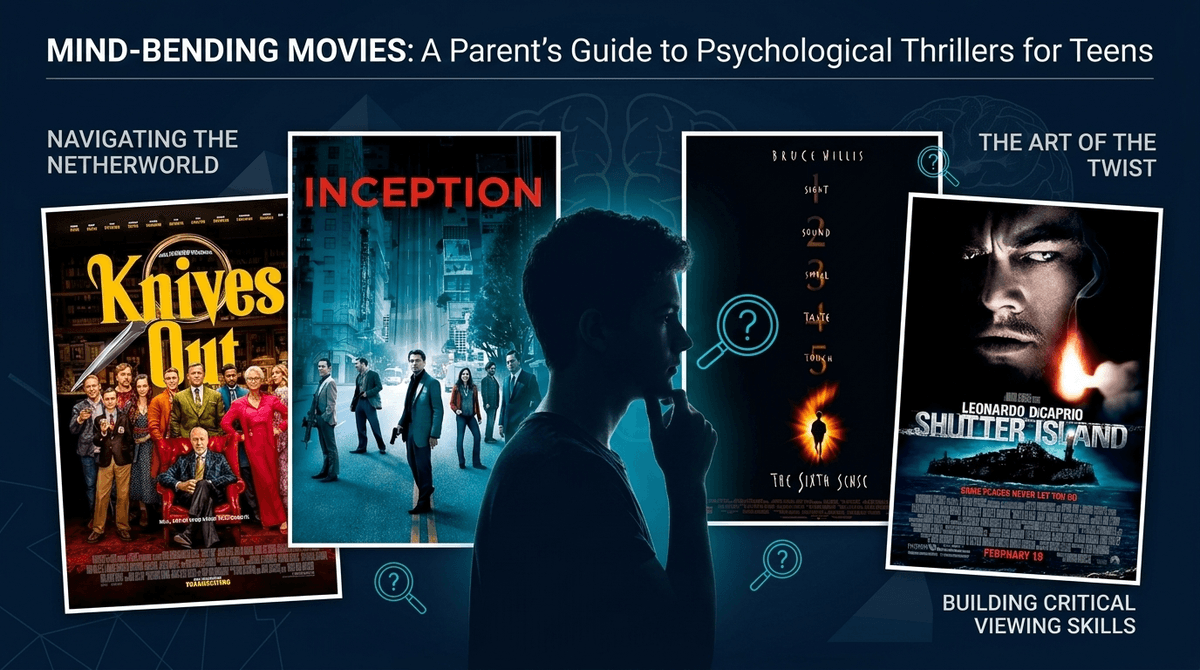
TL;DR: Your teen wants to watch something twisty, dark, and mind-bending. Here's how to navigate psychological thrillers without losing sleep (yours or theirs): Knives Out, Gone Girl, Shutter Island, and The Sixth Sense are solid starting points. Skip Black Swan until college.
There's something about the teenage brain that craves unreliable narrators and plot twists you don't see coming. Maybe it's because adolescence itself feels like one giant psychological thriller—you're constantly questioning reality, figuring out who to trust, and navigating social situations where nothing is quite what it seems.
According to our Screenwise community data, 92% of families report regular TV watching, with 40% using Netflix with kids' profiles and another 40% using it regularly as a family. Meanwhile, 42% of kids are watching YouTube solo and 38% with supervision. Translation: your teen is consuming something, and they're probably seeing thriller content recommended to them constantly.
Psychological thrillers offer a safe space to explore complex emotions—paranoia, betrayal, moral ambiguity—without real-world consequences. They're also genuinely intellectually engaging. A good psychological thriller requires active viewing: tracking clues, questioning motives, piecing together timelines. It's the opposite of passive scrolling, which is honestly refreshing.
Not all thrillers are created equal. Psychological thrillers focus on the mind—unreliable narrators, gaslighting, identity crises, perception vs. reality. They're about the terror of not knowing what's real, not about jump scares or gore (though some have both).
The difference between a psychological thriller and a horror movie? Get Out is a psychological thriller with horror elements. The Conjuring is straight horror. Inception is a psychological thriller wrapped in a heist movie. Se7en is a psychological thriller that will haunt you for weeks (not for teens, by the way).
Ages 13-14: Gateway Thrillers
Knives Out (PG-13) This is the perfect starter psychological thriller. It's got the twisty plot, the unreliable testimonies, the "wait, what just happened?" moments—but it's also genuinely funny and ultimately optimistic. No graphic violence, no sexual content, just a brilliantly constructed whodunit that rewards careful attention. The sequel, Glass Onion, is equally solid.
The Sixth Sense (PG-13) The twist that launched a thousand imitators. Yes, it's about a kid who sees dead people, but it's more melancholy than scary. Some intense moments but nothing gratuitous. Great for teaching media literacy about misdirection and visual storytelling.
Now You See Me (PG-13) If your teen wants something lighter, this heist thriller about magician-thieves delivers twists without the psychological darkness. Fun, fast-paced, and genuinely clever in spots.
Ages 15-16: Leveling Up
Shutter Island (R) This is where we enter R-rated territory, but for good reason. Shutter Island is a masterclass in unreliable narration and atmosphere. Some violence and disturbing imagery (it's set in a psychiatric hospital in the 1950s), but the real intensity is psychological. Watch it together the first time—you'll want to discuss the ending.
Gone Girl (R) Controversial pick, I know. This is rated R for language, some violence, and sexual content. But for mature 16-year-olds, it's an incredible examination of marriage, media manipulation, and sociopathy. The "Cool Girl" monologue alone is worth the watch for understanding performative identity. That said, know your kid—this one's dark and cynical.
The Prestige (PG-13) Christopher Nolan's twisty tale of rival magicians. Obsession, sacrifice, and the cost of ambition. Some violence but mostly psychological intensity. Requires multiple viewings to catch everything (which teens love).
Ages 17+: The Deep End
Memento (R) Told backwards. About a man with short-term memory loss hunting his wife's killer. Your teen will need a notepad. Brilliant, challenging, and appropriately rated R for violence and language.
Black Swan (R) Intense psychological breakdown of a ballet dancer. Rated R for strong sexual content, disturbing violent images, language, and some drug use. This is college-age territory—the psychological intensity is genuinely disturbing, even for adults.
Graphic Violence: Some psychological thrillers lean heavily into body horror or explicit violence. Silence of the Lambs is a masterpiece, but it's genuinely disturbing. Same with Prisoners. These are 18+ conversations.
Sexual Content: Gone Girl has explicit scenes. Fatal Attraction is basically about an affair gone wrong. Know what you're walking into.
Nihilism: Some psychological thrillers are deeply cynical about human nature. Nightcrawler is brilliant but offers zero hope for humanity. Balance these with stories that have moral clarity.
Triggering Content: Many psychological thrillers deal with mental illness, suicide, self-harm, or abuse. Girl, Interrupted is set in a psychiatric hospital. Joker is a descent into violent mental illness. If your teen is struggling with their own mental health, these might not be the right choice right now.
With 40% of our community using Netflix with kids and 40% using it regularly, you're probably navigating recommendations together. Netflix's algorithm loves pushing psychological thrillers because they have high completion rates—people binge them.
Some solid options currently streaming:
- The Platform (Netflix, TV-MA): Dystopian psychological thriller. Extremely violent and disturbing—17+ only.
- The Invisible Guest (Netflix, TV-MA): Spanish thriller with incredible twists. Subtitles required, some violence.
- Fractured (Netflix, TV-MA): Man's family disappears from a hospital. Solid unreliable narrator story.
Amazon Prime (used by 62% of our community, with 32% supervised and 30% giving kids free access) has a smaller but decent selection. The Vast of Night is an underrated gem—1950s sci-fi psychological thriller that's atmospheric without being scary.
Here's the thing about psychological thrillers: they're teaching media literacy. Your teen is learning to:
- Question narration and perspective
- Track multiple timelines and unreliable information
- Understand how editing and music manipulate emotion
- Recognize gaslighting and manipulation tactics
- Think critically about what they're shown vs. what's true
These are legitimately valuable skills in 2026, when 8% of kids in our community are on TikTok (where context collapse and unreliable information are the norm) and 42% are watching YouTube solo (where algorithmic recommendations can create reality distortion).
A teen who can track the misdirection in The Usual Suspects is better equipped to spot manipulation in their social media feeds.
Co-viewing is your friend here. Even with older teens, watching psychological thrillers together creates natural discussion opportunities:
- "Did you see that coming?"
- "Do you think they're telling the truth?"
- "What would you have done?"
- "How did the music make you feel in that scene?"
Pause liberally. Rewind to catch details. Look up explanations together after (Reddit threads about psychological thriller endings are genuinely fun rabbit holes).
For younger teens (13-15), I'd recommend watching anything rated R together first before deciding if they can watch similar content solo. Every kid's maturity level is different.
For older teens (16+), you might give them more autonomy but check in after: "How was it? Too intense? Want to talk about it?" Sometimes they'll say no, but keeping the door open matters.
Psychological thrillers aren't just entertainment—they're mental workouts. They demand attention, reward analysis, and create genuine conversation opportunities. In a media landscape dominated by passive scrolling and algorithm-fed content, that's actually pretty valuable.
Start with Knives Out or The Sixth Sense. Work your way up to Shutter Island and Gone Girl. Save Black Swan and Memento for when they're actually ready.
And if your teen wants to go deeper into the genre, check out our guide to thriller movies for teens or Find age-appropriate mysteries .
.
Your teen's brain is already living in a psychological thriller called high school. Might as well give them some well-crafted ones to analyze instead.