

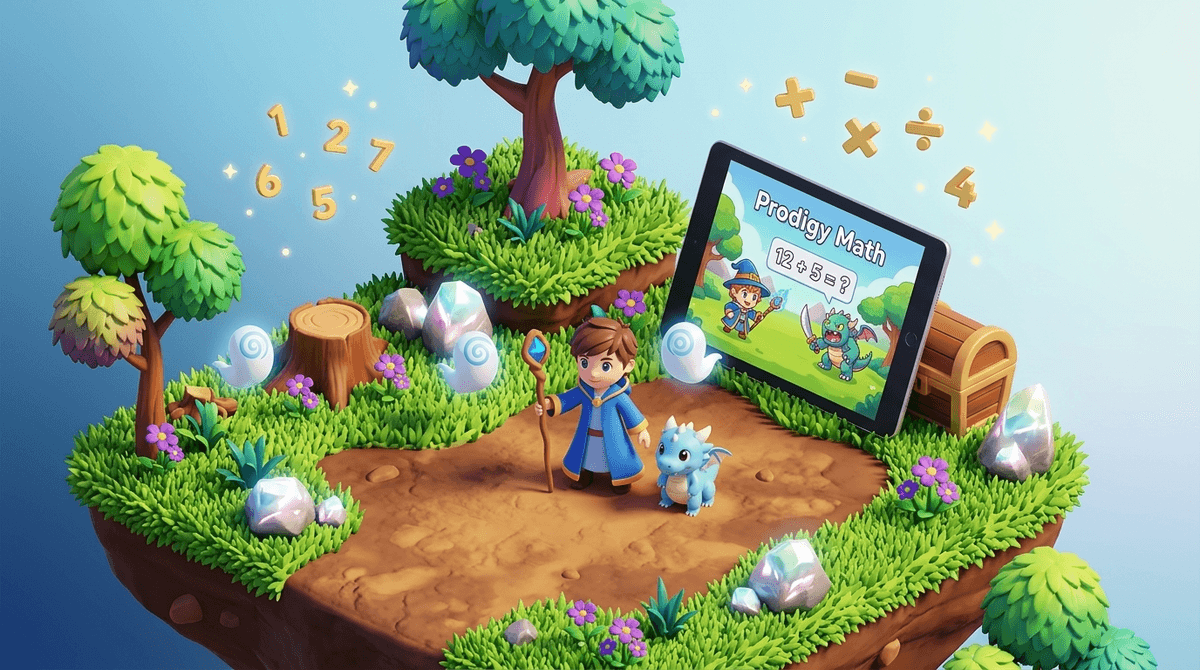
TL;DR: Prodigy Math is a Pokémon-style RPG that uses math problems as a combat mechanic. It’s wildly effective at getting kids to practice math, but it’s also a masterclass in "membership envy" marketing. If you can handle your kid asking for a paid subscription every five minutes, it’s a solid, safe educational tool.
Quick Links:
Imagine if Pokémon and a 3rd-grade math worksheet had a baby. That’s Prodigy Math. It’s a fantasy-themed role-playing game (RPG) where players take on the role of a young wizard. To win "wizard battles," catch pets, and explore new lands, kids have to solve math problems tailored to their grade level.
It’s primarily played as a website on Chromebooks (it’s a staple in elementary school classrooms), but there’s an app version for tablets too. The curriculum covers Grades 1 through 8, and the difficulty scales based on how the student is performing.
If you’ve heard your kid talking about "Epics," "Starlight Fest," or why they desperately need a "Luma" pet, they are deep in the Prodigy lore.
Kids love it because it doesn’t feel like school. It feels like a real game with:
- Avatar Customization: Changing hair, clothes, and gear.
- Pet Collection: Catching and evolving monsters (very Pokémon-coded).
- Social Presence: They can see their friends' avatars running around the same digital world.
- Progressive Rewards: Winning battles earns them "Gold" and items to decorate their in-game house.
For a kid, solving a subtraction problem isn't just a chore—it’s the "spell" that helps them defeat a boss. That’s a powerful psychological shift.
Here is where the "no-BS" part of this guide comes in. Prodigy is free to play, but the marketing for their paid membership is aggressive.
If your child uses the free version, they will constantly encounter "Member Only" items. They’ll see a cool chest they can’t open, a pet they can’t catch, or gear they can’t wear because they don't have a subscription. In the world of 8-year-olds, being a "non-member" can feel like being a "noob."
The membership doesn’t actually help them learn math any faster—it just gives them more "drip" (cosmetic items) and faster game progression. It’s essentially a "freemium" game model applied to education. As a parent, you need to decide if you’re okay with your kid being upsold while they do their homework.
Check out our guide on whether a Prodigy membership is actually worth the money
Yes and no.
Prodigy is fantastic for fluency and practice. If your kid needs to get faster at multiplication facts or more comfortable with fractions, the sheer volume of problems they’ll solve in a session is impressive. According to community data, kids often spend 50% of their time on the site actually solving math problems, which is a higher ratio than many other "edutainment" titles.
However, it’s not great at instruction. If a child doesn't understand a concept, the "hints" provided by the game are often just text-based reminders that a struggling reader might skip. It won't replace a teacher or a parent sitting down to explain why 1/2 is bigger than 1/4.
If you want something that focuses more on deep conceptual understanding and less on wizard hats, you might want to look at Zearn or Khan Academy.
Ages 6-9 (Grades 1-3): This is the sweet spot. The RPG elements are simple enough to navigate, and the "battle" mechanic keeps them engaged with basic arithmetic. You will likely deal with the most "Membership Envy" at this age.
Ages 10-12 (Grades 4-6): Still very popular, though some kids start to find the graphics a bit "kiddie" compared to Roblox or Minecraft. The math gets significantly harder (geometry, early algebra), and the game remains a good way to bribe them into doing extra practice.
Ages 13+: Most kids have aged out of the aesthetic by middle school, though the curriculum does support it. If they’re still playing, they’re likely doing it because it’s an easy way to kill time in the school computer lab.
One of the reasons teachers love Prodigy is that it’s a "walled garden."
- Chat: There is no open text chat. Players can only communicate using pre-written phrases (e.g., "Hello!", "Good game!", "Follow me!"). This eliminates the risk of cyberbullying or predatory behavior found on platforms like Discord.
- Privacy: The game is COPPA and FERPA compliant. When kids sign up through school, their data is protected. If you sign up at home, you’ll provide an email, but the personal info collected is minimal.
- Screen Time: Because it’s "educational," it’s easy for kids to argue for "just five more minutes." Be aware that the game uses many of the same dopamine-loop mechanics as Fortnite (daily rewards, limited-time events).
Read more about setting healthy boundaries for educational screen time
1. The "Teacher" Account vs. The "Parent" Account
If your kid started playing at school, they have a student account. You can create a Parent Account and link it to theirs. This gives you a dashboard showing which math skills they’re struggling with and how many questions they’ve answered. You can even send them "in-game rewards" for hitting goals, which is a nice way to be the "cool parent" without spending real money.
2. The "Epics" Marketing
Every few months, Prodigy releases "Epics"—special pets that often require a separate physical toy purchase or a high-tier membership. This is the "draining the bank account" part of the game. Be prepared to say "no" to these, as they are purely optional and add zero educational value.
3. It’s a "School Culture" Thing
If your child's teacher uses Prodigy, your kid will want to play it at home to keep up with their classmates. Digital status is real in 3rd grade. If they feel behind in the game, they might feel behind in the social hierarchy of the classroom. It’s worth a conversation about why some kids have "Memberships" and others don’t.
Get advice on handling "membership envy" and digital status at school
Prodigy Math is a net positive for most families. It turns a subject that many kids find stressful or boring into something they actually look forward to.
Is it a bit manipulative with its membership prompts? Yes. Is it "brain rot"? No.
It’s a functional tool that uses game design to solve the "I hate math" problem. As long as you go in with your eyes open about the sales tactics, it’s one of the safest and most productive corners of the internet for elementary-aged kids.
Next Steps for Intentional Parents:
- Check their progress: Ask your kid to show you their "World" and their favorite pet. It’s an easy way to engage without it feeling like an interrogation.
- Link your accounts: Set up your parent dashboard so you can see if they are actually solving problems or just spending two hours decorating their house.
- Set a "Membership Policy": Decide now if you’re willing to pay for the subscription ($60-$100/year depending on sales). If not, tell them upfront so they don't spend every afternoon begging.
- Explore alternatives: If the "game" part is too distracting, try Mathletics or SplashLearn for a slightly more focused experience.