

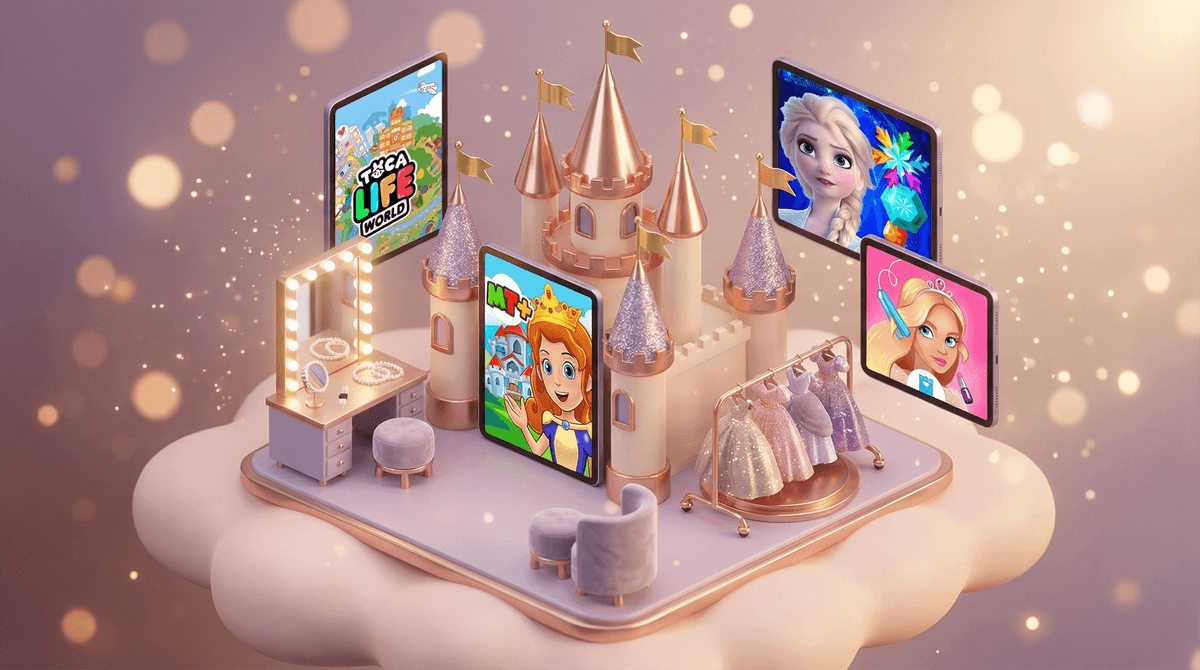
Princess games are a massive genre of mobile and tablet games aimed at younger kids—usually ages 3-10. We're talking dress-up games, makeover simulators, castle decorating apps, and "princess adventure" games where the gameplay is less about slaying dragons and more about choosing the right ball gown.
These games show up everywhere in app stores. Search "princess" on the App Store or Google Play and you'll find hundreds of options: Disney Princess Majestic Quest, Princess Salon, My Little Princess Castle, and about 500 variations on "Princess Dress Up Games for Girls." Some are tied to actual franchises (Disney, Barbie), but most are generic princess-themed games from smaller developers trying to capture that sparkly, tiara-wearing market.
The gameplay is usually pretty simple: tap to choose outfits, swipe to apply makeup, drag-and-drop furniture to decorate rooms. Think of them as digital dollhouses with a princess aesthetic. Many are free-to-play with in-app purchases for additional outfits, accessories, or "gems" to unlock new content.
Let's be real: the appeal is obvious. These games tap into the same creative play that's driven dress-up and dollhouse games for generations. Kids get to make choices, express preferences, and see immediate visual results. "I picked that dress and now she looks fancy!" It's satisfying in the way that any creative activity is satisfying.
The princess theme itself is powerful—whether we love it or not, princess culture is deeply embedded in kids' media. By age 5, most kids have been exposed to Frozen, Moana, or at least the general concept of princesses as aspirational figures. These games let kids interact with that world in a way that feels accessible and low-stakes.
Also? They're easy. Most princess games have zero learning curve, no way to "lose," and endless positive reinforcement. Every choice gets a sparkle effect and a "Beautiful!" popup. For younger kids still developing fine motor skills and confidence, that's genuinely appealing.
Here's where we need to talk honestly about what these games actually offer—and what they don't.
The positives:
- Creative expression - Kids are making aesthetic choices, experimenting with colors and styles, and exercising some level of creative control
- Low-pressure gameplay - No timers, no failure states, no stress
- Fine motor practice - For younger kids, the tapping and swiping can help develop coordination
The concerns:
- Gendered marketing - Most of these games are explicitly marketed as "for girls," which reinforces some pretty tired stereotypes about what girls should be interested in
- Appearance-focused content - The overwhelming emphasis is on looking pretty, choosing the right makeup, getting compliments on outfits—not exactly the most empowering messaging
- In-app purchase traps - Many free princess games are designed to frustrate kids into wanting purchases. "You can unlock this SPECIAL CROWN for just $4.99!" It's manipulative, and younger kids don't understand the difference between tapping a button in a game and spending actual money
- Passive gameplay - Most of these games don't involve problem-solving, strategy, or meaningful challenge. You're just... tapping through menus
- Ad overload - Free games often have aggressive ad placement—sometimes after every single action
Ages 3-5: If your preschooler is going to play princess games, stick with offline options or games with zero ads and no in-app purchases. Toca Boca games (like Toca Life World) offer similar creative play without the princess branding and without the monetization pressure. If you do go princess-themed, look for paid apps (usually $3-5) with no additional purchases.
Ages 6-8: This is peak princess game age. Kids are old enough to navigate the games independently but still young enough to be really into the aesthetic. The key here is supervision around purchases. Make sure in-app purchases require password approval, and have a conversation about how "free" games make money. You can also start introducing alternatives—games with more varied gameplay like Minecraft or Animal Crossing: Pocket Camp still offer creative expression but with more depth.
Ages 9+: Most kids start aging out of princess games naturally around this age. If your older kid is still into them, that's totally fine—but it's worth checking in about why. Is it genuine enjoyment, or is it just easy comfort content? Not every game needs to be educational, but you also don't want kids defaulting to the digital equivalent of staring at a wall.
Check the actual game before handing over the tablet. Not all princess games are created equal. Some are genuinely fine—simple dress-up games with minimal ads. Others are designed to be addictive, with constant popups pushing purchases, sketchy privacy practices, and ads for completely inappropriate content.
Look for:
- Clear privacy policies (especially around data collection from kids)
- Minimal or no ads
- Transparent pricing (paid upfront is usually better than "free" with endless upsells)
- COPPA compliance (required for apps targeting kids under 13)
Red flags:
- Games that require an account/email for a preschooler to play
- Aggressive push notifications ("Princess Anna misses you! Come back now!")
- Social features or chat functions (why does a dress-up game need chat?)
- Links to external websites or social media
The "is this just brain rot?" question: Look, I get it. Watching your kid tap through outfit after outfit for 30 minutes can feel... pointless. And honestly? A lot of these games are pretty low-value content. They're not teaching critical thinking or problem-solving. They're digital fidget toys.
But they're also not destroying your kid's brain. The issue isn't the princess theme itself—it's the passive consumption and the manipulative design of many free-to-play games. A 20-minute session of a well-designed princess game is fine. Two hours of being manipulated by ads and purchase prompts is not.
If you're looking for games that offer similar creative play without the problematic elements:
- Toca Life World - Open-ended creative play, diverse characters, no ads, no in-app purchases beyond expansion packs
- [Sago Mini](https://screenwiseapp.com/media/sago-mini-boardgame - Adorable games for younger kids with genuine educational value
- Minecraft - Creative building with way more depth (and yes, you can build castles)
- Animal Crossing: Pocket Camp - Decorating and customization without the princess branding
- Physical alternatives - Actual dress-up clothes, drawing/coloring, or even board games like Sleeping Queens offer princess themes with more engagement
Princess games aren't inherently harmful, but they're also not doing much to challenge or engage your kid. The biggest risks are around predatory monetization and reinforcing narrow ideas about gender and appearance.
If your kid loves these games, you don't need to ban them entirely. But you should:
- Vet the specific games they're playing
- Set clear boundaries around screen time and purchases
- Balance them with other activities—both digital and physical
- Talk about the messages these games send (even young kids can start thinking critically about why all the princesses look a certain way)
And if you're feeling guilty about letting your kid play these games? Take a breath. Every generation of parents has worried about whatever the current "junk food media" is. Your kid playing a princess dress-up game for 20 minutes isn't going to undo all your parenting. Just stay involved, stay informed, and remember that you can always redirect toward better options when you're ready.
Want to dig deeper? Check out our guide to age-appropriate mobile games or learn how to set up parental controls on iOS and Android to manage in-app purchases. And if you're trying to figure out whether your kid's screen time is typical for their age, Screenwise can help you understand your family's habits in context.