

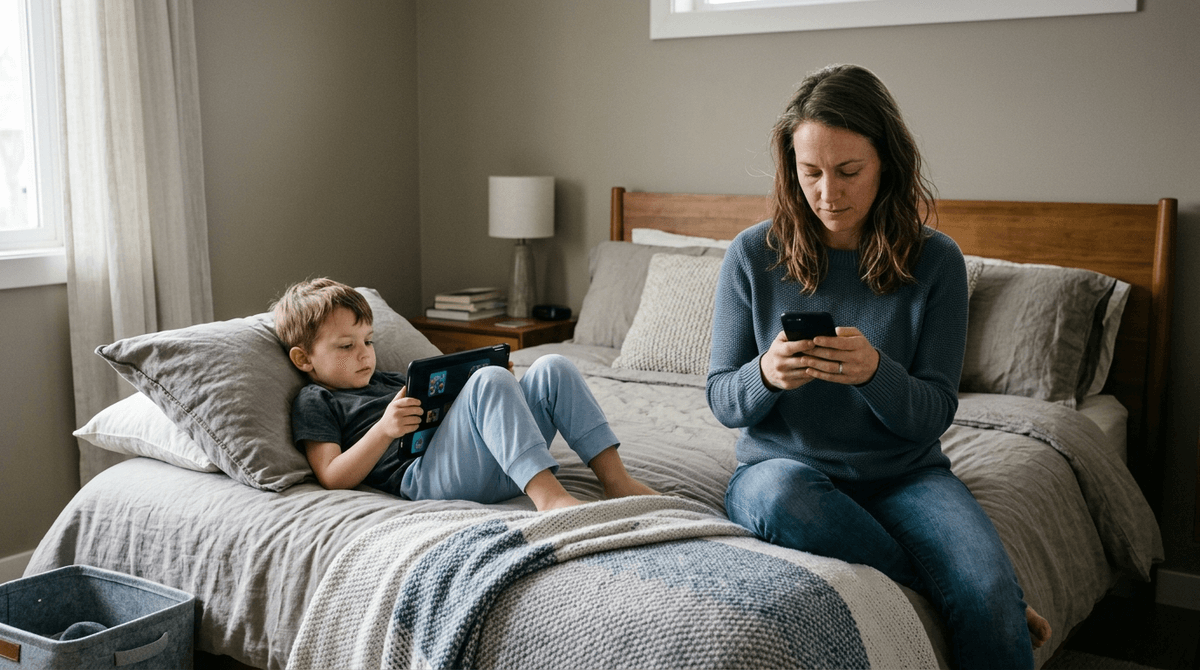
Preschoolers are spending over two hours a day on screens, blowing past every major medical guideline regardless of which country's rules you follow.
Most kids aged 2 to 6 exceed international screen time limits, largely because digital devices have moved into their bedrooms and their habits have begun to mirror their parents' own usage.
Health organizations like the WHO and AAP set strict limits to protect early brain development and physical health, but these goals are becoming decoupled from daily reality. If official rules feel impossible to follow, parents need to know which specific factors—like your own phone habits or a TV in the bedroom—are actually pushing the needle into the red.
Researchers wanted to see if the variety of global screen time recommendations actually changes how we measure "excessive" use. Because different countries have different benchmarks, it has been unclear if kids are failing one specific standard or if usage is universally high across all definitions.
Children in the study averaged 126 minutes of daily screen time, more than double the common 60-minute recommendation for this age group.
- The vast majority of preschoolers failed to meet even the most lenient health standards.
- Maternal screen habits are the biggest predictor of a child's usage; if you are on your phone more, they are too.
- Having a device in the bedroom and using the internet significantly increased the odds of crossing the "excessive" threshold.
- Kids who started using screens earlier in life were much more likely to have high-usage habits by age six.
This study suggests that while parents are often aware of the rules, they aren't following them—not because of a lack of knowledge, but because of environmental friction. When a screen is physically in a child's bedroom or a parent is modeling heavy use, the willpower required to stick to a 60-minute limit often evaporates.
The findings rely on parents reporting their own and their children's time, which usually results in people underreporting how much they actually use devices. Because the study focused on families in Portugal, the specific cultural pressures might differ slightly from other regions. It is also observational, so while bedroom devices and high screen time go together, we can't definitively say the device "caused" the high usage.
- If you want to cut your child’s screen time without a daily fight, move all tablets and TVs out of their bedroom immediately to remove the constant temptation.
- If you find yourself scrolling while playing with your preschooler, try setting your phone in a "charging station" in another room to break the modeling cycle that drives their usage.
- If your child is under two, delay their first exposure to digital media as long as possible to avoid "priming" them for higher usage patterns later in childhood.
Your own screen habits and the physical layout of your home matter more than the specific number of minutes recommended by the WHO. Focus on modeling moderate use and keeping devices out of private spaces to naturally bring your child’s usage back within healthy bounds.
Rodrigues D (2026). Guideline Recommendations and Estimates of Excessive Screen Time in Children. Acta medica portuguesa. doi:10.20344/amp.24635 — pubmed.ncbi.nlm.nih.gov