

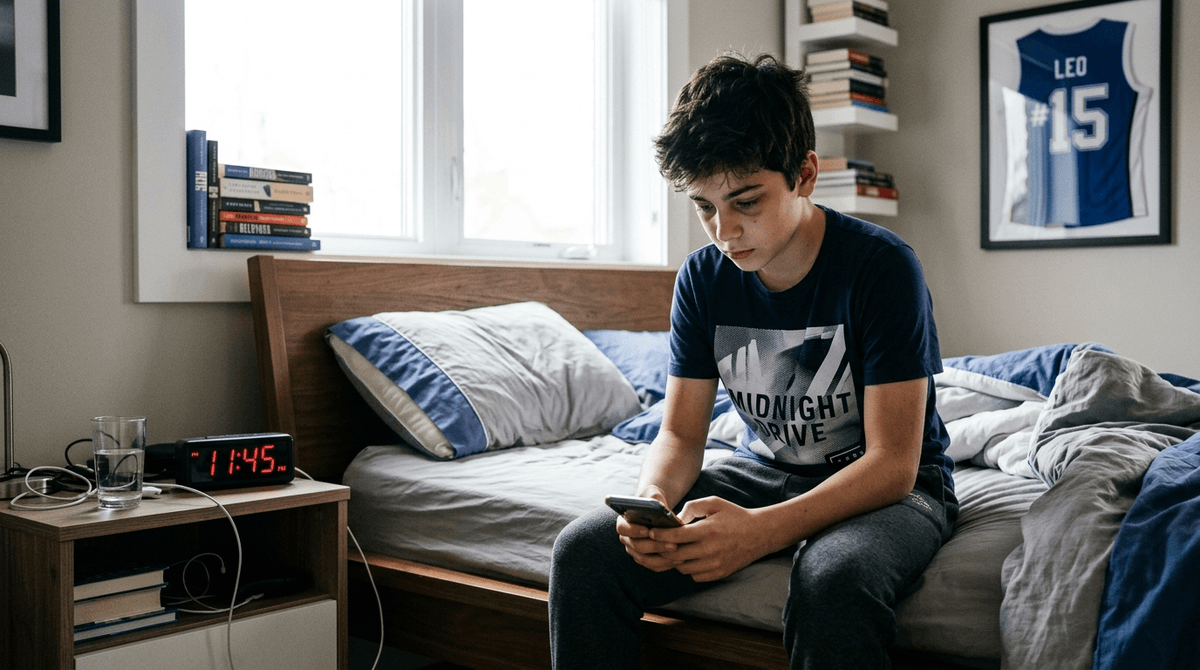

Children’s screen time quadruples between preschool and junior high, while bedtime drifts nearly two hours later—slashing sleep well below recommended limits even in rural environments.
Preschool habits do not stay in preschool: screen exposure accelerates rapidly as children age, while fixed wake-up times mean later bedtimes directly steal the sleep older kids need.
Parents often assume older kids will organically balance their free time or that living away from dense urban centers naturally protects children from sedentary habits. This data shows the opposite.
If you do not lock in firm bedtime routines and digital boundaries in early childhood, the transition to middle school hits like a freight train. Daily screen use expands to consume nearly six hours, pushing bedtimes past 10:30 PM and driving total sleep down to dangerous lows.
Researchers wanted to know whether living in a rural area naturally buffers kids against the modern sedentary trap. They tracked sleep, screen time, and outdoor play across five childhood stages to see where healthy habits break down.
- Sleep duration plummeted across childhood. Average sleep dropped from 9.6 hours in toddlers to 7.8 hours in junior high students, falling below national guidelines at every single age group.
- Bedtime drift caused the entire sleep deficit. Morning wake-up times remained static across all age groups, but average bedtimes pushed back from 9:02 PM in early childhood to 10:42 PM in junior high.
- Screen time quadrupled. Daily screen exposure rose from 1.46 hours in toddlers to 5.7 hours by junior high.
- Outdoor play remained surprisingly low. Toddlers averaged just 17 minutes of daily outdoor play, peaking at only 51 minutes during junior high.
Because school start times are non-negotiable, bedtime is the only dial parents can turn to protect sleep. Every minute a middle schooler stays up late on a device is a minute of sleep permanently lost—there is no morning cushion.
Additionally, living near green space does not automatically produce active kids. Without intentional structure, screens win the competition for outdoor time regardless of geographic setting.
This study used a cross-sectional design, capturing a single snapshot of different kids at different ages rather than following the exact same children over a decade. Data relied on parent and self-reported questionnaires, which tend to underreport screen time and overreport sleep. Finally, the cohort was located entirely in rural Japan, where cultural homework and evening routines may differ from Western settings.
- If your elementary child's bedtime is creeping later... enforce a strict lights-out routine now, because morning wake-up times will stay fixed for years to come.
- If you count on your rural or suburban yard to keep kids active... schedule specific outdoor activities daily, as proximity to nature alone does not drive physical play.
- If your child is entering middle school... set hard limits on handheld screens before the school year starts to prevent an explosive spike in recreational screen use.
Do not expect children to outgrow heavy screen habits or naturally wander outside as they mature. Defending early bedtimes and keeping screens out of late-night routines during early childhood is the best defense against adolescent sleep deprivation.
Shu H, Jiang L, Hirose N et al. (2026). Lifestyle behaviors from early childhood to junior high school in rural Japan: a cross-sectional study. BMC public health. doi:10.1186/s12889-026-27954-5 — pubmed.ncbi.nlm.nih.gov