

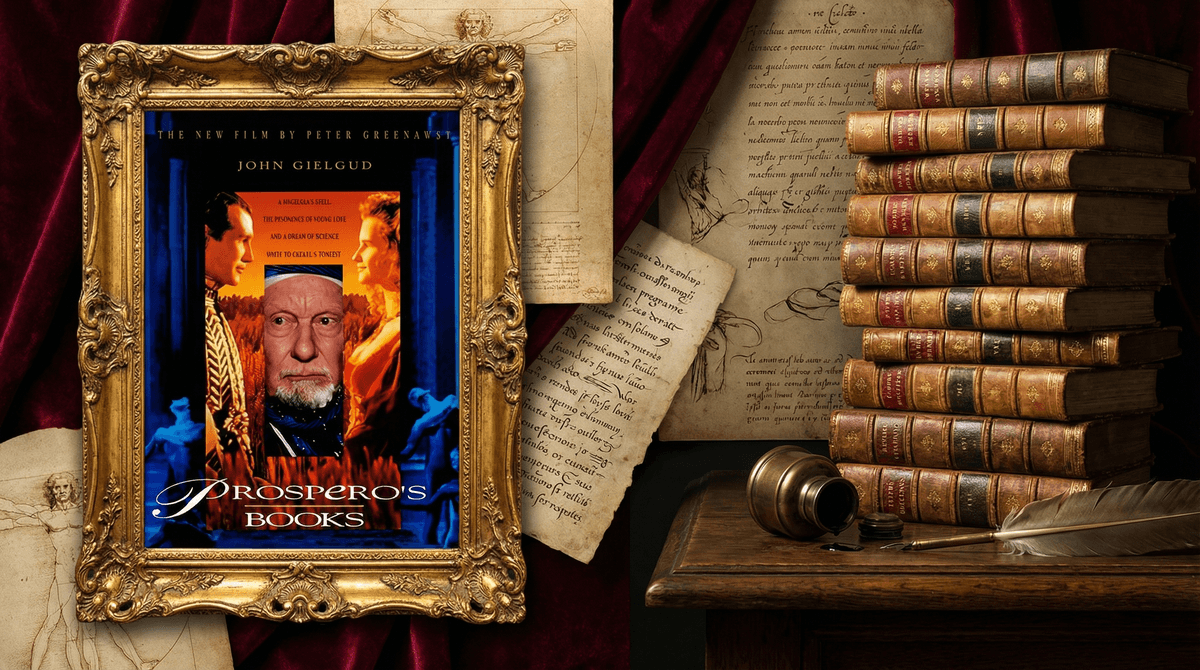
Prospero's Books: When Shakespearean Art Film Meets Full-Frontal Nudity
TL;DR: Peter Greenaway's 1991 adaptation of The Tempest is a visually stunning experimental film that's also packed with extensive nudity and challenging content. This is strictly for mature teens 17+ who are ready for both avant-garde cinema and frank discussions about artistic nudity. Not sure if your teen is ready? Ask about age-appropriate Shakespeare adaptations .
.
Prospero's Books is Peter Greenaway's experimental 1991 film adaptation of Shakespeare's The Tempest, starring John Gielgud as Prospero. It's less a traditional movie and more a visual art installation that happens to tell a story. Greenaway uses early digital compositing technology to layer multiple images on screen simultaneously, creating a baroque, overwhelming aesthetic that's unlike anything else in cinema.
The film reimagines the play through 24 magical books that Prospero brings to his island, each rendered with elaborate visual effects. Gielgud speaks nearly all the dialogue himself—for all characters—until the final act when other actors finally get to use their own voices.
It's rated R, and that rating is doing some serious heavy lifting.
You're likely reading this because:
- Your teen is taking an AP English class and discovered this exists
- Your film-obsessed high schooler wants to explore "challenging cinema"
- Someone mentioned it's a Shakespeare adaptation and you assumed it was school-appropriate
- You're screening it yourself first (smart move)
Here's what you need to know upfront: This film contains extensive full-frontal nudity of both men and women throughout its runtime. We're not talking about a brief artistic shot or two. We're talking about sustained, constant nudity as a deliberate aesthetic choice. Naked bodies are layered into nearly every frame as living set decoration, dancing in the background, posed as living sculptures.
This isn't gratuitous in the exploitative sense—Greenaway isn't making softcore porn. But it's also not subtle or brief. The nudity is presented as part of the film's visual tapestry, treating the human body as an artistic element alongside the elaborate sets, costumes, and digital effects.
Greenaway's vision is genuinely interesting from a film theory perspective. He's exploring Renaissance ideas about the body, knowledge, and art. The nudity references classical painting and sculpture. The film is deeply intellectual, deliberately challenging, and operates more like a moving painting than a conventional narrative.
But here's the thing: Artistic intent doesn't change what's on screen. A 14-year-old watching this in a family room is going to see a lot of naked people, regardless of the filmmaker's theoretical framework. And that's going to be uncomfortable for most families, even those who are generally media-permissive.
This is fundamentally different from, say, Schindler's List, where brief nudity serves the horror of the Holocaust, or Titanic, where there's one famous drawing scene. The nudity here is constant and central to the film's visual language.
Ages 13 and under: Absolutely not. Full stop.
Ages 14-16: Still no for the vast majority of families. Even mature teens who can handle complex themes may not be ready for this level of sustained nudity. The film also requires significant patience for experimental pacing and non-linear storytelling. If your teen struggles to sit through a three-hour Lord of the Rings movie, they're definitely not ready for this.
Ages 17-18: This is where it becomes a genuine family decision rather than a hard no. Some factors to consider:
- Is your teen studying film seriously? Students in AP Film, taking college film courses, or genuinely interested in experimental cinema have more context for what they're watching.
- Have you discussed artistic nudity before? If your family has never talked about the difference between artistic and sexual nudity, this isn't the place to start.
- Can your teen handle deliberately challenging art? This film is difficult. It's slow, non-linear, visually overwhelming, and requires active interpretation. It's not entertainment in the traditional sense.
If you're looking for Shakespeare adaptations that are actually appropriate for teens, consider:
- Kenneth Branagh's Much Ado About Nothing (PG-13): Accessible, fun, great cast. Ages 12+.
- Baz Luhrmann's Romeo + Juliet (PG-13): Modern setting, some violence and brief nudity, but age-appropriate for most high schoolers. Ages 14+.
- The 2010 version of The Tempest with Helen Mirren: Rated PG-13, actually watchable, and covers the same source material. Ages 13+.
- 10 Things I Hate About You (PG-13): If you want Taming of the Shrew without the stress. Ages 12+.
Looking for more options? Check out Shakespeare adaptations for teens.
If you do decide this is appropriate for your older teen, have the conversation before you watch:
Set clear expectations: "This film contains extensive nudity throughout. It's presented as art, not as sexual content, but it's still going to be a lot of naked bodies on screen. Are you comfortable with that?"
Discuss the context: Talk about how Renaissance art depicted the nude body, and how Greenaway is referencing that tradition. Look at some classical paintings together beforehand if it helps establish context.
Check in during viewing: It's okay to pause and discuss. "What do you think Greenaway is trying to achieve here?" This isn't a movie you watch passively anyway.
Debrief afterward: "How did you feel about the nudity? Did it serve the artistic vision, or did it feel excessive?" There's no wrong answer—helping your teen develop their own critical lens is the goal.
Beyond the nudity, other content considerations:
- It's genuinely boring for most viewers: This isn't a criticism, it's a fact. The film is deliberately slow and experimental. Most teens will be checking their phones within 20 minutes.
- The digital effects are dated: What was cutting-edge in 1991 looks primitive now. This can actually be interesting from a film history perspective, but it won't have the visual impact Greenaway intended.
- Gielgud is remarkable: If your teen can appreciate performance, watching a legendary actor command the screen is genuinely worthwhile.
- It's very, very British: The film assumes knowledge of Shakespeare, Renaissance art history, and European cinema traditions. American teens may feel lost without significant context.
Prospero's Books is a fascinating film for the right audience—film students, Shakespeare scholars, people who visit art museums for fun. It's also completely inappropriate for most teenagers, regardless of how mature they are.
If your teen wants to explore challenging cinema, start with something like 2001: A Space Odyssey or Blade Runner—films that are artistically ambitious without the nudity barrier.
If they're studying The Tempest, literally any other adaptation will be more useful and less awkward for everyone involved.
If they're 17+ and genuinely interested in experimental film, watch it together, talk about it openly, and treat it as an educational experience rather than entertainment.
And honestly? Most teens who think they want to watch this will tap out after 15 minutes anyway. Greenaway's vision is admirable, but it's not exactly TikTok-friendly pacing.
Want to explore more challenging films with your older teen? Check out art films appropriate for high schoolers or talk to our chatbot about your specific situation.