

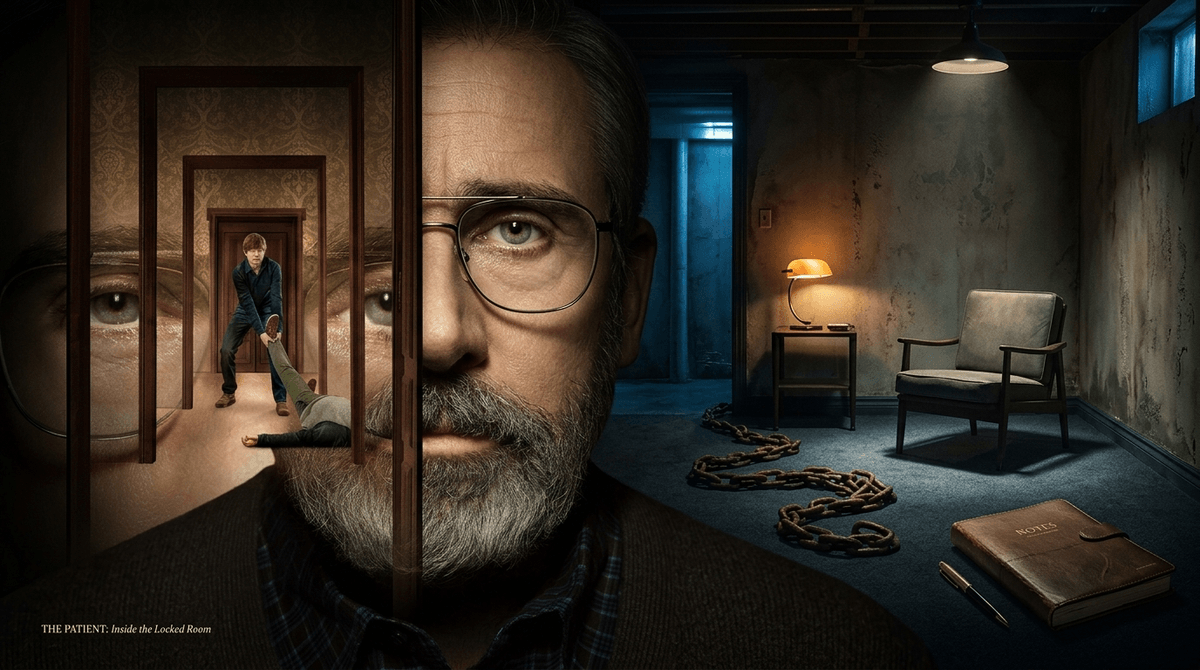
The Patient is a psychological pressure cooker that trades cheap jump scares for a grueling, high-stakes therapy session. It’s not a slasher flick; it’s an ethics class where the professor is chained to a floor in a serial killer’s basement. If your teen is into true crime, high-tension dramas, or stories that actually respect their intelligence, this is one of the most compelling things they could watch—provided they’re ready for a slow-burn that doesn't pull its emotional punches.
TL;DR: The Patient is an intense limited series starring Steve Carell as a therapist kidnapped by a serial killer (Domhnall Gleeson) who wants to "cure" his urge to murder. It’s heavy on psychological tension, grief, and Jewish identity, and light on graphic gore, though the violence that does occur is brutal. Best for older teens (15+) who can handle a claustrophobic vibe and a divisive, thought-provoking ending.
Alan Strauss (Steve Carell) is a therapist mourning the recent death of his wife. One of his patients, Sam Fortner (Domhnall Gleeson), decides that the only way to stop his compulsion to kill people is to bring his therapist home—literally. Sam kidnaps Alan, chains him to a bed in a finished basement, and demands intensive daily therapy. Over ten episodes, the show balances Alan’s desperate attempts to survive, Sam’s erratic behavior, and Alan’s internal reflections on his own fractured family.
Most serial killer media falls into one of two buckets: the "detective procedural" where we hunt the monster, or the "slasher" where we watch the monster work. The Patient refuses both. It’s a chamber piece. Most of the show takes place in a single room, which makes it feel incredibly claustrophobic.
The violence isn't constant, but it's impactful. When Sam kills, it’s often off-camera or shown in the aftermath, but the psychological weight of the threat is always there. The show uses sound design—the clinking of the chain, the heavy footsteps upstairs—to keep the audience on edge. For a teen used to the fast-paced action of something like Stranger Things, this might feel slow at first. But for the kid who likes to deconstruct why characters do what they do, it’s a masterclass.
One of the most remarkable things about this show is how deeply it engages with Alan’s Jewish identity. It’s not just window dressing; it’s the core of his character. He spends his captivity processing his relationship with his son, Ezra, who became an Orthodox Jew—a choice that created a massive rift in their family.
Alan’s "imaginary" conversations with his own former therapist (played by David Alan Grier) and his memories of the Holocaust (specifically through the lens of Viktor Frankl’s Man's Search for Meaning) give the show a depth you don't usually find in "kidnapping" thrillers. It’s a great entry point for talking about how people use faith and family history to find resilience in impossible situations.
This is not a show you watch while scrolling TikTok. If your teen is the type to have a second screen going at all times, they’re going to miss the nuance that makes The Patient work. The tension is built in the silences—in Steve Carell’s eyes as he realizes his patient is losing his grip, or in the weirdly mundane moments where Sam brings Alan takeout from different restaurants. It’s a show that rewards focus.
The Heavy Hitters: If They Liked This, Try These
If your teen finished the series and wants more of that "psychological chess match" vibe, here are a few deeper cuts that hit the same way:
- If they loved the "profiling the killer" aspect of The Patient, this is the gold standard. It’s about the early days of the FBI’s behavioral science unit. It’s clinical, fascinating, and just as focused on conversation over combat.
- It might seem like a weird pivot, but The Bear captures that same high-frequency anxiety and the struggle to process grief while performing a high-stakes job.
- If the therapy sessions were the draw, this show is literally nothing but therapy sessions. It’s brilliant, dialogue-heavy, and shows the complicated power dynamic between therapist and patient.
- Alan Strauss literally hallucinates/remembers this book while in captivity. It’s a foundational text on finding meaning in suffering, written by a psychiatrist who survived the Holocaust. For an older teen, it’s a life-changing read.

The most important thing to know about The Patient is that it doesn’t offer a Hollywood ending. It’s a bleak show. It deals with the reality that you can’t "fix" everyone, and that sometimes, despite your best efforts and your most profound empathy, things don't go the way they should.
The Violence: There is a scene involving a foot injury that is particularly hard to watch, and the depictions of strangulation are visceral. It’s not "fun" violence; it’s meant to be upsetting.
The Pacing: Episodes are short (around 30 minutes), which makes it feel digestible, but the story moves at a deliberate crawl. This is intentional—it mimics the feeling of being trapped—but it might frustrate viewers looking for a more traditional "escape" plot.
If you watch this with your teen (and it's a great "co-watch" for older kids), here are a few ways to dig in afterward:
- The Empathy Trap: Alan is trying to empathize with a monster to save his own life. Does Sam actually want to change, or does he just want to feel better about himself?
- The Faith Rift: The tension between Alan and his son Ezra is a huge part of the story. Why do you think Alan struggled so much with his son’s choice to become more religious?
- The Ending: Don’t spoil it, but once you get there, ask: Was there any other way this could have ended that would have felt "real"?
Q: Is The Patient okay for a 13-year-old? Probably not. While there isn't a ton of sexual content or constant profanity, the psychological weight and the specific nature of the violence are geared toward a more mature audience. Most 13-year-olds will find it either too slow or too upsetting.
Q: How much gore is actually in the show? It’s relatively low on gore compared to something like American Horror Story. Most of the violence is "clean" but brutal—think strangulation or blunt force. The most graphic moments involve the aftermath of killings rather than the acts themselves.
Q: Is the show based on a true story? No, it’s entirely fictional. However, the creators (Joe Weisberg and Joel Fields, who also made The Americans) did a lot of research into psychotherapy and Jewish history to make the characters feel authentic.
The Patient is a rare find: a "prestige" thriller that doesn't rely on gimmicks. It’s a showcase for Steve Carell’s dramatic range and a thoughtful exploration of what it means to be a human being under extreme duress. If your teen is ready for a story that asks more questions than it answers, it’s well worth the time.
For more recommendations on what to watch next, check out our curated lists: