

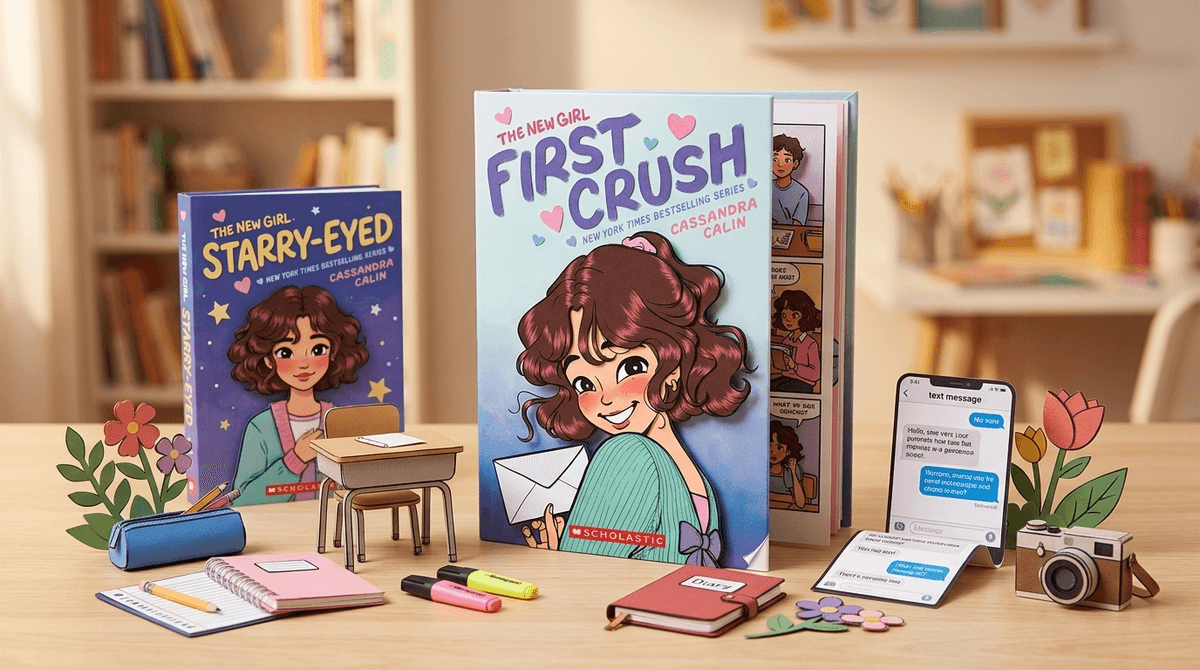
If you’re wondering if The New Girl: First Crush is too "mature" for your middle-schooler because of the period talk or the romance in the title, let’s clear that up: it’s exactly as mature as a 12-year-old actually is—which is to say, it’s delightfully awkward, slightly messy, and completely honest. Cassandra Calin has built a career on illustrating the "cringe" moments of life, and she brings that same unvarnished, funny energy to the second installment of Lia’s story. It’s not a book about life-shattering drama; it’s a book about the high-stakes reality of surviving a bad haircut, a first period, and a crush on a boy who might not know you exist.
TL;DR: The New Girl: First Crush is a top-tier graphic novel for the 9-13 crowd that handles puberty and middle-school romance with zero condescension. If your kid loved Raina Telgemeier’s Smile or Real Friends by Shannon Hale, this is the natural next step. It’s funny, visually stunning, and handles "the talk" topics like periods and crushes with the kind of normalcy that actually lowers a kid's anxiety.
Middle school is a minefield of self-consciousness, and Cassandra Calin is the reigning queen of drawing exactly what that feels like. In The New Girl: First Crush, we follow Lia as she continues to navigate her new life after moving from Romania. The "new girl" trope is well-worn, but Calin keeps it fresh by focusing on the internal monologue.
Kids love this series because Lia isn't a "girl boss" or a chosen one; she’s a kid who gets flustered, makes social gaffes, and spends way too much time overthinking a three-word text. For intentional parents, the value here is in the normalization of "mid" moments. It’s a masterclass in showing kids that everyone feels like a disaster sometimes, and that's actually fine. If your kid is currently in the "I'm the only one who feels this weird" phase, this book is a quiet, funny reassurance that they have plenty of company.
Let’s talk about the "period stuff." One of the central arcs in First Crush involves Lia getting her period. In many books, this is treated as a "Very Special Episode"—heavy, dramatic, or clinical. Calin treats it like a logistical annoyance. There’s blood, there’s the panic of not having a pad, there’s the awkwardness of talking to a mom about it, and then life goes on.
It’s the most helpful way to present puberty: as a thing that happens while you’re busy doing other things. It’s not scandalous, and it’s not a biology textbook. It’s just Lia’s life. If you’ve been looking for a way to "normalize the normal," handing your kid this book is a lot more effective than a formal sit-down. It opens the door for a casual "Yeah, that pad scene was relatable, right?" which is a much easier entry point for a conversation than a PowerPoint presentation on hormones.
If your kid flies through this one (and they will—Calin’s pacing is cinematic), don’t let the momentum die. The "graphic novel about middle school" genre is booming, but there’s a lot of filler out there. These are the ones actually worth the shelf space:
This is a fantastic deeper cut. It follows a group of kids who are thrown together for community service and realize they have way more in common than the "labels" their school has given them. It hits that same "finding your people" vibe as The New Girl but adds a layer of mystery and multi-perspective storytelling that keeps older middle-schoolers hooked.
If the draw of The New Girl: First Crush is the "I’m new and I don’t know what I’m doing" energy, Swim Team is the perfect follow-up. It deals with anxiety, friendship, and the specific pressure of being the kid who doesn't know the "unspoken rules" of a new environment. Plus, the art is vibrant and the sports-underdog story is genuinely compelling.
For the kid who had questions after the period scenes in The New Girl, this is the gold standard for puberty guides. It’s inclusive, straightforward, and written in a way that doesn’t make kids feel like they’re in health class. It covers the "why" behind the stuff Lia experiences in the graphic novel.
If your kid loves Calin’s art style—the expressive faces, the cozy but detailed world-building—they should be watching Hilda on Netflix. While it leans more into fantasy than The New Girl, it shares that same DNA of a girl navigating a world that’s bigger and weirder than she expected, all while keeping her integrity intact. Check out our best shows for kids list for more in this vein.
Graphic novels are often dismissed as "fast reads," but there’s a lot of craft here. If you want to turn a 20-minute read into a longer conversation, focus on the how of the storytelling.
- The Silent Panels: Calin is great at using 3-4 panels with no dialogue to show Lia’s internal panic. Ask your kid: "How do you know what she’s thinking in that scene where she sees her crush?" It’s a quick lesson in visual literacy and empathy.
- The Cultural Bridge: Lia is navigating life as an immigrant. Ask about the specific things she finds weird or different about her new school compared to what she mentions about home. It’s a low-stakes way to talk about perspective and how our background shapes how we see the world.
The "friction point" here isn't the content—it's the format. Graphic novels like this are the "gateway drug" for reluctant readers. If you have a kid who says they hate reading but they’ve finished The New Girl: Starry-Eyed and First Crush in one weekend, don't push them toward "real" books immediately. Let them live in the graphic novel world for a while. The brain is doing just as much work decoding text and image simultaneously as it is reading a wall of prose. For more on this, see our best books for kids list.
Q: Do you need to read the first book before "First Crush"? Yes, it’s highly recommended. While the plot of each book is relatively self-contained, the character growth and the established friendships from The New Girl: Starry-Eyed provide the necessary context for why Lia’s "first crush" feels like such a big deal in book two.
Q: What age is "The New Girl: First Crush" appropriate for? The sweet spot is ages 9 to 13. Younger kids (7-8) can certainly read it, but the themes of puberty and romantic crushes might not resonate as deeply. For high schoolers, it might feel a bit young, though fans of Calin’s webcomics will likely enjoy the art regardless of age.
Q: Is there any "inappropriate" content in the book? It depends on your definition, but for most intentional parents, the answer is no. It deals with periods and the "butterflies" of a first crush. There is no graphic violence, heavy profanity, or sexual content beyond innocent middle-school pining. It’s "PG" in the truest sense.
The New Girl: First Crush is a win. It’s one of those rare books that feels like a secret shared between friends rather than a lesson handed down by adults. It respects the "big feelings" of middle school without making them feel silly, and it handles the reality of growing up with a sense of humor that kids actually find funny.
- If they loved the relatable humor, check out our digital guide for middle school for more age-appropriate media.
- If they’re looking for more visual storytelling, browse our best books for kids list and filter for graphic novels.
- Ask our chatbot for more recommendations
