

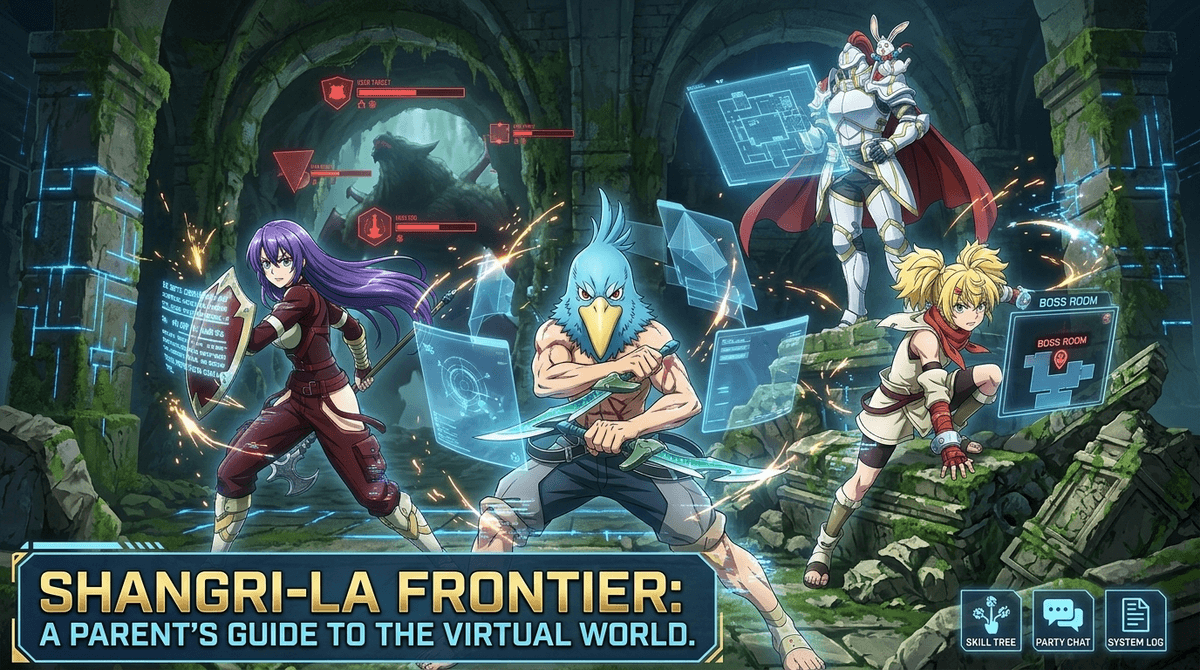
Shangri-La Frontier is the ultimate "gamer’s anime," and it’s hitting a massive second wind right now with the June 2026 Netflix drop and the launch of the new mobile game. It’s not just another "stuck in a video game" story—it’s a celebration of the grind, the glitches, and the weird satisfaction of being better at a game than the developers intended. If your kid is obsessed, it's likely because the show respects their intelligence regarding gaming culture rather than talking down to them.
Shangri-La Frontier follows a "trash game hunter" who brings his skills to a polished AAA virtual reality title. It’s high-energy, visually stunning, and leans into gaming strategy over typical fantasy tropes. For families looking for more like it, check out Bofuri for a lighter take or Zelda: Breath of the Wild for that same sense of open-world discovery.
The core hook of Shangri-La Frontier is the concept of "Kusoge"—literally "crap games." The protagonist, Sunraku, doesn't spend his time on polished blockbusters; he spends it playing buggy, broken, nearly unplayable messes. Why? Because beating a boss when the hit-detection is broken and the floor is disappearing requires a level of skill that "normal" gamers don't have.
When he finally decides to play Shangri-La Frontier—the world’s most perfect VRMMO—he approaches it with the mindset of a guy who is used to the world breaking around him. He plays naked (except for a bird mask) to maximize his speed stats, and he treats every encounter like a puzzle to be solved.
Kids love this because it mirrors their own gaming lives. They know what it’s like to find a "cheese" strategy or to spend three hours trying to jump over a wall the developers meant to be a barrier. It’s a show that validates the "speedrunner" and "min-maxer" mentality.
As of May 2026, we’re seeing a massive surge in the franchise. Netflix just added the latest arc, which has brought a whole new audience to the series. But the real conversation in the hallways is about the Shangri-La Frontier: SLF Unleashed mobile game that launched earlier this year.
The game is a high-fidelity action RPG that tries to replicate the "feel" of the anime’s combat. It’s slick, it’s fast, and yes, it has a gacha mechanic (randomized character/item pulls). If your kid is into the show, they are almost certainly eyeing the mobile game. The good news: the game actually requires genuine timing and skill—it’s not just a "pay-to-win" clicker. The bad news: like any high-end 2026 mobile title, it’s designed to be a daily habit.
If you walk past the TV, you’re going to see a shirtless guy with a blue bird head fighting a massive, terrifying wolf. It looks weird. It is weird. But in terms of content, Shangri-La Frontier is one of the "cleaner" entries in the Shonen genre.
The Action: Strategy Over Gore
Yes, there is violence, but it’s strictly video-game violence. When characters take damage, they lose HP bars; when they die, they dissolve into blue polygons. There’s no "real-world" stakes here—nobody is actually dying in real life (unlike the darker Sword Art Online). The focus is almost entirely on the mechanics of the fight. It’s a masterclass in iterative problem-solving. Ask your kid: "What did Sunraku have to change about his strategy to beat Lycaon?" They’ll likely give you a ten-minute lecture on frame rates and status effects.
The 'Fanservice' Factor
Anime often has a "cringe" factor for parents regarding how female characters are drawn. Shangri-La Frontier is pretty mild here. There are a few character designs that lean into the "armored bikini" trope, but the show doesn't linger on it the way some older series do. The main female character, Saiga-0, is a literal tank who wears massive, bulky armor that makes her look like a Gundam. It’s refreshingly focused on the gameplay.
If your kid is all-in on the "trash game hunter" lifestyle, there are plenty of ways to lean into that energy that don't involve just watching more TV.
For the "I Love the Strategy" Kid
If they like the way Sunraku breaks the game, they’ll love Zelda: Tears of the Kingdom. It’s basically a "build your own trash game" simulator where the physics engine is meant to be messed with.
For the "I Love the Anime" Kid
If they’ve finished the Netflix drop and want more, point them toward Bofuri: I Don't Want to Get Hurt, so I'll Max Out My Defense. It’s a similar "playing the game wrong" vibe but much more "cozy" and humorous. If they want something with a bit more edge but still focused on gaming, Log Horizon is the gold standard for "how would a society actually work inside a video game?"
For the "I Want to Make Games" Kid
The protagonist’s knowledge of "trash games" is actually a great entry point into game design. Why is a game bad? Is it the hitboxes? The UI? The balancing?
Get some recs for game design books for kids
Instead of focusing on "screen time," focus on the expertise. The show is about being an expert in a niche field.
- "What makes a game 'trash' versus 'God-tier' in this show?" (This gets them thinking about quality and craftsmanship).
- "Why does Sunraku choose to play without armor?" (This opens a door to talking about trade-offs and high-risk/high-reward strategies).
- "If you could fix one 'bug' in your favorite game, what would it be?"
Q: What age is Shangri-La Frontier appropriate for? It’s a solid fit for ages 10 and up. Younger kids might find the heavy "gamer speak" (stats, status effects, RNG) confusing, while teens will find the high-quality animation and strategic depth genuinely engaging.
Q: Is there any "real world" danger in the show? Unlike other "trapped in a game" anime, the characters in Shangri-La Frontier can log out whenever they want. It’s just people playing a game for fun, which keeps the tone much lighter and less stressful.
Q: Are there content warnings for the 2026 mobile game? The game is rated T for Teen. The main thing to watch is the in-app purchases for "crystals" used to pull new gear. It’s a standard 2026 mobile monetization model—fine if you have boundaries in place, but potentially expensive if left unchecked.
Q: Is Shangri-La Frontier better than Sword Art Online? Most "intentional" parents find it better because it lacks the "life or death" stakes and the more problematic romantic subplots of SAO. It’s much more focused on the joy of gaming itself.
Shangri-La Frontier is a rare win: a show that actually understands why kids love video games. It’s not a cautionary tale about "addiction"—it’s a story about mastery, persistence, and finding community in weird places. If they’re watching it, they’re watching a show about a kid who works incredibly hard to overcome obstacles using his brain. You could do a lot worse.
- Explore our best games for kids list to find titles that hit that same "open world discovery" note.
- Check out our digital guide for middle schoolers for more on navigating anime and gaming culture.
- Find more anime like Shangri-La Frontier