

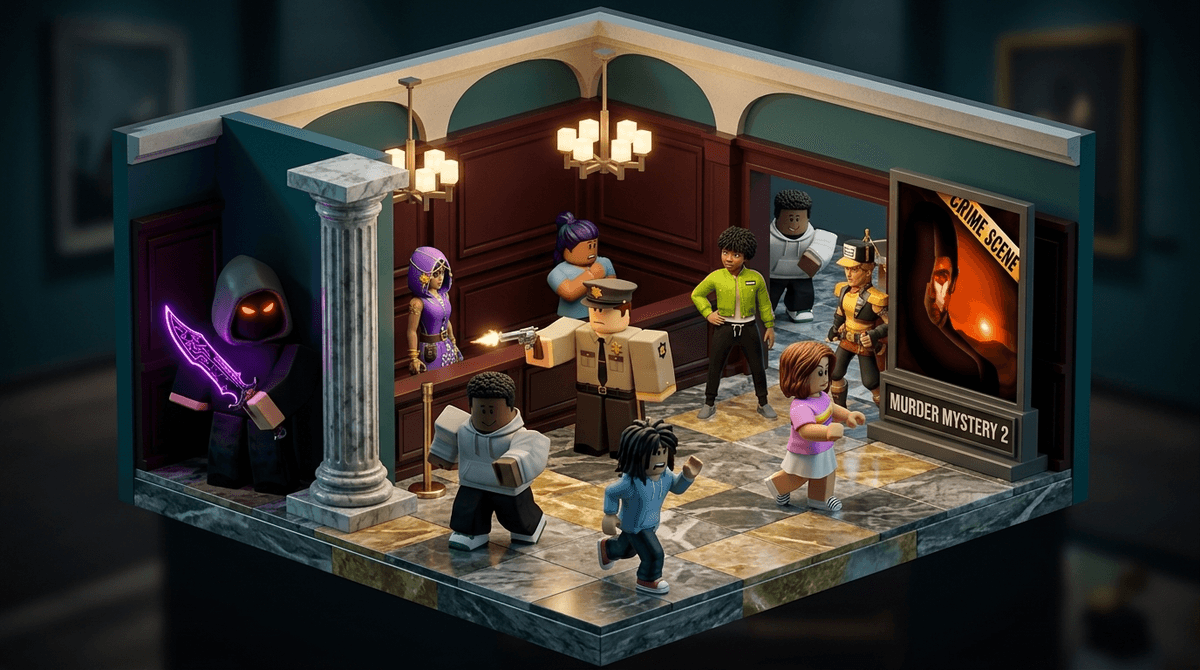
Murder Mystery 2 (or MM2, as your kid calls it) isn’t the digital slasher film the name suggests; it’s actually a high-speed game of cartoon tag played with a "Who Done It" twist. The "murder" is about as graphic as a game of Clue, but the real heat—and the reason your kid might be glued to the screen—is a complex, player-driven economy of rare digital knives that functions more like a high-stakes sneaker market than a video game.
TL;DR: Murder Mystery 2 is a social deduction hit on Roblox where players act as a Murderer, Sheriff, or Innocent. While the blocky violence is mild, the game's core revolves around collecting and trading "Godly" weapons, which can lead to aggressive monetization and savvy scammers. It’s a great lesson in digital value and skepticism, provided you’re keeping an eye on their "trades."
If you watch over their shoulder, you’ll see a lobby of blocky avatars jumping around a map (like a bank, a mansion, or a workplace). At the start of each round, everyone is secretly assigned a role:
- The Murderer: The only one with a knife. Their job is to eliminate everyone else without getting caught.
- The Sheriff: The only one with a gun. Their job is to track down and shoot the Murderer. If they accidentally shoot an Innocent, they’re out.
- The Innocents: Everyone else. They have no weapons. Their job is to run, hide, and witness enough to help the Sheriff. If the Sheriff dies, an Innocent can pick up the dropped gun and become the new hero.
The rounds are fast—usually under three minutes. It’s iterative, social, and relies on that hit of adrenaline you get when you realize the person standing next to you is the one you’re supposed to be running from.
Here is the Screenwise take: The "murder" part of MM2 is the secondary game. The primary game for most long-term players is the Knife Economy.
In MM2, your knife isn't just a tool; it’s a status symbol. There are tiers of rarity: Common, Uncommon, Rare, Legendary, and the holy grail—Godly, Chroma, and Ancient. These items don't actually make you "better" at the game (a Godly knife stabs exactly like a Common one), but they look cool, trail sparkles, and carry immense social capital.
Because players can trade these items, a massive "gray market" has sprung up around the game. There are entire websites (like MM2Values) dedicated to tracking the "market price" of digital knives. This is where kids can get into trouble. Scammers are everywhere, using "trust trades" (where one person promises to give an item after receiving one) or "value spoofing" to trick younger players out of their rarest gear.
If your kid is upset after a session, it’s almost never because they lost a round; it’s because someone "scammed their Chroma."
Like many Roblox titans, MM2 is built on "Crates." You spend in-game coins (earned by playing) or Robux (bought with your credit card) to open a box. You have a 99% chance of getting a "Common" piece of junk and a tiny, tiny fraction of a percent of unboxing a "Godly."
It is, for all intents and purposes, a slot machine for kids. It’s not "evil," but it is designed to keep them pulling the lever. If you haven't had the "odds and house advantages" talk yet, MM2 provides the perfect opening.
If your kid is already deep into MM2, don't just roll your eyes at the blocky knives. Use it as a training ground for digital literacy. This game is a masterclass in social engineering and market dynamics.
- Ask about the "Value List": Ask them which website they use to check if a trade is fair. It shows them that digital items have a fluctuating value, just like stocks or Pokémon cards.
- The "Too Good to Be True" Rule: MM2 is the perfect place to teach the "if a stranger offers you a Godly for nothing, there's a catch" lesson. That skepticism will serve them well across the entire internet.
- Discuss the "Sheriff" Pressure: Being the Sheriff is actually stressful—you have the one weapon that can save the day, but if you miss, you lose. It’s a great entry point into talking about performance anxiety and "clutching" in games.
MM2 allows players to buy a "Radio" pass, which lets them play music from the Roblox library for the whole lobby to hear. While Roblox has cleaned up its audio library significantly, you might still hear some "bypassed" tracks—songs that have been slightly altered to get past the censors—featuring language you might not love. If the lobby gets too loud or the music is annoying, there’s a "Mute Radios" button in the game settings. Point it out to your kid; it’s a lifesaver for your sanity, too.
If they’re into the social deduction and "Who Done It" vibes but you want to branch out from the Roblox ecosystem, try these:
- Among Us: The gold standard of social deduction. It’s more about logic and lying than MM2’s twitch-reflex gameplay.
- Unsolved Case: A free, two-player co-op puzzle game where you have to communicate to solve a mystery. Great for building actual teamwork skills.
- Town of Salem: For older kids (12+), this is a much more complex version of the "Mafia" or "Werewolf" party games. It’s all text-based and requires serious deduction.
Q: Is Murder Mystery 2 safe for a 7-year-old? The gameplay itself is fine—it’s essentially "tag" with blocky avatars. The main risk for a 7-year-old is the social aspect: the chat can be salty, and younger kids are the primary targets for item scammers. If they play, consider turning off chat in the Roblox parental settings.
Q: Why is my kid asking for Robux for "Godlies"? "Godly" items are the rarest in the game. You can’t usually buy them directly; you have to buy "Gems" to open crates and hope you get lucky. It’s a loot-box system. If they want a specific item, they’re better off trading for it than "gambling" on crates, but remind them that these items are purely cosmetic.
Q: Can you actually "die" in the game? Yes, but it's very "Roblox." Your character falls apart into a few blocks and you wait for the next round to start (usually a minute or two). There is no blood, no gore, and no realistic violence.
Murder Mystery 2 is a staple of Roblox culture for a reason: it’s fast, social, and has a progression system that feels rewarding. The "murder" is a distraction; the real game is the community and the economy. As long as your kid knows how to spot a scammer and you’ve got a handle on the crate-opening spend, it’s a relatively harmless way to burn twenty minutes.
- Check out our best games for kids list for more social deduction picks.
- Read our guide to Roblox parental controls to lock down the chat and spending.
- Find games like Murder Mystery 2
